BLOGThe Bird's Eye View
Timely Perspectives, Unconventional Thinking
We’re excited to share timely market insights, thoughtful perspectives and expert commentary as part of our commitment to providing modern investment solutions to modern challenges.
BLOGThe Bird's Eye View
Timely Perspectives, Unconventional Thinking
We’re excited to share timely market insights, thoughtful perspectives and expert commentary as part of our commitment to providing modern investment solutions to modern challenges.

The July gathering of the Federal Open Market Committee (FOMC) resulted in no change to the central bank’s key policy rate, which was held steady at 3.5–3.75%.1 Three regional Fed presidents dissented in favor of a 25-basis point hike, suggesting that Chair Warsh could have pushed through a rate hike if so inclined. By choosing not to do so, Warsh positions himself as a predictable chair disinterested in surprising the market.
In his press conference, Warsh described two major developments since the June FOMC meeting: 1) a sharp increase in nominal and real Treasury yields, and 2) remarkable growth of business investment, which is pushing up some prices but preparing the ground for future growth. Interestingly, Warsh didn’t mention the collapse of the Iran/US memorandum of understanding and subsequent increase in oil prices that drove the big intermeeting increase in real yields.
While Warsh stressed that inflation is too high and needs to be brought down, his comments overall did not strike us as committed to a near-term rate hike. For example, while noting that the Fed seeks price stability, he also stated the central bank is trying to “understand inflation dynamics” absent the series of shocks—pandemic, wars, energy demand, tariffs—the economy has faced this decade. To us, this sounds a lot like the look-through strategy the Fed had been following under former Chair Powell.2
The decision to leave rates on hold shifted market-based rate expectations lower, and the market is now pricing a 66% chance of a hike by September and a 90% chance of a hike by October. The Treasury curve steepened in response to the announcement, with short yields falling and the 30-year yield hitting its highest level since 2007. The dollar weakened, stocks fell, and the price of gold rose.3
To us, this sounds a lot like the look-through strategy the Fed had been following under former Chair Powell.
Note that there will be two more inflation prints before the next meeting in September. If these point to accelerating inflation, the Fed will be under increased pressure to hike. While today’s personal consumption expenditure inflation report came in lower than expected, the GDP report suggests strength in underlying domestic demand, with the economy increasingly reliant on artificial intelligence capex and a declining savings rate to support consumption.4
Record Pace of Muni Supply Finds Ample Demand

Head and Chief Investment Officer of Municipal Credit Team
Following two years of record new issuance, investor appetite for municipal bonds has remained unsated so far in 2026. While first-half issuance of $299 billion—including a record-setting $163 billion in the second quarter—has the market on track to set another annual high-water mark, this paper continues to be met by strong demand across vehicle types, including municipal bond exchange-traded funds (ETFs), tax-exempt mutual funds and separately managed accounts, as well as direct holdings by individuals.1
Issuer fundamentals remain supportive, even as they normalize from stimulus-fueled conditions of the pandemic years. State general fund revenues have continued to grow, driven by better-than-expected personal income tax receipts. Additionally, most states continue to bolster their rainy-day funds—with many starting from nominal highs—in anticipation of future needs.2 Improved pension funding—reflecting market performance, increased government contributions and tweaked benefit structures—further demonstrate fiscal strength.3
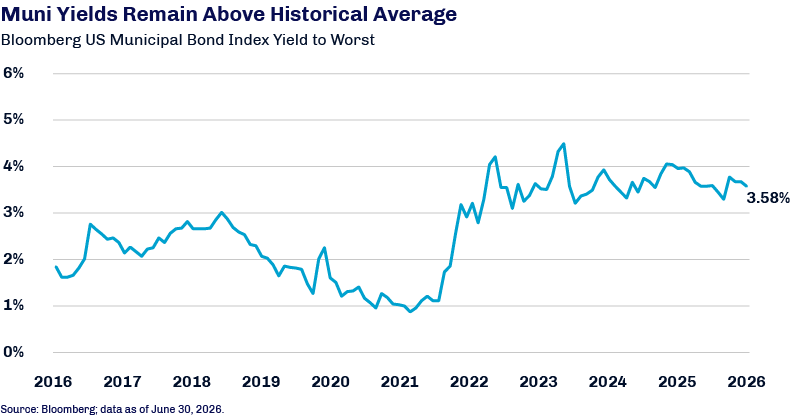
The hawkish tone of new Fed Chair Kevin Warsh has helped push Treasury rates higher in recent months, particularly on the front end of the curve.4 While muni yields tend to follow Treasuries over time, strong inflows can temporarily disrupt this relationship. To wit, municipal yields in general have drifted lower during this period.5 Despite the recent pullback, however, tax-equivalent yields for munis stand near the top quartile of their 10-year range, and high yield munis offer even more compelling prospective returns.6