Commentaries

International Equity Strategy Commentary

International Equity Strategy Commentary

Market Overview

As of June 30, 2026

Easing tensions in the Middle East prompted a strong rally in risk markets during the second quarter.

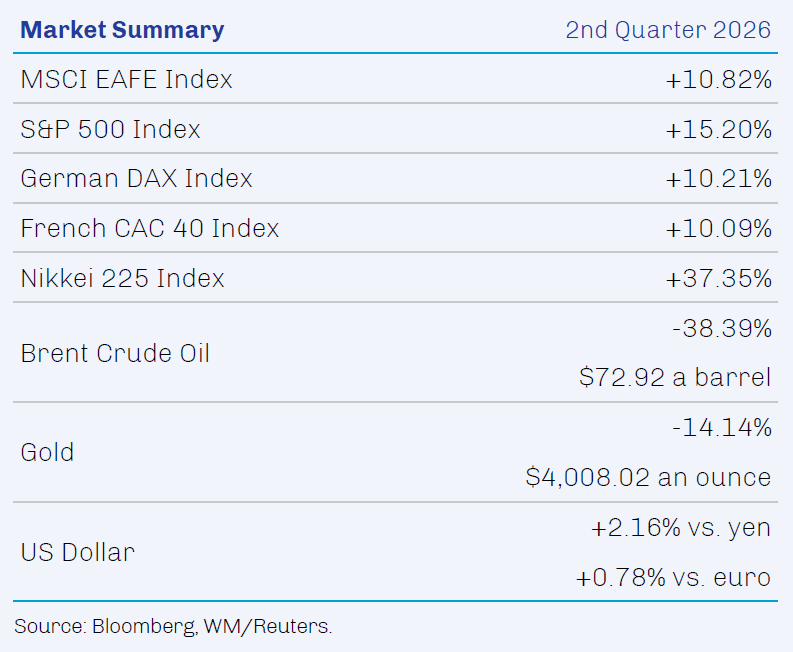
With a fragile peace reached between the US and Iran, equity markets more than recovered from their first quarter challenges. The S&P 500 Index advanced 15.2% in the second quarter while the MSCI EAFE Index gained 10.8%. Growth names came roaring back during the period, with the MSCI World Growth Index more than doubling the return of its value counterpart.1

Celebrating Credibility

To us, the most notable development during the second quarter was the pronounced shift higher in US interest rate expectations even as those for other major economies generally moderated. One reason for this has been the appointment of Kevin Warsh as chair of the Federal Open Market Committee, replacing Jerome Powell. While Warsh’s nomination for the role in March initially had some observers questioning his ability to lead the central bank independent of President Trump’s rate-cutting influence, sentiment regarding his credibility has since shifted markedly. While it remains to be seen if Warsh’s credibility is merely enjoying a honeymoon period to begin his term, his consistently hawkish tone has helped push two-year Treasury yields and the dollar higher and gold lower.2

While we view rate hikes as possible based on Warsh’s rhetoric, the deliberate lack of formal Fed guidance under the new regime makes policy trajectory difficult to assess. Further, as credible as Warsh may be, he doesn’t have the same degree of policy flexibility that many of his predecessors had given today’s fiscal situation. The ability to increase interest rates meaningfully in the face of inflationary pressures is likely constrained by the government’s need to continually roll over its existing debt obligation and to finance large primary deficit at prevailing higher interest rates.

Markets, too, have maintained their credibility in the eyes of investors. Excepting the Covid-19 period, financial conditions in the US are pretty much the easiest they’ve been in the last couple of decades, as risk perception has remained limited as evidenced by tight credit spreads and generally high equity valuations .3 The strong demand for financial assets can be seen in the percentage of household wealth invested in equities versus real estate. Currently, more US wealth is held in equities relative to real estate at any point in the post-World War II period. Moreover, the only other times this ratio approached current levels was at two equity market peaks in the late 1960s and late 1990s.4 The natural response to this demand has been increased equity issuance, which turned positive for the first time since the post- Covid days.5

And while this exuberance is cause for concern, it is not without support. Earnings expectations have been very strong, for example, and S&P 500 estimate revisions have been biased higher, primarily driven by the artificial intelligence (AI) infrastructure buildout.6 Easing oil prices as a fragile peace was reached between the US and Iran have helped. After peaking near $140/bbl on the spot market in early April, Brent crude ended the period around $70/bbl—more or less consistent with pre-war levels.7 However, the fragility of the deal— which was declared null by Trump in early July following renewed Iranian attacks—combined with operational constraints suggest traffic in the Strait of Hormuz is likely to remain well below normal levels for some time.

Perhaps more impactful to earnings has been households’ absorption of tariff- and energy-related price increases. The US personal savings rate declined to 3% in its latest reading, half the long-term average of 6%.8 Given the very high savings rate of the highest-earning Americans, this trend implies that lower-income households are spending more than they earn and are relying on debt to bridge the gap. This is something to keep an eye on; consumers will need to rebuild their savings buffer at some point, to the detriment of corporate profit margins.

The magnitude of capital expenditures by hyperscalers—companies like Amazon, Apple, Meta, Microsoft and Oracle that operate massive data centers supporting cloud computing—has been another source of support for investor sentiment. Spending on data-center software and information processing equipment relative to GDP now exceeds the dot-com peak, funded primarily out of operating cash flow and, increasingly, debt issuance.9 While spending on data centers and other AI infrastructure is forecast to continue, its current rate of growth to us seems difficult to sustain. Meanwhile, this spending has produced frictions in the real economy, pushing up prices on inputs ranging from copper to dynamic random access memory (DRAM) chips and serving as an inflationary impulse to the economy as a whole.

Gold Price Continues to Wane

Expectations of less accommodative monetary policy was an anchor for gold during the quarter, dragging the metal’s price down by around 14%. At current levels, gold is near its 50-year geometric average relative to the amount of Treasury debt outstanding. We would argue, however, that the quality of Treasuries is not at its 50-year average given the country’s massive primary deficit and what may be a structural shift higher in interest rates.10

The deterioration of assets like Treasuries is likely among the reasons central banks have continued to be a source of gold demand as they diversify their reserves in an effort to hedge financial and geopolitical risks. Central banks have bought an average of 1,000 tonnes of gold per year since 2022, and gold now exceeds US Treasuries as a percentage of total international reserves. Further, 89% of central bankers polled in a recent survey by the World Gold Council expect global gold reserves to increase in the next 12 months.11

The price of gold had more than doubled over the preceding two years in response to rising geopolitical risk, and a correction upon the realization of a priced-in risk is not surprising and consistent with the pattern observed during similar supply shocks in the Middle East in the 1970s. While the prospect of higher nominal interest rates in an inflationary environment may weigh on gold in the near term, we remain confident the benefits of a strategic long-term allocation to gold as a potential hedge in diversified portfolios.

Finding Value Beneath the Surface

After struggling during the first quarter, growth stocks surged in the second, and, in our view, value stocks remain cheap relative to growth despite occasional blips of outperformance. That said, there may be more to this story than index-level analysis suggests. Comparing an equal-weighted version of the S&P 500 Index to the traditional market-cap weighted index, for example, reveals that the former is more rationally valued. In fact, the gap between these two indexes is the widest it has been in the last 15 years or so, suggesting potential opportunity outside of the mega cap stocks that dominate benchmark performance.12 Notably, international stocks have also remained cheap relative to US stocks by historical standards.

As a result, the market volatility during the second quarter offered ample opportunity to reposition the portfolio into stocks we believe continue to trade at attractive valuations relative to their long-term prospects, despite record-high index levels. We believe that considering a diverse collection of scarce, durable assets at sensible valuations could benefit our investors in the long run.

Portfolio Review


The International Equity strategy posted a positive absolute return in second quarter 2026. Developed Europe and emerging markets were the leading contributors while North America and developed Asia excluding Japan detracted. Information technology, financials and consumer staples were the leading contributors among equity sectors, while energy was the only detractor and communication services and materials lagged. The International Equity strategy underperformed the MSCI EAFE Index in the period.

Leading contributors in the First Eagle International Equity Strategy this quarter included Samsung Electronics Co., Ltd. Pfd Non-Voting, Merck KGaA, Compagnie Financière Richemont SA, FANUC Corporation and Samsung Life Insurance Co., Ltd.

Samsung Electronics is a global technology company and major manufacturer of diverse electronic components with a dominant presence in memory semiconductors. Shares performed well as strong pricing for both dynamic random-access memory (DRAM) and NAND memory chips underpinned earnings growth. Persistent demand from hyperscalers and long-term supply agreements underpin market expectations for sustained robust profitability.

Merck KGaA is a global life science, healthcare and electronics company based in Germany. Sales for the cancer drug Keytruda were strong during the quarter. Additionally, as the company announced its definitive agreement to acquire US life science tool company Bio-Techne, investors welcomed Merck’s shift away from midsize European pharma to instead focus on higher-quality, faster-growing, longer-duration franchises.

Shares of Swiss luxury goods company Richemont—with maisons that include Cartier and Van Cleef & Arpels—rallied on restored stability in the luxury goods market as hopes for reduced geopolitical tensions in Iran eased anxieties globally and alleviated pressure on the crucial Middle Eastern market. Strong jewelry sales, a solid cash position and resilient demand across the Americas and Europe contributed to returns.

Based in Japan, FANUC is a global leader in computerized numerical control devices and robots. Reported earnings exceeded market expectations, reflecting double-digit growth in robotics and a major share buyback. Investor enthusiasm continues for FANUC’s collaboration with third-party large language models—including through partnerships with Nvidia and Google—to bring “physical AI” (i.e., converting language into robotic actions) into mainstream manufacturing. Opening its control system to outside plug-ins expands FANUC’s use cases by simplifying integration and programming for users.

Samsung Life Insurance is a South Korean financial services provider of life, health and pension insurance, as well as retirement products, trust services and loans. Shares were strong during the quarter on surging valuation for Samsung Life’s substantial position in Samsung Electronics, robust demand for health insurance products, margin expansion and accounting changes that increased visibility into the company’s insurance operations.

The leading detractors in the quarter were Shell PLC, Imperial Oil Limited, Jardine Matheson Holdings Limited, Nutrien Ltd. and Willis Towers Watson Public Limited Company.

Shares of oil and gas supermajor Shell traded down alongside a decline in oil prices despite reporting better-than-expected earnings for its most recent quarter. Although one of the company’s key production facilities in Qatar was damaged by missile strikes, Shell’s geographically diverse liquefied natural gas portfolio provides flexibility to reroute cargo destinations from South America and Southeast Asia. We continue to like management’s commitment to returning cash to shareholders through dividends and buybacks.

Imperial Oil is a Canadian integrated oil company that is 70% owned by Exxon Mobil. Shares of Imperial Oil traded down alongside easing crude oil prices during the quarter. We continue to like the company’s low cash-production costs, network of centralized upstream reserves and integrated downstream refineries, and focus on returning cash to shareholders through stock buybacks.

Headquartered in Hong Kong, holding company Jardine Matheson Holdings controls a diversified collection of business franchises predominantly across Greater China and Southeast Asia. The stock declined alongside other Singaporean property companies during the quarter. The company’s new chief executive announced a new investment strategy to improve capital allocation, grow earnings and return cash back to shareholders through dividends and buybacks. We like Jardine’s solid balance sheet, attractive assets and management’s focus on improving shareholder returns.

Canadian-domiciled Nutrien is one of the world’s largest producers of potash fertilizer and the third largest producer of nitrogen fertilizer. Shares of Nutrien traded down alongside the second quarter decline in fertilizer prices, which were elevated during the first quarter because of supply disruptions caused by the closure of the Strait of Hormuz. The company reported better than expected results for its most recent quarter, driven by record potash sales volume, increased production and strong nitrogen and retail performance. We continue to like Nutrien’s network of high-quality, low-cost mines, its strong balance sheet, and its track record of using free cash flow to decrease debt and buy back stock.

London-based Willis Towers Watson is one of the largest global insurance brokerage and consulting companies. Shares declined as the company reported a deceleration in organic revenue group for its most recent quarter. We believe the company’s turnaround plan to improve profitability remains intact, and we continue to like Willis Towers Watson’s high customer retention and ability to participate in nominal economic drift.