


BLOGThe Bird's Eye View
Timely Perspectives, Unconventional Thinking
We’re excited to share timely market insights, thoughtful perspectives and expert commentary as part of our commitment to providing modern investment solutions to modern challenges.
BLOGThe Bird's Eye View
Timely Perspectives, Unconventional Thinking
We’re excited to share timely market insights, thoughtful perspectives and expert commentary as part of our commitment to providing modern investment solutions to modern challenges.
The “Korea Discount” Gets a Value-Up Turnaround

Head of Global Value Team and Portfolio Manager
While the year-to-date outperformance of non-US equities relative to US names may be attributable to a natural ebb and flow of markets around the long-term mean, the rebound in certain markets may also be a function of secular forces that have awakened animal spirits. One such instance is corporate governance and tax reform in Korea.
In 2024, Korea’s Financial Services Commissions introduced the Corporate Value-Up Program to combat the persistent “Korea discount” in equity valuations as a result of foreign investors’ general reluctance to invest in Korean-domiciled businesses. These reforms are focused on the expansion of fiduciary standards on corporate boards to spur changes at chaebols, the large, family-controlled conglomerates that dominate the Korean economy. While this initiative is in its early stages, we believe that it has the potential to drive a sustained interest and durable re-rating of Korean equities if it becomes a catalyst for meaningful improvements in corporate governance.
We believe reforms have the potential to drive a sustained interest and durable re-rating of Korean equities.
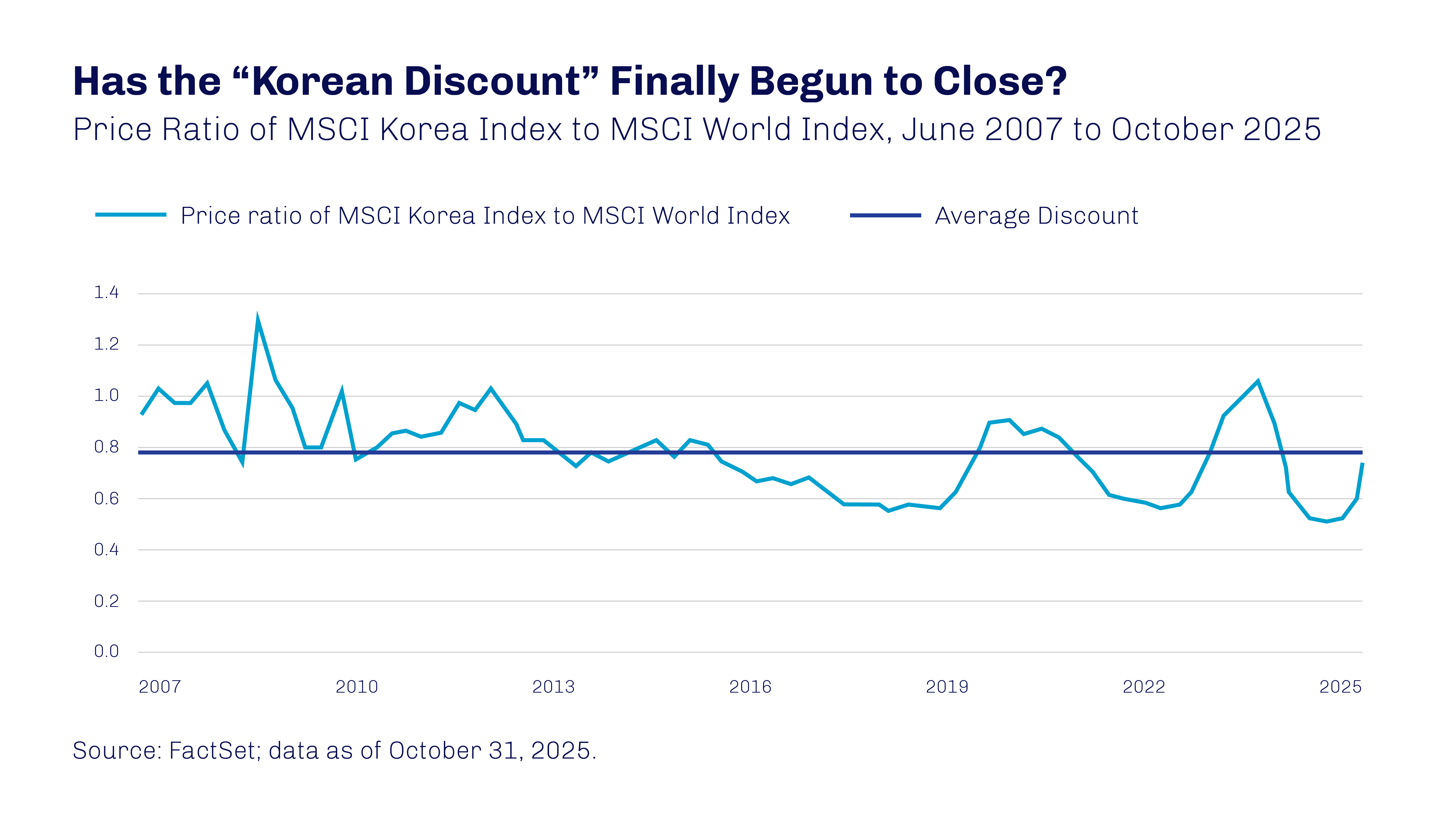
Fueled by a variety of other factors like growing investments in artificial intelligence and the recently announced trade deal between the US and Korea, the MSCI Korea Index has been a standout performer with an 84% gain in year-to-date 2025.1 While the “Korean discount” is still below its long-term historical average, it has begun to narrow this year. We remain cognizant of risks and challenges, and, as a result, we believe that selectivity in this market is paramount. With a track record of three decades of investing in Korea, we have observed that the country’s corporate focus on innovation in high-end precision manufacturing has contributed to a high density of world-class enterprises, including high-quality global companies with strong management teams and a qualified manufacturing base.2

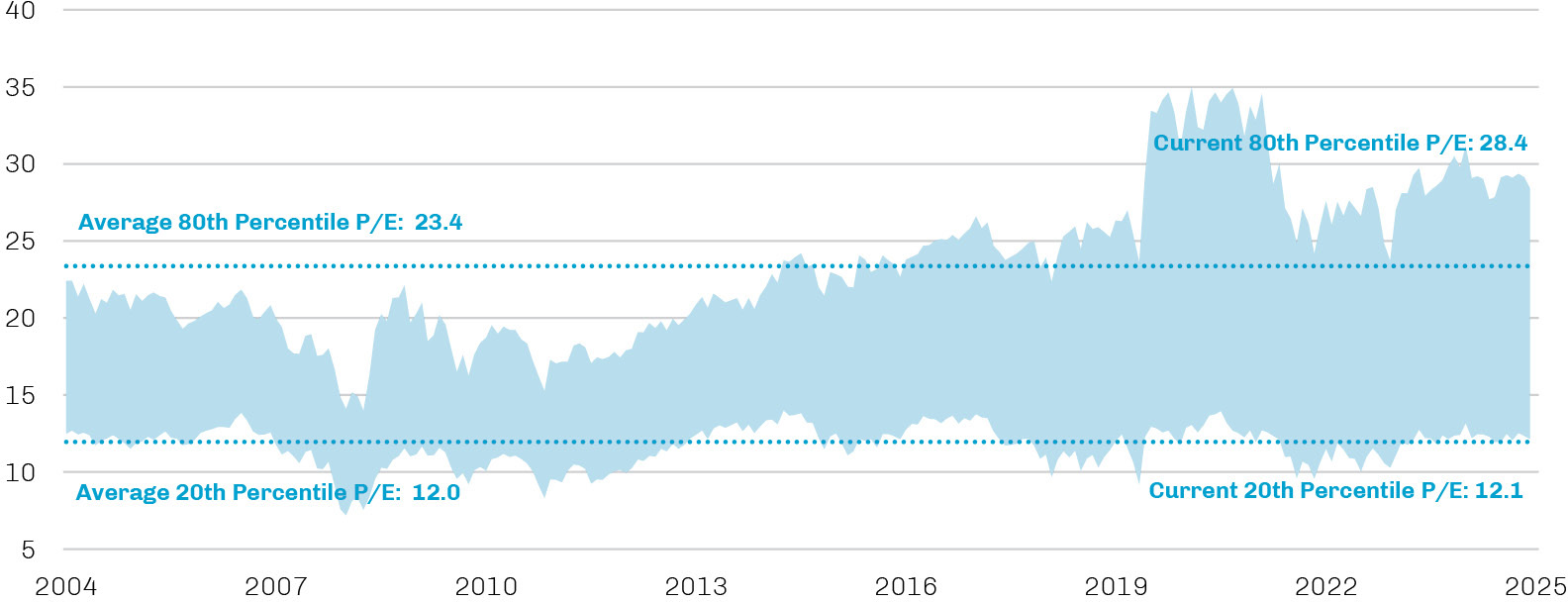
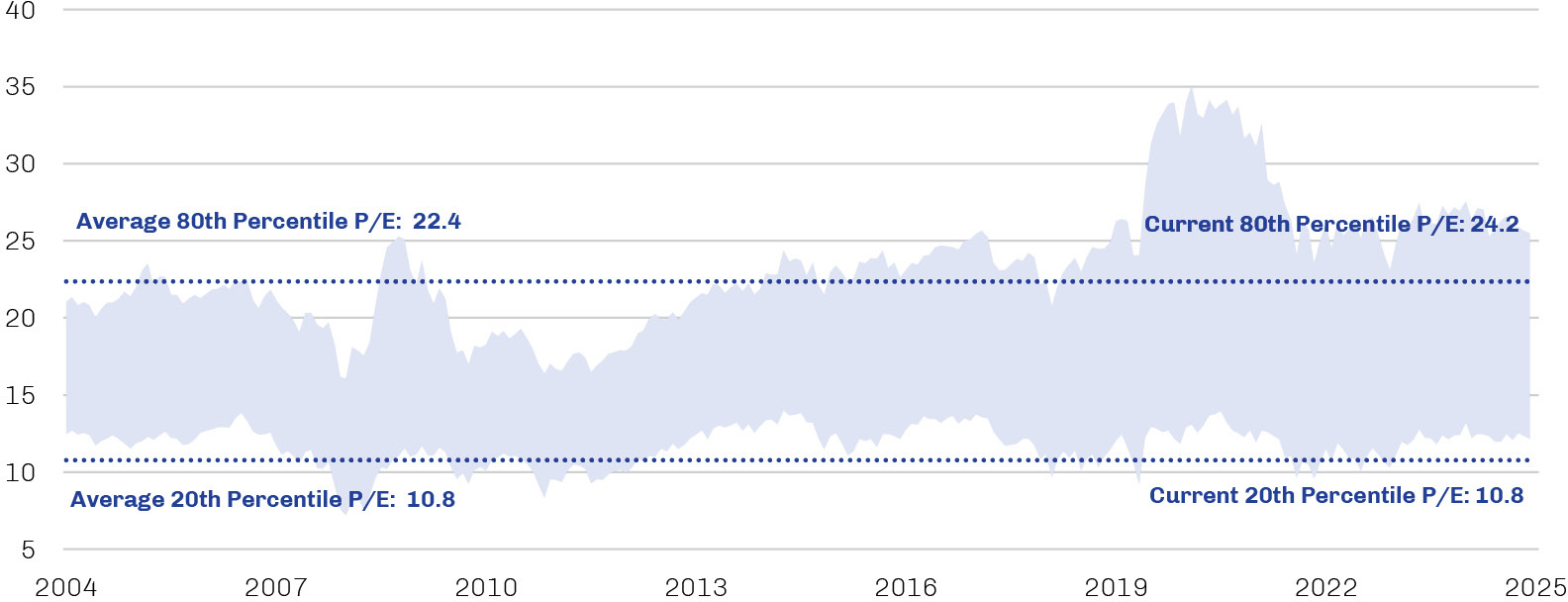
One of the more prominent themes in today’s equity markets is the unusually wide valuation gap. The top 20% most expensive companies in the S&P 500 Index trade at a price-to-earnings ratio (P/E) of just over 28x, while the bottom quintile trades near 12x—marking a wider valuation gap than the historical norm. As for international equities, the pattern is similar, with the highest valued quintile of the MSCI EAFE Index trading just over 24x versus the cheapest trading near 11x.1
The overall valuation backdrop in the US remains stretched relative to its long-term average. As of late October, the S&P 500’s forward P/E stood at 23x, compared to its 20-year average of roughly 16x and 30-year average of 17x.2 While these multiples have eased somewhat earlier in the year, they remain well above their historic norms. This could be a reflection of the heavy influence of mega-cap technology companies, which continue to drive much of the index’s performance and contribute to the perception of US stocks as being overly expensive. That being said, international markets appear much closer to fair value and can benefit from supportive tailwinds, such as moderating inflation trends and a weaker U.S. dollar shown earlier in the year.
For investors seeking diversification, the wide gap between expensive and relatively cheap names supports the case for selectivity—and for global exposure in regions where valuation spreads may offer greater upside potential. Active managers with a focus on quality can be well positioned to navigate this uneven landscape and possibly capitalize on the global market’s persistent inefficiencies.
Valuation Dispersion Remains Wide, Suggesting a Benefit to Selectivity
Comparison of S&P 500 Index (top) and MSCI EAFE Index Valuation Dispersion (bottom) 80th Percentile Versus 20th Percentile P/Es
October 2004 through October 2025
Source: FactSet, as of October 31, 2025.