BLOGThe Bird's Eye View
Timely Perspectives, Unconventional Thinking
We’re excited to share timely market insights, thoughtful perspectives and expert commentary as part of our commitment to providing modern investment solutions to modern challenges.
BLOGThe Bird's Eye View
Timely Perspectives, Unconventional Thinking
We’re excited to share timely market insights, thoughtful perspectives and expert commentary as part of our commitment to providing modern investment solutions to modern challenges.

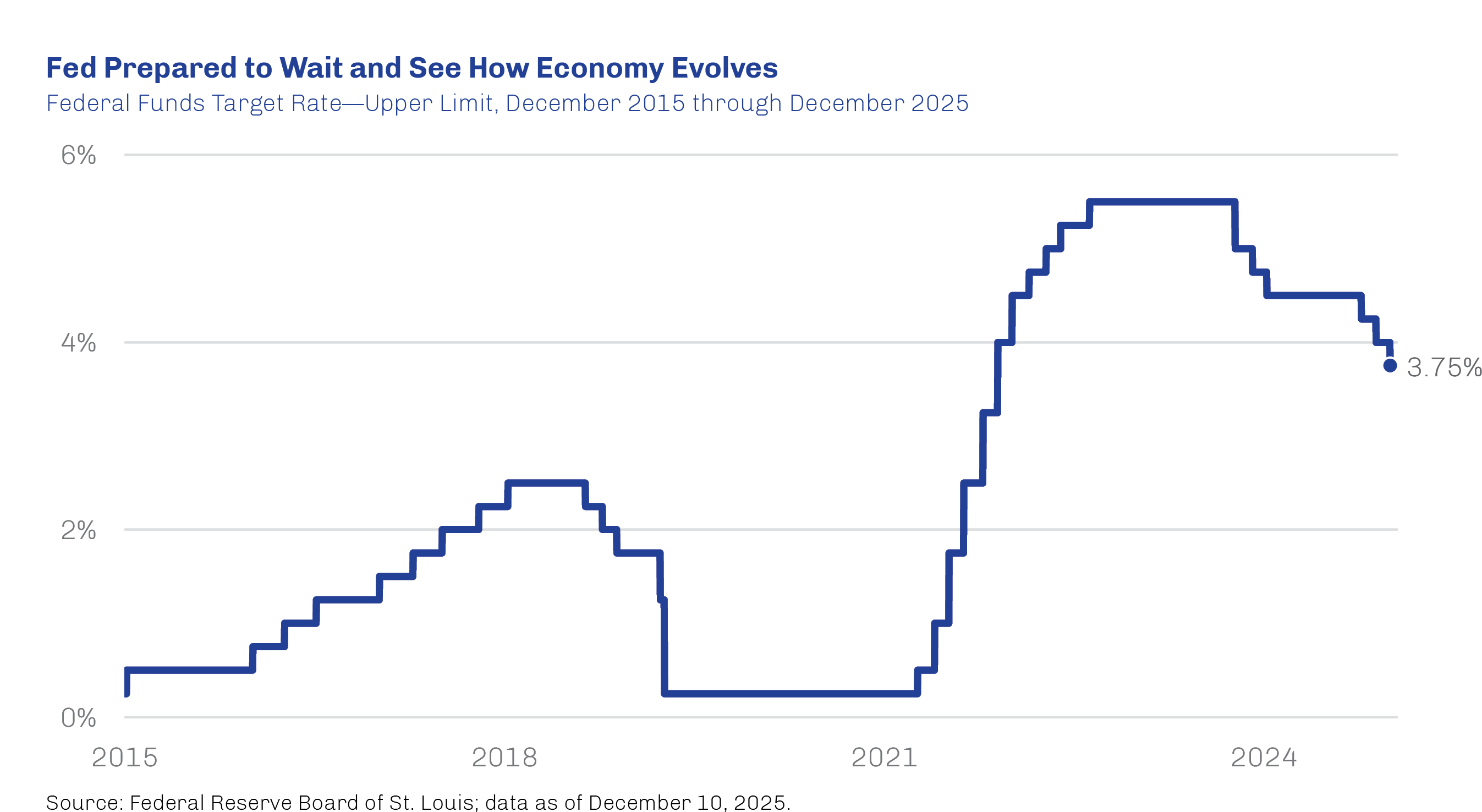
The Federal Open Markets Committee (FOMC) on December 10 cut the federal funds rate 25 basis points to a range of 3.50–3.75%. There were three dissents—the most in six years—as two voters favored no cuts, while one favored a 50 basis point cut, though the dot plot of rate projections indicated broader “soft” dissent among the 19 officials.
While expectations of this meeting had been for a “hawkish cut,” the Fed instead delivered what we view as a balanced, risk-friendly cut that hinted at an extended pause driven by improved growth dynamics. With the rate near neutral, the Fed is “well positioned” to wait and see how the economy evolves as data reporting impacted by the government shutdown catches up and fiscal stimulus kicks in during the first quarter.
The median FOMC participant forecasts one additional cut in both 2026 and 2027, though the distribution of forecasts was extremely wide. Futures markets, in contrast, are pricing a little over two cuts next year, with the first cut fully priced in for June when the next chair takes over from Powell. The market is not pricing any further cuts beyond 2026.
The Fed also announced that it will begin buying Treasury bills to expand its balance sheet at a pace of $40 billion per month starting on December 12 to ensure reserves remain ample. Its quantitative tightening program ended on December 1.
The Instability Beneath the Equipoise

Head of Global Value Team and Portfolio Manager
With equity market valuations higher and credit spreads tighter than historical averages, risk perception in financial markets appears to reflect an economy in equilibrium. John Williams, president of the New York Fed, has described this as a state of “equipoise” in which the risks to employment and inflation in the US are balanced.1
Certainly not in balance are the country’s fiscal settings, and, as a result, the federal deficit as a percentage of GDP remains historically outsized relative to the unemployment rate.2 Normally, low unemployment rates and decent economic growth such as we have seen in recent years beget higher tax revenues and tighter fiscal policy—and thus budget deficits much smaller than the 6%-plus we’re at today.3 Nothing out of Washington suggests the current fiscal dynamics is likely to change anytime soon.
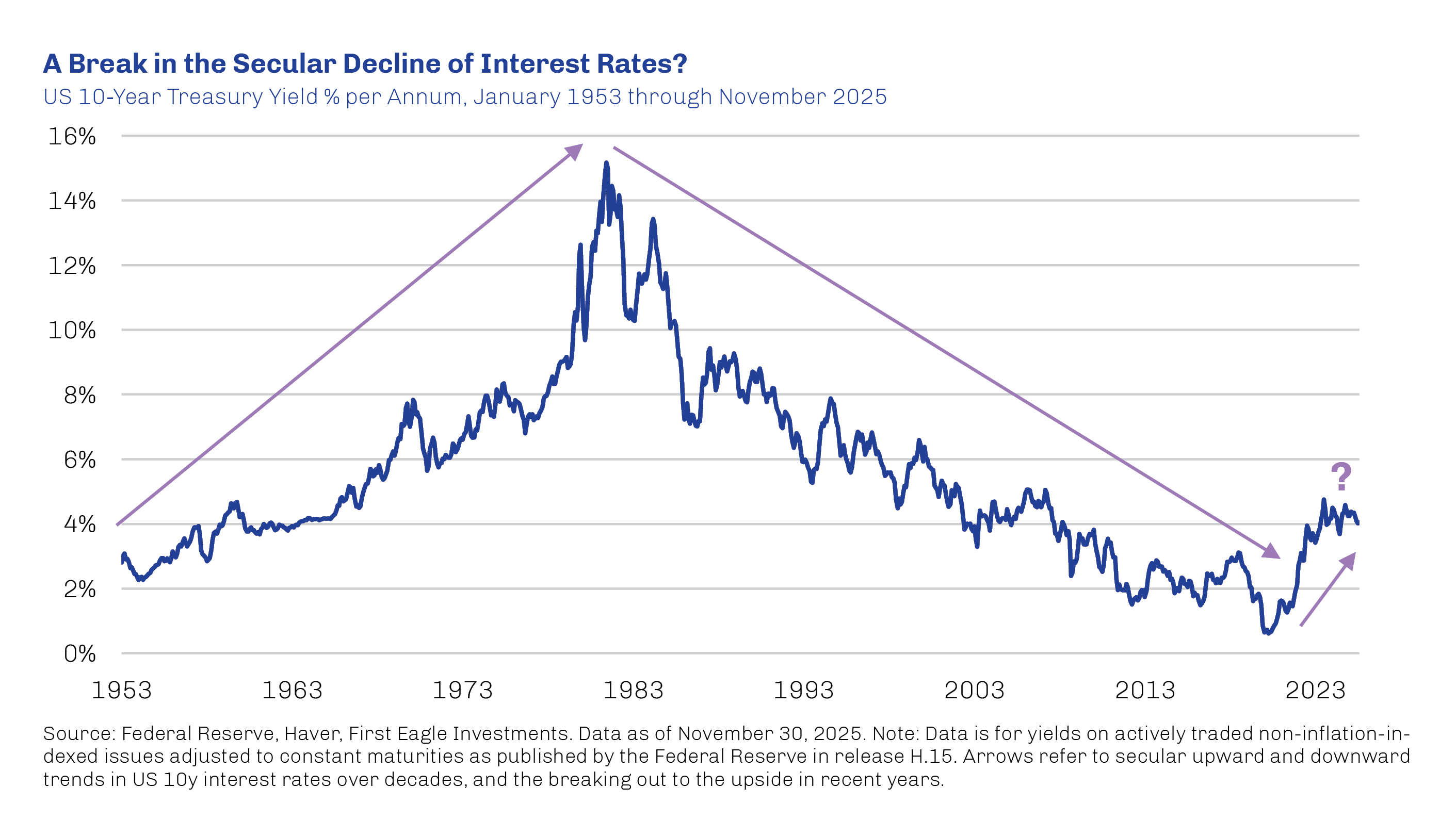
That said, persistent deficit spending has imparted some positive nominal drift to the economy, which has trickled down into corporate earnings and margins and supported financial markets. But the continuously expanding government debt pile has also raised the specter of currency debasement and other adverse financial outcomes. As shown in the table below, the upward bias in 10-year Treasury yields—after four decades of secular decline—may be manifesting these concerns.