


BLOGThe Bird's Eye View
Timely Perspectives, Unconventional Thinking
We’re excited to share timely market insights, thoughtful perspectives and expert commentary as part of our commitment to providing modern investment solutions to modern challenges.
BLOGThe Bird's Eye View
Timely Perspectives, Unconventional Thinking
We’re excited to share timely market insights, thoughtful perspectives and expert commentary as part of our commitment to providing modern investment solutions to modern challenges.

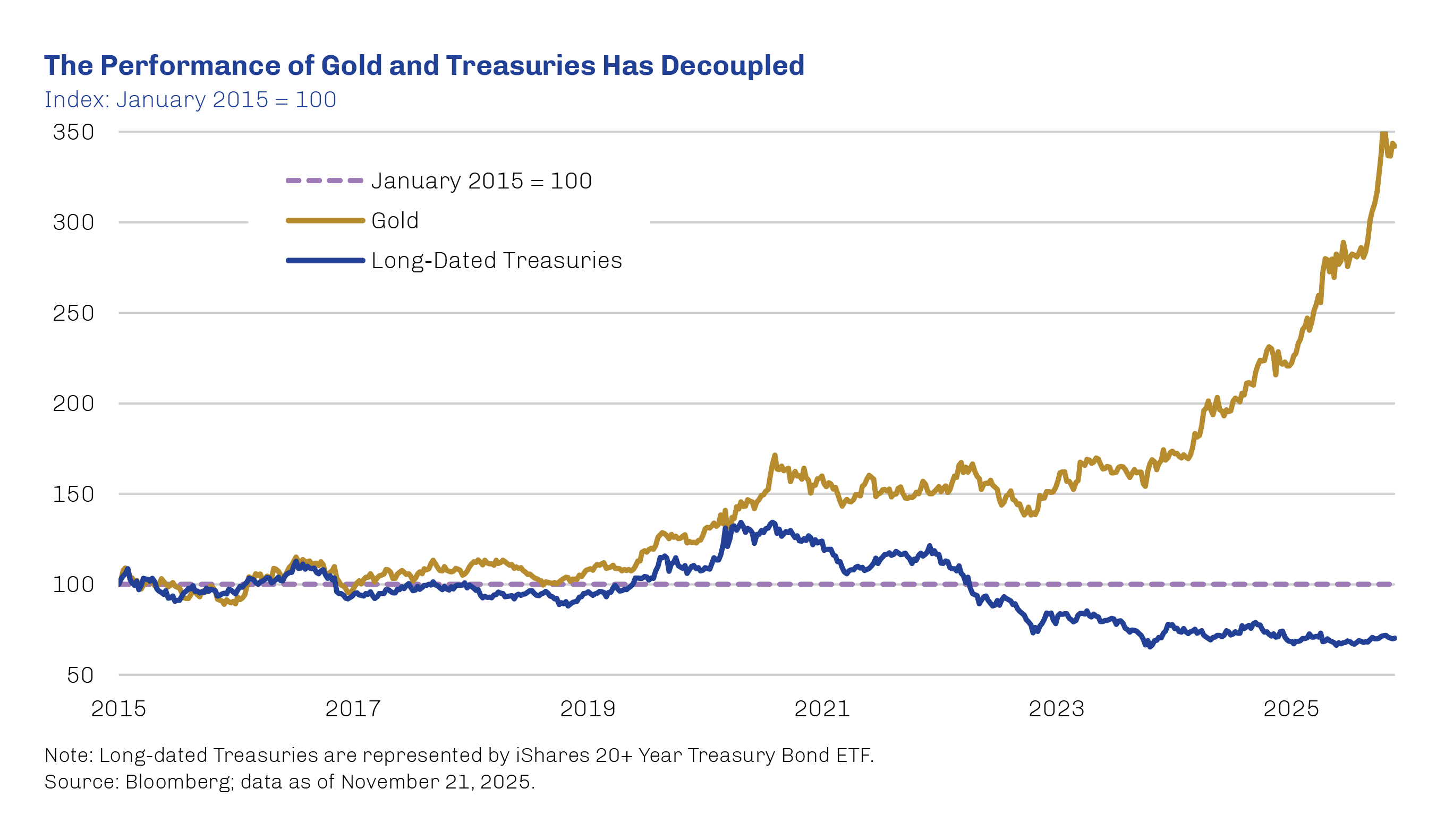
Since bottoming at around $1,630/oz in October 2022, the price of gold has increased by more than 150%.1 Among the more remarkable aspects of this rally is that it has occurred amid mostly rising interest rates, historically a headwind for the gold price, suggesting other factors are at play.
It’s been our experience that the gold market can sometimes serve as the metaphorical canary in the coalmine, sussing out potential dangers before they manifest in asset prices more broadly. One such danger, in our view, has been the massive and ongoing accumulation of government debt.
The US federal deficit, for example, remains historically outsized relative to the unemployment rate—as it has since the outbreak of Covid-19.2 This persistent deficit spending has imparted some positive nominal drift to the economy, which has trickled down into corporate earnings, margins and supported risk assets. We believe it also helps explain the decoupling of gold and Treasuries shown below.
Gold—whose relatively fixed supply historically has enabled it to participate in the nominal drift of the economy over time—appears to be acknowledging the double-bind facing US policymakers: Do nothing to address the deficit and increase the risk of inflation, or take action to curb deficit spending and increase the risk of recession.
Dealmakers Go Beyond the Mainstream

Senior Managing Director and Chief Investment Officer of Direct Lending, Napier Park Global Capital
Spreads in direct middle market loans compressed during the third quarter and leverage ticked higher as lenders competed for a limited supply of deals. Activity remained sluggish as pipelines continued to slowly rebuild from the dislocations surrounding the tariff announcements.
With leveraged buyouts still relatively constrained, add-on mergers and acquisitions (M&A) has been a more consistent source of demand for private credit lenders, accounting for nearly three-quarters of buyout transactions in the third quarter.1 In the lower middle market, in particular, we are seeing activity in private equity rollups of basic, cash-flowing businesses with pricing power and inelastic demand—such as HVAC, plumbing, elevator servicing and landscaping. For private equity buyers, these smaller businesses offer an opportunity to professionalize, scale and consolidate within sectors of the US economy that have long remained outside the M&A mainstream.
It’s possible that the Fed’s recent rate cuts—with the potential for additional cuts before year end—may herald a change in M&A sentiment. If so, we believe that activity in the lower middle market is likely to accelerate before demand in the upper end. With relatively simple capital structures and limited leverage, smaller companies tend to be more sensitive to changes in the cost of capital and modest rate cuts can spur a pickup in dealmaking. That said, spread levels are unlikely to improve meaningfully even if volumes increase over the next few quarters, in our view, as it will take time for the market to reestablish supply/demand equilibrium.
We believe that activity in the lower middle market is likely to accelerate before demand in the upper end.