BLOGThe Bird's Eye View
Timely Perspectives, Unconventional Thinking
We’re excited to share timely market insights, thoughtful perspectives and expert commentary as part of our commitment to providing modern investment solutions to modern challenges.
BLOGThe Bird's Eye View
Timely Perspectives, Unconventional Thinking
We’re excited to share timely market insights, thoughtful perspectives and expert commentary as part of our commitment to providing modern investment solutions to modern challenges.

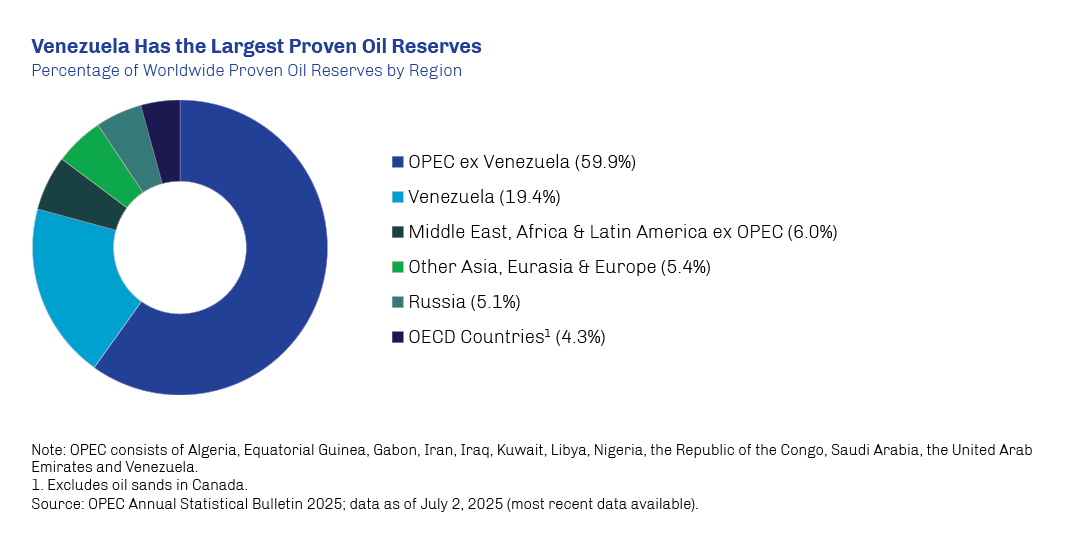
Select energy names rallied in early January—particularly oilfield services, US refiners and producers with historical exposure to Venezuela—as investors priced in the possibility that the country’s long-sanctioned oil sector could reopen following the arrest of Venezuelan President Nicolás Maduro.1 With more than 300 billion barrels of accessible resource—the largest proven oil reserves in the world—markets are excited by this possibility.2 We believe that any potential meaningful impact is likely to unfold far more slowly than markets anticipate given the estimated cost and complexity of such an endeavor.
Despite making up approximately 17% of global oil reserves, Venezuela produces less than 1% of global crude supply, a fraction of its capacity.3 Years of sanctions and chronic underinvestment have left production capacity severely impaired, and most of Venezuela’s oil is extra heavy crude, which is more expensive and difficult to extract, transport, process and refine. Estimates suggest that it would require tens of billions of dollars to rehabilitate Venezuela’s existing oil fields and pipelines in order boost output within a few years.4 The country’s entire energy complex is operating well below any comparable global resource base.
In our view, any material contribution to global oil supply would likely take two to three years at a minimum with nearly $100 billion of investments. Moreover, large energy companies have publicly expressed the need for improved fiscal terms, as well as broader security and legal assurances, which we believe reflects the broader risks of the current geopolitical landscape.5
Without any quick fixes in sight, we believe that select legacy energy businesses in possession of scarce, vital assets in stable jurisdictions with a record of prudent stewardship of capital may be better positioned to meet the world’s long-term energy demands.

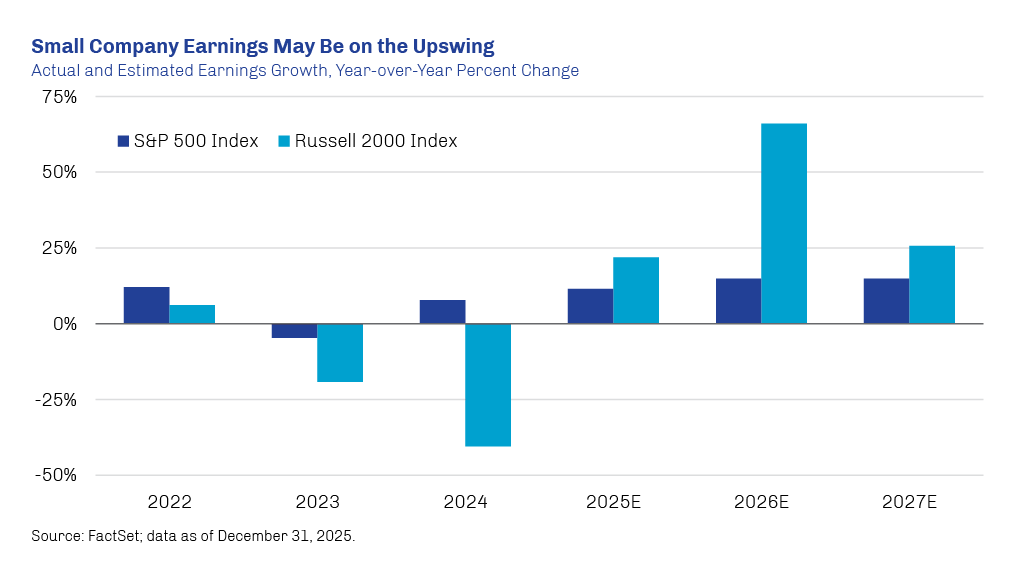
As fundamental investors, we view underappreciated earnings potential as a holy grail that historically has been rewarded in the marketplace. After three years of being overshadowed by companies in the S&P 500 Index, a resurgence in small cap earnings may at last be underway.1 As shown in the chart below, earnings for the Russell 2000 Index are forecast to outpace those of the S&P 500 Index for at least the next two years.
Multiple tailwinds could support this earnings growth for small caps, including:
Outsourced technology may enable small companies to scale their operations, improve efficiency and facilitate the conversion of some costs from fixed to variable, easing the need for working capital.
Artificial intelligence benefits small cap companies over a very long cycle. Suppliers to data center construction can expand their customer base without incremental spending on research and development, thus supporting margin expansion. Healthcare and consumer goods companies could see benefits through reduced spending on expenses and enhanced development of superior products with pricing power.
Prospectively lower interest rates could be especially beneficial to those many smaller companies with substantial levels of variable-rate debt.
A resurgent IPO market could benefit publicly traded small cap companies overall as private equity sponsors acknowledge meaningful hurdle rates in this higher rate environment and monetize their investments through public markets.
With the relative performance of small caps still near previous cyclical troughs—and respecting the tendency for mean reversion—eventual strong sustained earnings growth from small companies could drive meaningful returns going forward.2