BLOGThe Bird's Eye View
Timely Perspectives, Unconventional Thinking
We’re excited to share timely market insights, thoughtful perspectives and expert commentary as part of our commitment to providing modern investment solutions to modern challenges.
BLOGThe Bird's Eye View
Timely Perspectives, Unconventional Thinking
We’re excited to share timely market insights, thoughtful perspectives and expert commentary as part of our commitment to providing modern investment solutions to modern challenges.
Seeking Ballast as the Dark Clouds of Complacency Gather

Deputy Head of Global Value and Portfolio Manager
In an environment of pronounced macro, financial, geopolitical and structural concerns, risk perception in US markets remains low. Equity market valuation multiples are rich, high yield spreads are tight and implied volatility is low.1 We believe the biggest risk today is the lack of “margin of safety”2 as sovereign debt levels increase, geopolitical tensions rise and US economic growth becomes increasingly reliant upon technology capex, namely in artificial intelligence.
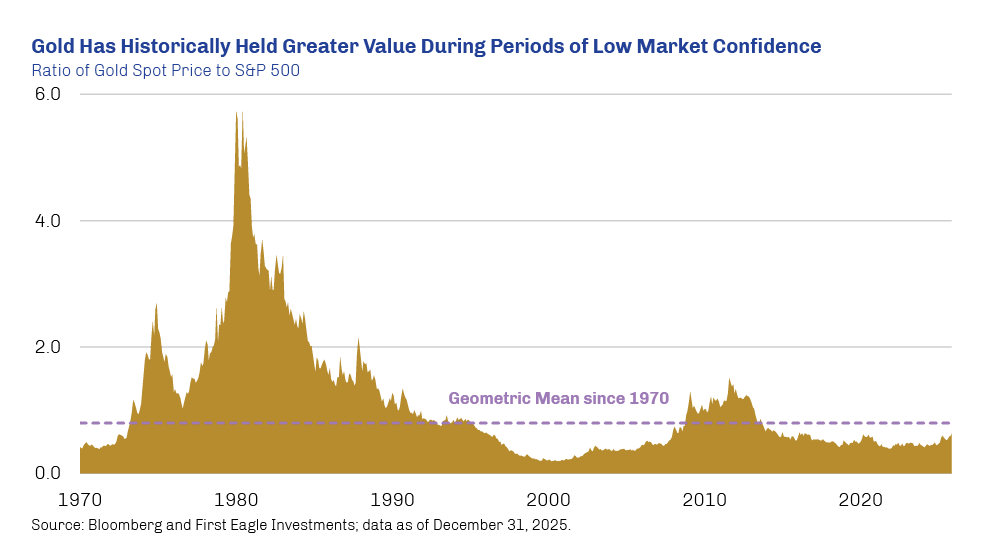
As the dark clouds of complacency accumulate, we seek ballast across assets that provide different layers of resilience. We continue to highly value the strategic hedge potential of gold given the fiscal and geopolitical dynamics currently in place. The monetary value of gold has been reasserting itself as the gold price has increased significantly over the past two years. We note that this rally has merely aligned gold with its 50-year geometric average relative to the stock of US public debt while bringing it closer to its geometric average versus the S&P 500 Index. Gold has historically been worth more than equities during periods of low confidence in markets, and it has been getting closer to its historical average relative to the S&P 500, as seen in the chart below.3
Gold, however, is not the only source of ballast. Nor is cash. In fact, one of our focuses in recent years has been on building resilience through businesses we believe offer ballast through their lower risk character. This is not achieved simply through higher allocations to traditionally defensive segments of the market like health care and consumer staples, though we do have meaningful exposure to these sectors. Rather, we evaluate stocks across industries from the bottom up in search of attributes we believe contribute to low correlations to the broader market, including strong balance sheets, high margins, diverse product lineups, long-lived assets and contractually obligated revenues.
AI’s Energy Appetite

Portfolio Manager and Senior Research Analyst

Portfolio Manager and Senior Research Analyst
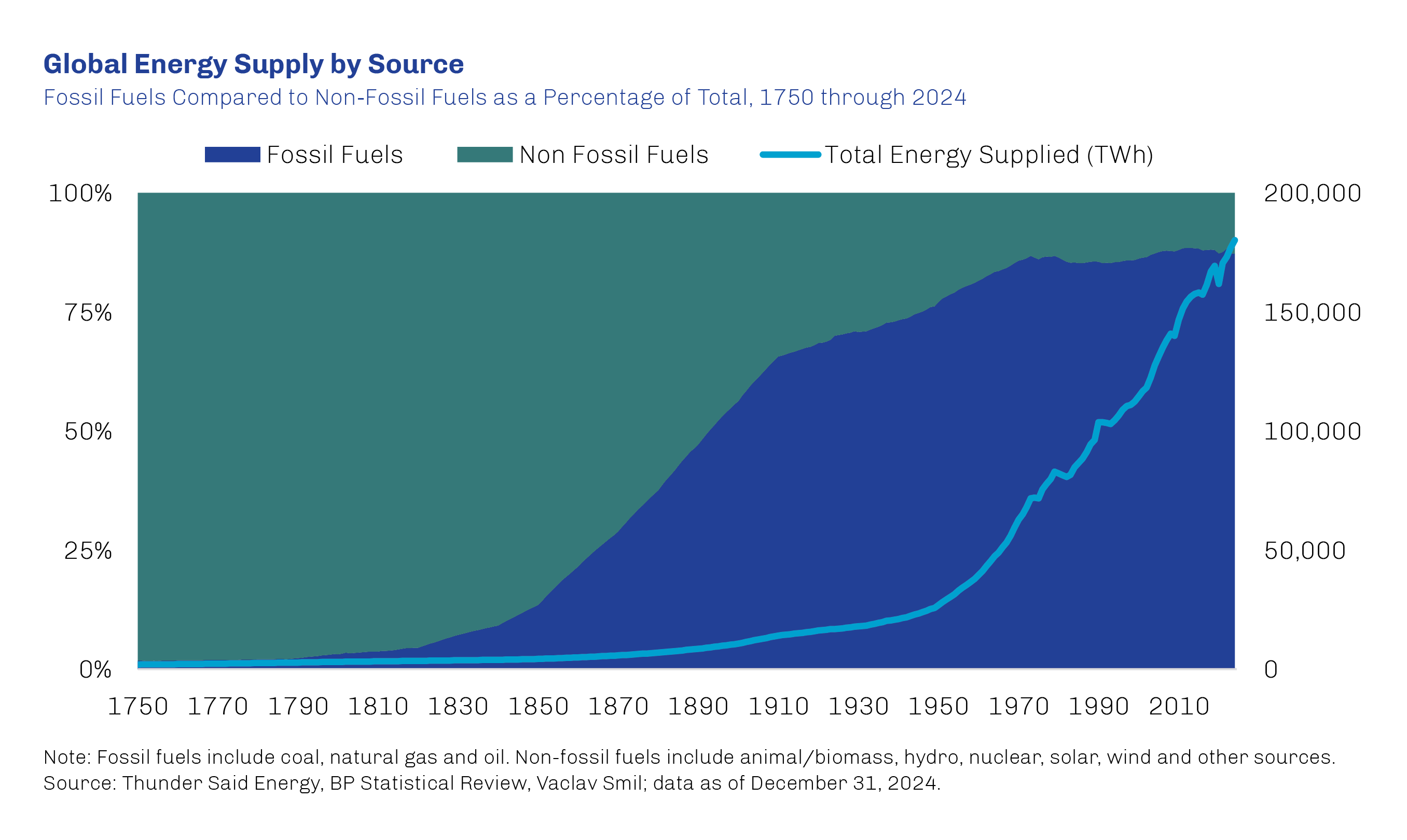
Global capital spending on energy is expected to rise by about 2% in real terms to $3.3 trillion in 2025.1 About two-thirds of this investment is directed toward renewables, nuclear, grids, storage, low-emissions fuels, efficiency and electrification, roughly twice the amount of investment in oil, natural gas and coal. Despite the massive investments and technological advances in renewables over the past decade, fossil fuels today still account for approximately 70% of energy consumption—roughly the same as 30 years ago.2
Energy transitions historically have unfolded over very long periods. In addition to demand driven by global population growth and increasing economic activity—particularly in developing economies—the current surge in artificial intelligence is a significant new source of energy use, which we believe may further extend an already long and winding transition. Some forecasts suggest energy demand from data centers could quadruple within a decade, potentially making data centers the fourth largest source of consumption after China, the US and India.3
This enormous demand points to a continued need for greater supplies of both traditional and renewable forms of energy. Potential beneficiaries, in our view, include well positioned legacy energy businesses with scarce, vital assets such as major suppliers of liquified natural gas, midstream companies with infrastructure essential to processing, transporting and storing oil, gas and natural gas liquids, and services businesses that help maximize productivity, including those deploying emerging technologies.