BLOGThe Bird's Eye View
Timely Perspectives, Unconventional Thinking
We’re excited to share timely market insights, thoughtful perspectives and expert commentary as part of our commitment to providing modern investment solutions to modern challenges.
BLOGThe Bird's Eye View
Timely Perspectives, Unconventional Thinking
We’re excited to share timely market insights, thoughtful perspectives and expert commentary as part of our commitment to providing modern investment solutions to modern challenges.
On January 30, President Trump announced he would nominate Kevin Warsh to be the next chair of the Federal Reserve when Jerome Powell’s term ends in mid-May. Warsh’s nomination, in my view, alleviates some degree of concern about the central bank’s independence, especially relative to some of the other candidates that were being considered. On their own, reduced concerns about Fed independence are helpful for the dollar and weigh on the debasement trade; not surprisingly, the dollar rallied on the announcement while gold and silver sold off sharply.1
Warsh has built a reputation as an inflation hawk going back to his days as a Fed governor from 2006 to 2011, but public statements since Trump re-took office last year have been critical of the measured pace of policy easing. He has suggested that the US is amid an artificial intelligence-driven productivity boom that allows for faster economic growth—and lower interest rates—without stoking inflation, but I think it’s way too early to conclude productivity has durably increased. I expect Warsh to push the federal funds rate lower by 50–75 basis points this year, which is what I would have expected even with no change in leadership. Faster rate cuts, on their own, would tend to have a negative impact on the dollar.
Warsh also has been critical of the Fed’s balance sheet expansion, but I don’t expect a near-term restart of quantitative tightening—which ended in December 2025—given the current level of reserves. Broader regulatory reform, a time-consuming exercise, would be necessary to meaningfully reduce reserves. Potentially, a Warsh Fed could accelerate efforts to shift the Fed’s balance sheet back to Treasury securities exclusively, with a bias toward short-term bills, and the steepening in the Treasury yield curve that we are seeing is in line with this view.
A Warsh Fed could potentially accelerate efforts to shift the Fed’s balance sheet back to Treasury securities exclusively.
Can Smaller Deals Yield Better Value?

Senior Managing Director and Chief Investment Officer of Direct Lending, Napier Park Global Capital
Credit markets finished a strong 2025 in generally positive fashion despite tight spreads, all-in yield compression and heightened risk—idiosyncratic, macroeconomic and geopolitical. New-issue spreads across middle market direct lending contracted over the course of the year, and spreads in the lower middle market fell to a historical low of 513 basis points.1
In today’s environment of rate cutting or declining base rates, investors need to recalibrate and focus again on spread. As returns on direct loans migrate down with base rates, spreads can become the dominant component of yield, determining and driving the stability of returns for investors. If a lender is able to originate loans with wider spreads without taking on unwanted credit risk, even in a declining rate environment, acceptable return levels compared to the broader market can be maintained for investors.
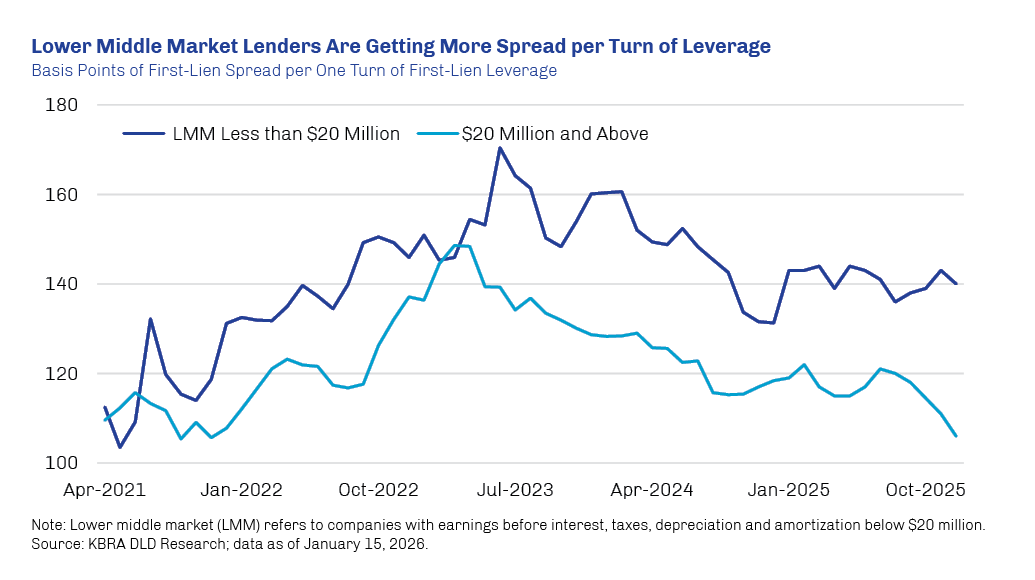
We are seeing higher spread per turn of leverage in the lower middle market for companies with earnings before interest, taxes, depreciation and amortization below $20 million2, which reinforces our focus on private equity rollups of basic, cash-flowing businesses with pricing power and inelastic demand—such as HVAC, plumbing, elevator servicing and landscaping. For private equity buyers, these smaller businesses offer an opportunity to professionalize, scale and consolidate within sectors of the US economy that have long remained outside the mergers and acquisitions mainstream.