BLOGThe Bird's Eye View
Timely Perspectives, Unconventional Thinking
We’re excited to share timely market insights, thoughtful perspectives and expert commentary as part of our commitment to providing modern investment solutions to modern challenges.
BLOGThe Bird's Eye View
Timely Perspectives, Unconventional Thinking
We’re excited to share timely market insights, thoughtful perspectives and expert commentary as part of our commitment to providing modern investment solutions to modern challenges.

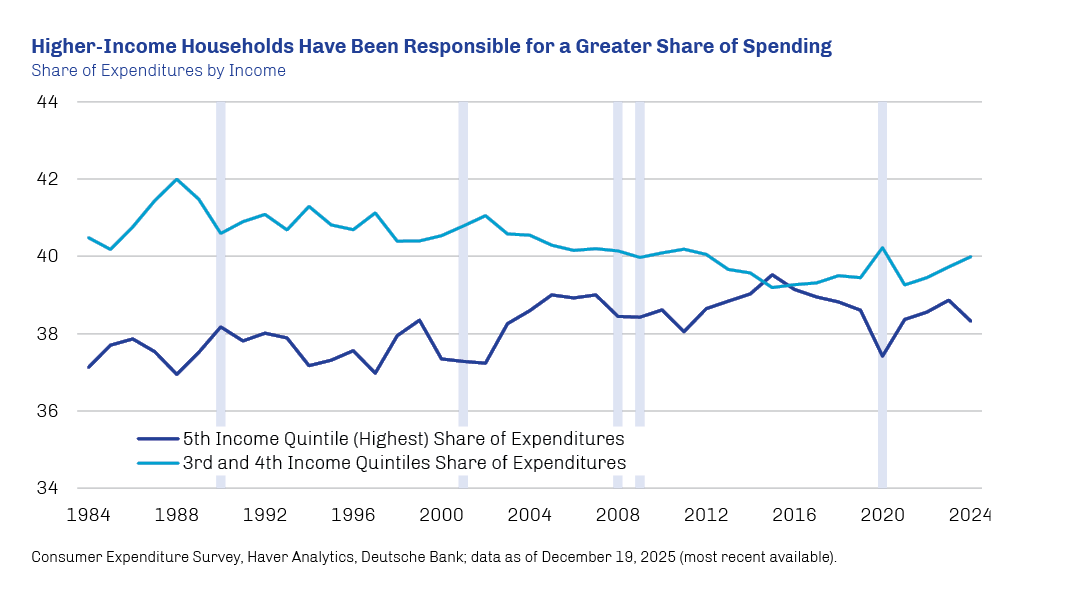
As the K-shaped economy continues to develop, with activity increasingly dependent upon upper-income households, we remain cautious on structured credit exposure to lower-credit consumers.1
Auto loan and lease delinquencies remain elevated relative to the past 20 years, with prime auto delinquencies at the 84th percentile and subprime at the 99th percentile. That said, these levels have persisted for several years, and more recent securitizations, including some deep subprime vintages, have generally exhibited stable to improving performance. Importantly, prior deals have largely maintained structural integrity, with limited bond losses or downgrades to date.
Delinquency trends are likely to remain pressured into early 2026. Financial conditions remain tight, with policy rates still near 15-year highs.2
While above-average tax returns stemming from the 2025 tax-and-spending bill could help stressed consumers catch up on loan payments, consumer confidence is the lowest it’s been in 10 years amid persistently above-target inflation and signs of softening employment. And that was before recent, large high-profile layoff announcements from Amazon (16,000 jobs) and UPS (30,000 jobs).3
As overall credit-market returns ratchet down along with declining base rates, spreads can become the dominant component of yield, determining and driving the stability of returns for investors. With tight spreads, all-in yield compression and heightened risks—idiosyncratic, macroeconomic and geopolitical—caution across asset classes remains our new conviction.

As the US Eastern Seaboard digs out from a storm that dumped as much as two feet of snow in major metropolitan centers, investors and business leaders worldwide are unpacking the latest flurry of activity in the Trump administration’s efforts to recast global trade.
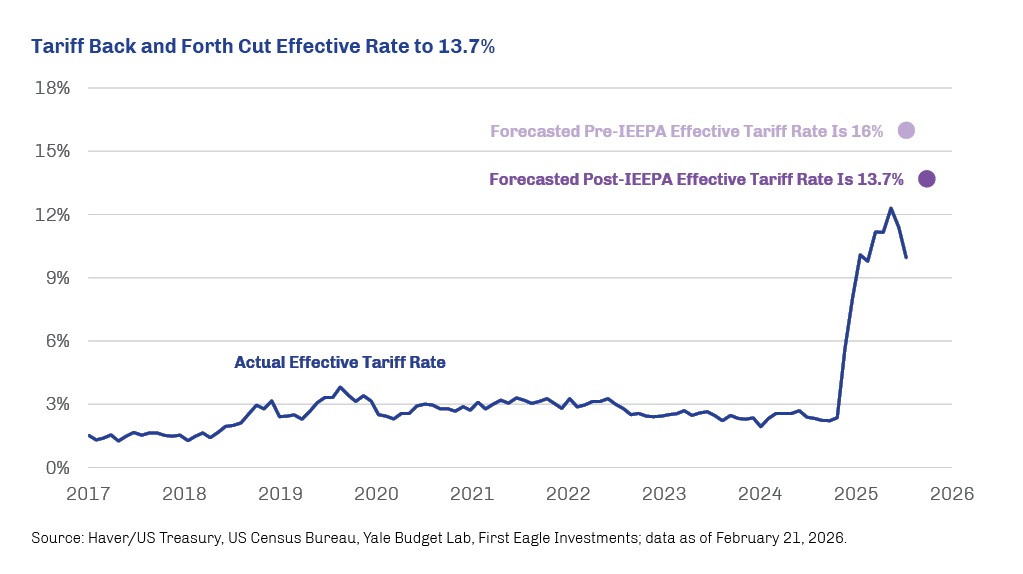
The Supreme Court on Friday ruled 6-3 against the Trump administration’s use of the International Economic Emergency Powers Act (IEEPA) to impose the fentanyl-related and “reciprocal” tariffs announced in the first few months of 2025. As anticipated, Trump was quick to respond to this rebuke, immediately announcing a new 10% global tariff under Section 122 of the Trade Act of 1974, a rate he raised to 15% a day later. The Yale Budget Lab estimates that these actions reduced the effective tariff rate to 13.7% from 16% previously. As of December 2025, the actual tariff rate (based on customs revenues/imports) was 10%.1
Section 122 of the Trade Act of 1974 allows the imposition of tariffs up to 15% for up to 150 days, during which time the Trump administration is expected to seek justification under more permanent statutes. One commonality among the potential alternative statutes is the need for investigations and hearings, which will serve as bottlenecks to implementation. Further, the restrictions inherent in these statutes and the skepticism evident in the Supreme Court’s ruling suggest to us that the future likely holds less tariff revenue and more litigation.
The issue of IEEPA refunds went unaddressed in the Supreme Court decision, but many businesses have already filed lawsuits. We estimate nearly $100 billion of the $195 billion in customs revenue collected in fiscal 2025 could be refunded—slowly, in all likelihood—which implies that last year’s fiscal deficit was 6.2% of GDP as opposed to the reported 5.8%.2
Though tariff uncertainty will persist, the Supreme Court’s ruling is an important reaffirmation that both the rule of law and checks and balances still exist in the US, even if their execution is delayed.