BLOGThe Bird's Eye View
Timely Perspectives, Unconventional Thinking
We’re excited to share timely market insights, thoughtful perspectives and expert commentary as part of our commitment to providing modern investment solutions to modern challenges.
BLOGThe Bird's Eye View
Timely Perspectives, Unconventional Thinking
We’re excited to share timely market insights, thoughtful perspectives and expert commentary as part of our commitment to providing modern investment solutions to modern challenges.

Though credit markets finished a strong 2025 in generally positive fashion, broad market exposure this year continues to offer limited compensation for risk as spreads compressed and volatility remained subdued.
In the face of rising idiosyncratic risk, tight credit spreads across sectors are near five-year lows while base rates below year-ago levels reduce all-in yields for passive exposure. Massive issuance has been met by similarly strong demand, offsetting the widening that might otherwise have occurred.1 A significant component of this demand has come from retail and intermediary investors looking to access inherently less liquid assets through daily liquidity structures including exchange traded funds and mutual funds.
Broad credit market exposure this year continues to offer limited compensation for risk.
In our experience, periods of prolonged valuation compression tend to unwind when underlying structural imbalances are exposed. These repricings can be swift, and are often catalyzed by one or both of the following:
- Asset and liability mismatches—where short-duration capital is invested in longer-dated or less liquid assets—creating forced sellers when liquidity is needed
- Excess leverage applied to assets priced for low default and low volatility, amplifying downside when conditions normalize
With today’s credit market dynamics reinforced by supportive monetary policy and ongoing fiscal spending, we anticipate continued investment outcomes driven not by credit market direction but by selectivity, underwriting discipline and the potential to avoid downside—i.e., alpha over beta.

Our focus on resilient wealth creation is rooted in the notion that capital can be deployed in such a way that it keeps pace with the nominal drift of the economy over time and thus retains its purchasing power. Perhaps counterintuitively to some, we believe the most effective way to fulfill this purpose—far better than what is considered “safe” short-term government securities—is through thoughtful allocations to risk assets.
Our perspective hinges on differentiating between what we describe as “fixed principal” assets and “fixed positional” assets. Treasury bills, for example, are fixed principal assets; the yield paid to investors is fixed, as is the nominal value of the bill at maturity. Considered risk-free due to its explicit US government backing, every T-bill held to maturity has paid its investors exactly what was promised, no more and no less. While such stability has its merits, it also has its drawbacks; as the supply of these assets varies over time with the funding needs of the government, their real, inflation-adjusted value at maturity is unknowable.
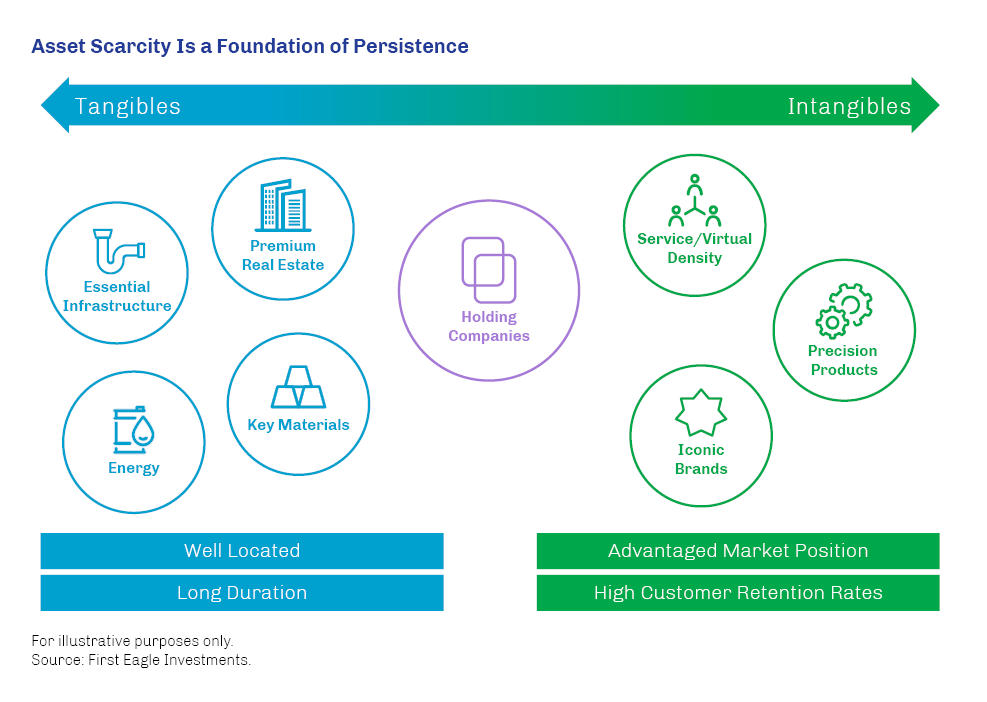
In contrast, equities are examples of fixed positional assets; while their yield is variable or nonexistent and their terminal value is unknown, their relatively fixed supply historically has enabled them to participate in the nominal drift of the economy. As nominal prices have increased alongside the expanding money supply and growing government debt, equity prices have kept pace. We believe this effort hinges on identifying companies that own assets with scarcity value—whether tangible or intangible—that have the potential to provide long-term advantages in profitability and durability.
The relatively fixed supply of equities historically has enabled them to participate in the nominal drift.