BLOGThe Bird's Eye View
Timely Perspectives, Unconventional Thinking
We’re excited to share timely market insights, thoughtful perspectives and expert commentary as part of our commitment to providing modern investment solutions to modern challenges.
BLOGThe Bird's Eye View
Timely Perspectives, Unconventional Thinking
We’re excited to share timely market insights, thoughtful perspectives and expert commentary as part of our commitment to providing modern investment solutions to modern challenges.
August showed the resilience of fixed income markets, as Treasury, corporate and securitized bonds delivered positive returns despite higher rates, persistent inflation concerns and heavy issuance.
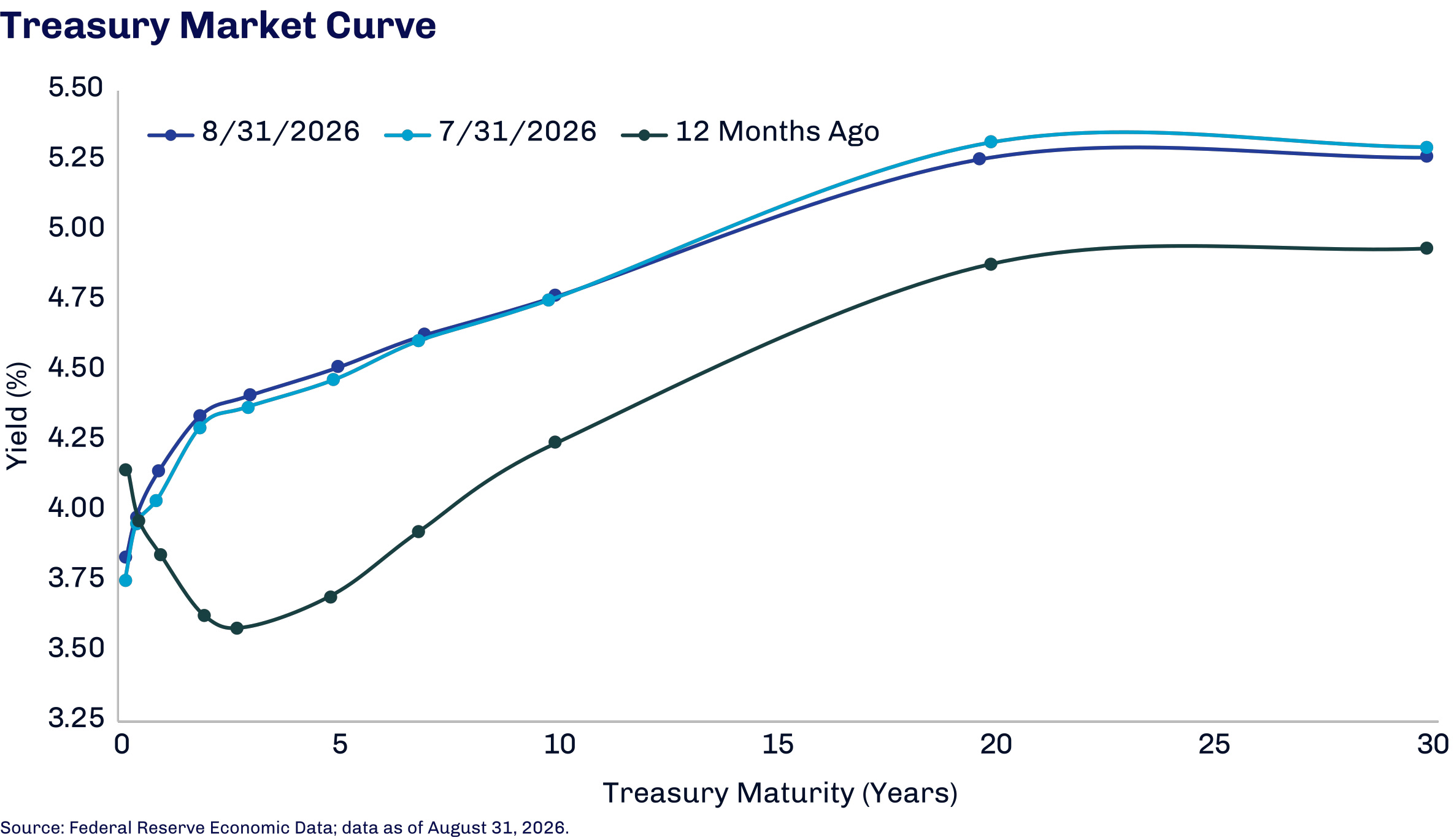
Treasury and rates. Treasury yields generally moved higher as investors confronted US federal debt exceeding $40 trillion, renewed conflict in the Middle East and Fed Chairman Kevin Warsh’s commitment to fighting inflation. Yet higher yields didn’t automatically mean negative returns. Coupon income helped offset price declines, allowing the Treasury Index to return 0.31%. The 30-year Treasury was the standout, returning 0.64%, while the one-year Treasury was the only other tenor to generate a positive price return. Markets also reconsidered the possibility of another rate hike, ending August with futures pricing a 65.1% probability.1
Corporate credit. Investment grade corporate bonds rebounded from their second-worst month of the year, returning 0.43% in August. Spreads tightened to 77.8 basis points, lower than pre-Middle East conflict levels. Supply remained substantial, as investment grade issuance reached an August record of $163 billion, 68% above the four-year August average, bringing year-to-date issuance to $1.5 trillion. High yield markets were strong, gaining 0.97% for its best monthly return in four months.1,2
Securitized. After a challenging July, securitized markets rebounded in August, returning 0.50% overall and outperforming comparable-duration Treasuries. Agency residential mortgage-backed securities (RMBS) returned 0.52%, while shorter-duration asset-backed securities (ABS) gained 0.28% and non-agency commercial mortgage-backed securities (CMBS) returned 0.30%. Delinquency trends were mixed; prime auto delinquencies edged higher, subprime auto dipped and non-agency RMBS remained stable. Issuance slowed in ABS and non-agency RMBS, while non-agency CMBS issuance increased from July.1
Securitized Assets: Looking Beyond the Benchmark

Portfolio Manager

Client Portfolio Manager
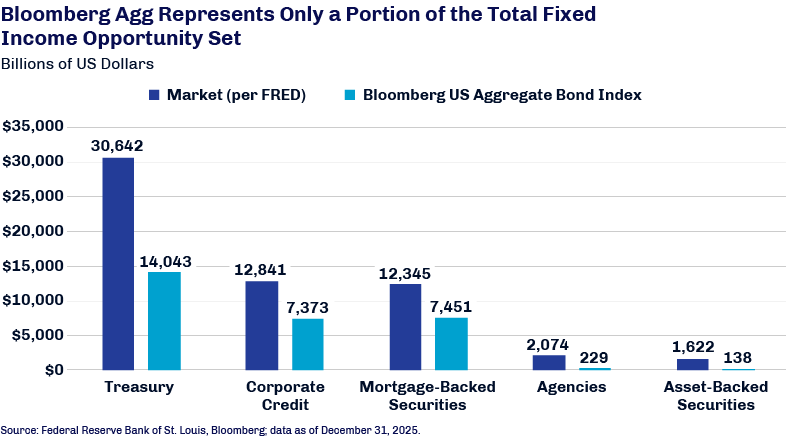
The bond market is bigger than its benchmarks. For active fixed income investors, that gap isn’t merely an interesting statistic—it can expand the opportunity set.
The US core bond universe totaled nearly $60 trillion at year-end 2025,1 while the Bloomberg US Aggregate Bond Index represented $29.2 trillion.2 Index eligibility and liquidity requirements leave meaningful portions of the market outside its boundaries, including mortgage-backed, asset-backed and commercial mortgage-backed securities. For active managers, that creates a broader hunting ground for bottom-up security selection and relative-value opportunities.
Securitized assets also offer a different risk profile than traditional corporate debt. Instead of depending on the financial health of a single company, investors gain exposure to pools of loans backed by consumers, businesses or commercial collateral. Structural credit enhancements can provide additional protection when losses exceed expectations.
Of course, complexity cuts both ways. Simply investing outside a benchmark isn’t an advantage. Understanding collateral, deal structures and how securities may behave under stress requires specialized expertise.
That is where experience matters. Securitized markets have weathered the global financial crisis, European debt crisis, Covid-19 volatility and other periods of stress. Managers who have invested through multiple cycles may be better positioned to distinguish a temporary dislocation from a durable opportunity.
Benchmarks are useful comparison tools, but they aren’t investment road maps. For investors willing to do the work, looking beyond an index’s boundaries can uncover opportunities others may simply never find.