BLOGThe Bird's Eye View
Timely Perspectives, Unconventional Thinking
We’re excited to share timely market insights, thoughtful perspectives and expert commentary as part of our commitment to providing modern investment solutions to modern challenges.
BLOGThe Bird's Eye View
Timely Perspectives, Unconventional Thinking
We’re excited to share timely market insights, thoughtful perspectives and expert commentary as part of our commitment to providing modern investment solutions to modern challenges.
The Tug of War in Gold

Portfolio Manager and Senior Research Analyst

Portfolio Manager and Senior Research Analyst
The price of gold initially rose following the February 28 outbreak of armed hostilities in the Middle East as investors flocked to perceived “safe havens.” However, the metal has subsequently declined—losing nearly 3% from March 2 to March 11—even as other “safe haven” assets, most notably the US dollar, continued to rally.1 History suggests this volatility amid tumultuous conditions is not atypical.
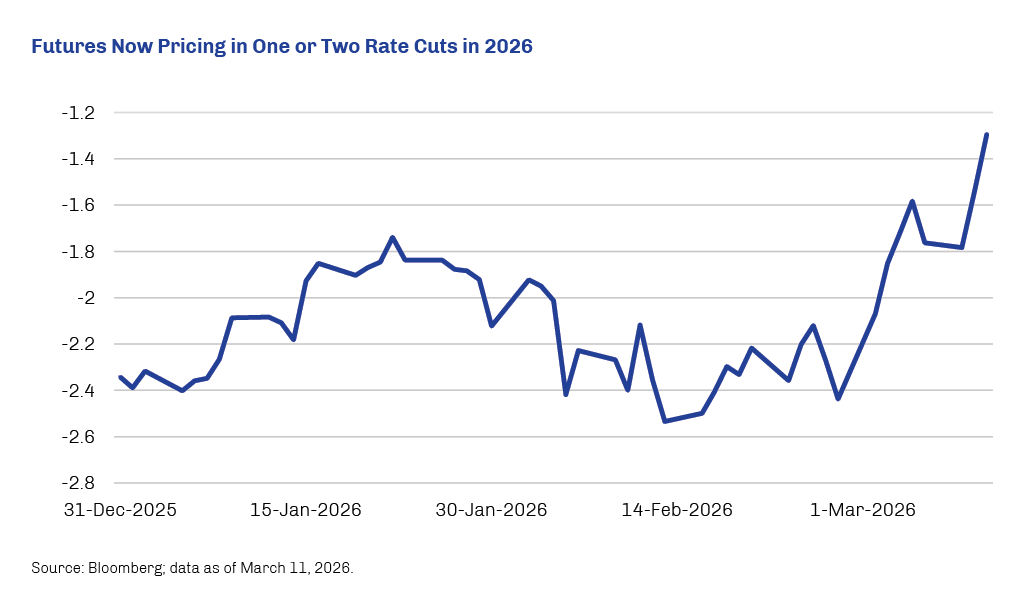
With a near-total shutdown of shipping traffic through the Strait of Hormuz—through which approximately 20% of global oil and liquified natural gas (LNG) passes—Brent crude oil prices spiked to nearly $120 per barrel on March 9, highlighting the potential global inflationary impact of this conflict.2 In response, options markets have reined in their expectations for 2026 federal funds rate cuts, and the resulting higher-for-longer policy rate scenario has pushed real interest rates higher, a classic headwind to the gold price.3 The rebound in the US dollar, an effective unwind of the popular dollar-devaluation trade, has further constrained gold.4
Technical factors also may be adding incremental price pressure. Investors in search of liquidity in the face of market stress often look to an easily salable asset like gold, and its performance of late makes profit taking particularly enticing. Gold has more than doubled in price over the past two years and is still up 20% year to date despite its volatility over the past week-plus.5
While there are multiple factors that could continue to weigh on gold in the near term, we continue to view the potential for recession as the key risk. Even though recessions historically have been positive for gold over the medium to long terms, their onset can be a short-term negative, as we most recently saw during the brief but sharp Covid-related recession in 2020 and the 2008–09 recession associated with the global financial crisis. In both instances, however, gold’s value as a potential hedge against adverse events ultimately reasserted itself after an initial period of price weakness.6
Between a Rock and a Hard Place

Head of Global Value Team and Portfolio Manager
After reaching an all-time high in the first quarter of 2025, the US current account deficit has receded but remains well above its historical average.1 The current account deficit reflects an imbalance between savings and investment in the economy, which by formula must be offset by inflows of foreign capital.
A current account deficit is not necessarily a bad thing; the US has long been a popular destination for foreign investment, bolstered by the dollar’s status as the global reserve currency. That said, a large current account deficit can complicate efforts to remediate the country’s very large fiscal deficit.
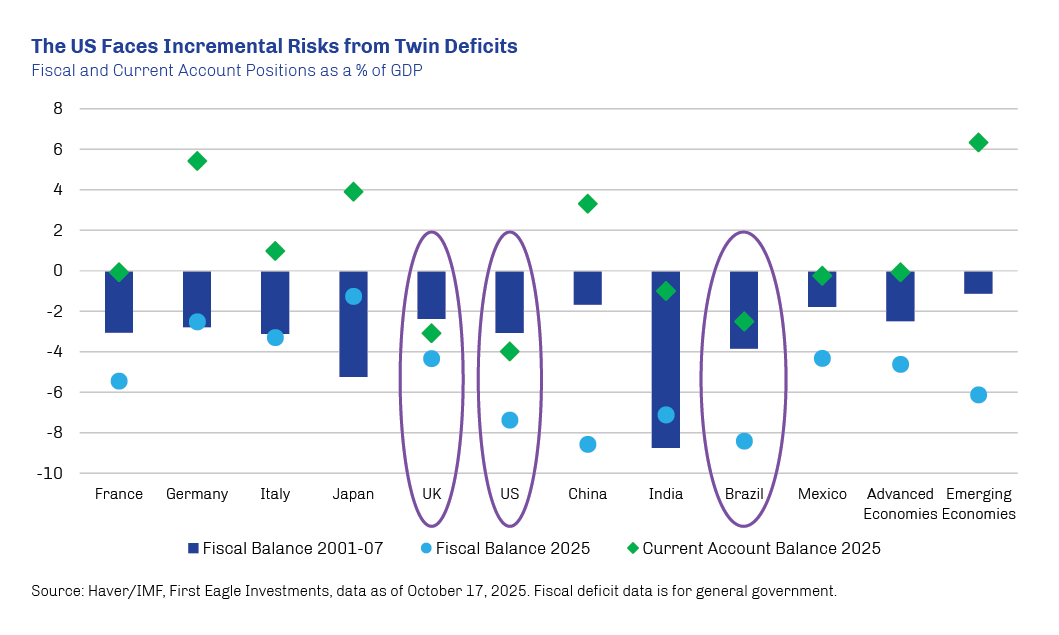
The US is among only a few key economies facing twin deficits—alongside the UK and Brazil—and this combination represents an incremental risk that most others do not bear.2 Twin deficits are nothing new for the US, which has run them consistently since the early 1980s with only a few exceptions, the most recent being 2001.3 More often than not, the fiscal deficit has been larger as a percentage of gross domestic product than the current account deficit.4 Much-needed efforts to consolidate fiscal policy have the potential to destabilize and bleed into the private sector, impacting free cash flow, causing corporate credit issues and increasing the risk of recession.5