
BLOGThe Bird's Eye View
Timely Perspectives, Unconventional Thinking
We’re excited to share timely market insights, thoughtful perspectives and expert commentary as part of our commitment to providing modern investment solutions to modern challenges.
BLOGThe Bird's Eye View
Timely Perspectives, Unconventional Thinking
We’re excited to share timely market insights, thoughtful perspectives and expert commentary as part of our commitment to providing modern investment solutions to modern challenges.
A Supply Path to Energy Security

Portfolio Manager and Senior Research Analyst

Portfolio Manager and Senior Research Analyst
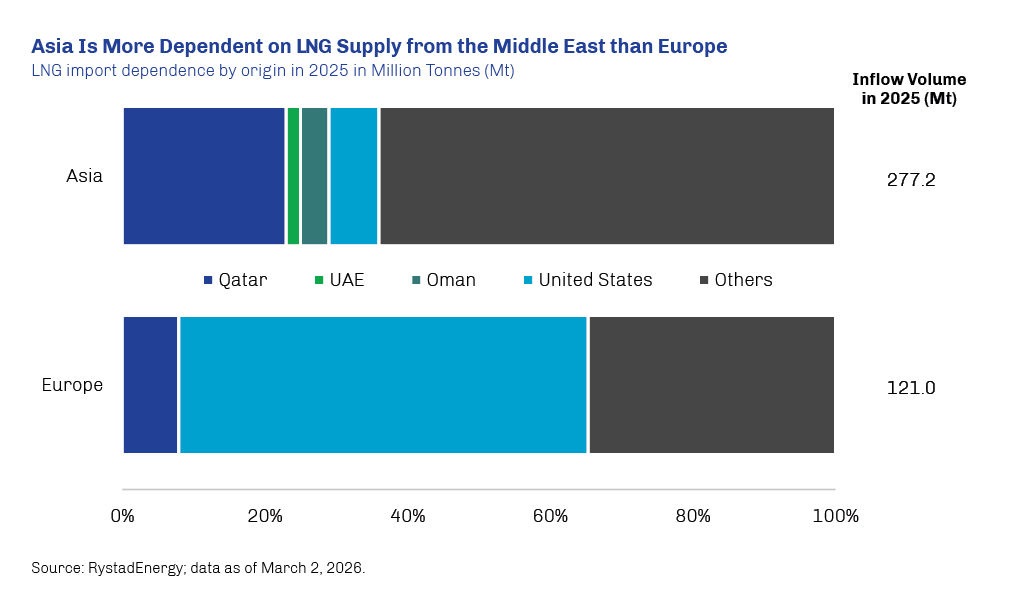
Recent tensions in the Middle East reinforce how energy security is paramount to both governments and investors. Roughly 20% of global oil and liquified natural gas (LNG) supply passes through the Strait of Hormuz, making it one of the world’s most important energy chokepoints, most notably for supply to Asia.1 Without any large-scale pipeline alternatives, short-lived disruptions—whether from physical damage, shipping delays or insurance withdrawals—can quickly tighten markets and push prices higher.
LNG is particularly sensitive to these bottlenecks because a significant share of global supply originates in the Gulf region.2 LNG plays a growing role in power generation, industrial activity and heating. When transit through the strait is constrained, it can quickly impact global gas markets, tightening availability and increasing volatility for import-dependent economies.
Energy exposure can potentially serve as both opportunity and ballast. When geopolitical tensions rise, oil and LNG prices often reprice quickly, supporting the earnings and cash flow of well-positioned producers. Energy revenues tend to move with inflation, helping offset pressure in more rate-sensitive sectors.3 We believe real assets companies—particularly those with proven reserves, long-term contracts and physical infrastructure—can provide resilience when financial assets are under stress during periods of macro uncertainty.
Within the energy sector, we focus on supply dynamics, not demand drivers, because reliable supplies of energy are critical to the proper functioning of economies. Increasing energy supply is capital intensive, politically influenced and spans multi-year periods. As a result, effective spare capacity is limited relative to total global demand, and infrastructure bottlenecks—pipelines, export terminals and shipping lanes—can quickly become binding constraints.
Accordingly, we favor select energy companies and service providers that control scarce, long-lived assets in stable jurisdictions, operate with low costs and maintain strong balance sheets. These characteristics position them to potentially benefit when prices strengthen, while providing potential durability if conditions normalize. In our view, that combination—the ability to withstand disruption and potentially benefit from long-term volatility—makes energy a resilient component of a diversified portfolio.

After weeks of pressuring Tehran for a new nuclear deal while simultaneously amassing American firepower in the region, the US on the morning of February 28 (local time) launched Operation Epic Fury in conjunction with Israel, targeting Iranian leadership and military targets across the country. In response, Iran has attacked US military bases throughout the Gulf as well as the region’s economic and energy hubs.
The reaction of financial markets to the outbreak of war has been fairly measured and predictable, with oil and gas prices moving higher alongside perceived safe-haven assets like gold and the US dollar. Treasury yields and inflation break-evens rose, suggesting the market is more concerned about the inflationary impact of the attack on Iran than the potential hit to growth. While global equities markets opened sharply lower on Monday morning, many traced back the worst of their declines; the S&P 500 Index, for example, was flattish by noon eastern. Oil majors and defense and aerospace names largely advanced, while airlines and cruise operators were among the industries most negatively impacted.1
From a macroeconomic perspective, the war’s impact on global energy supplies is of primary concern. A sustained surge in energy prices could reignite inflation pressures, derailing central bank plans to cut interest rates and weighing on economic activity globally. European natural gas prices have soared since an Iranian attack prompted closure of Qatar’s main liquified natural gas refinery. While Iran accounts for less than 3% of global oil supply, it could disrupt traffic through the Strait of Hormuz, a narrow waterway connecting the production centers of the Persian Gulf with the Arabian Sea through which about one-fifth of the world’s oil supplies travel.2
From a macroeconomic perspective, the war’s impact on global energy supplies is of primary concern.
Shipping traffic through the Strait of Hormuz has already shuddered to a halt over the past few days, as insurers will not underwrite the journey given the increased risk. A prolonged disruption to traffic could provoke a sharper oil price increase with serious implications for global economic activity, particularly in China and the other Asian markets to which the bulk of the oil traveling through the strait is destined.3 OPEC+ agreed to increase output by 206,000 barrels per day starting in April, but many of the cartel’s key production centers—Saudi Arabia being one notable exception—are largely dependent on the Strait of Hormuz for export, suggesting that the additional supply could bring little relief in the case of extended shipping disruptions.
Though the potential duration of active hostilities between the US/Israel and Iran remains unclear at this point, normalcy appears unlikely in short order. The leadership vacuum created by the killing of Iran’s Supreme Leader Ayatollah Ali Khamenei widens the range of potential outcomes to the conflict and the likelihood of ongoing volatility in markets. Geopolitics were among the potential fat-tail investment risks on our radar entering 2026, and we believe the recent escalation of tensions in the Middle East highlights the importance of resilient portfolio construction.