BLOGThe Bird's Eye View
Timely Perspectives, Unconventional Thinking
We’re excited to share timely market insights, thoughtful perspectives and expert commentary as part of our commitment to providing modern investment solutions to modern challenges.
BLOGThe Bird's Eye View
Timely Perspectives, Unconventional Thinking
We’re excited to share timely market insights, thoughtful perspectives and expert commentary as part of our commitment to providing modern investment solutions to modern challenges.
A Hawkish Hold in the Face of Uncertainty

Portfolio Manager and Senior Research Analyst
The Federal Reserve held its policy rate steady at 3.5-3.75% following its March 18 meeting. The new dot plot of fed funds rate forecasts was unchanged from December’s, with a median expectation of one rate cut in 2026 and one in 2027. However, seven of the 19 participants did not see the need for a cut this year as tariff and energy shocks pressure the central bank’s dual mandate from both sides.1
Not surprisingly given the subsequent outbreak of war in the Middle East, the Federal Open Market Committee (FOMC) participants’ uncertainty about their economic projections increased sharply since December’s board meeting, with risks to gross domestic product (GDP) growth weighted to the downside and risks to inflation and the unemployment rate weighted to the upside.
Given the outbreak of war in the Middle East, uncertainty about economic projections has increased sharply.
The median forecast for both headline and core PCE inflation rose, while labor market projections were basically unchanged through the forecast horizon. Fed Chair Powell indicated it’s still too early to judge the potential impact of the war on inflation and the labor market, as it will depend largely on the severity and duration of the oil price shock. He instead spent most of his press conference discussing the impact of tariffs, which the Fed staff estimates is adding 0.5-0.75% to 3% core personal consumption expenditure (PCE) inflation, though he expects this to fade once lapped this summer.2
The committee increased its forecasts for real GDP growth through 2028. It also bumped up its estimate of potential economic growth to 2%, which Powell attributed to improved productivity growth but noted it was too early to attribute it to artificial intelligence (AI). The median estimate of the longer run neutral policy rate increased to 3.1% from 3.0%.3
In response to Powell’s remarks, the market shifted its expectation of the next interest rate cut to mid-2027 from December 2026. This reaction seems excessive to me. A short-lived oil shock could potentially open up space for a cut in the fourth quarter under the next chair, while a more severe shock—especially one that tightened financial conditions—could actually lead to more rate cuts if accompanied by a weaker labor market.4
The US dollar has long been perceived as a “safe haven” asset during periods of discord; true to form, the greenback has rallied since the onset of war in Iran. Making a structural case in favor of the dollar is more challenging, however.
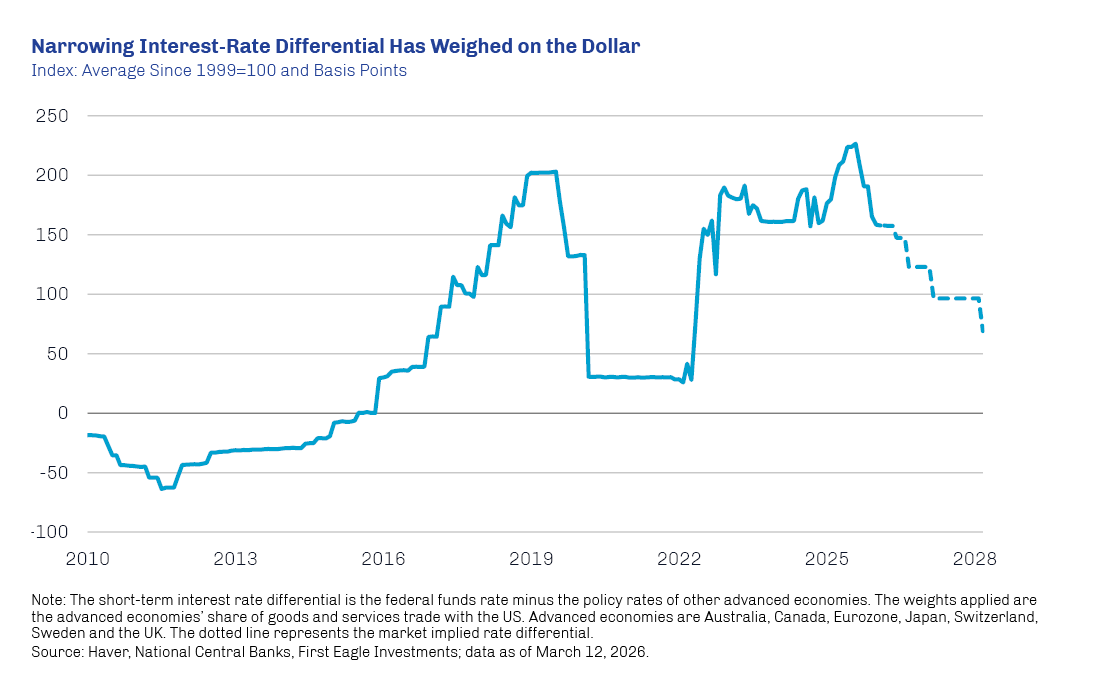
Though the dollar has fallen 10% since the start of 2025 after a long period of strength, we’re open to the possibility that we may be in only the early stages of a weak-dollar period once geopolitical conditions normalize. The dollar remains about 15% above its long run average, and there are a number of dynamics that suggest continued reversion to the mean is possible.1
On the policy side, cuts to the federal funds rate have compressed interest-rate differentials and pressured the dollar. At the same time, a US fiscal deficit that is historically outsized relative to unemployment and for which political will to consolidate is lacking may promote structurally higher inflation and debasement of the currency.2
Meanwhile, dollar support from foreign investment in the US may wane as rich US equity market valuations, US overweights in foreigners’ portfolios, and increasing US-centric risk encourage repatriation or smaller investment flows into the US. At the same time, lower interest rate differentials make hedging US dollar risk cheaper, potentially encouraging more hedging and weighing on the dollar. These same factors may prompt domestic US investors to increase foreign allocations in pursuit of more attractive opportunities in markets abroad. Notably, international markets historically have tended to outperform during periods of dollar weakness; to wit, the MSCI World ex USA Index returned 32.6% in 2025 compared to the 17.9% gain of the S&P 500 Index.3
Geopolitical tensions and the potential for financial weaponization have also called into question international reliance on the dollar. For example, freezing Russia’s access to dollar-denominated reserves following its invasion of Ukraine in 2022 appeared to trigger a shift in central banks’ appetites toward more politically neutral assets. Having averaged around 470 tonnes per year from 2010 to 2021, central bank gold purchases averaged more than 1,000 tonnes per year from 2022 to 2025, and gold holdings now exceed Treasuries as a share of foreign reserves for the first time in 30 years.4