BLOGThe Bird's Eye View
Timely Perspectives, Unconventional Thinking
We’re excited to share timely market insights, thoughtful perspectives and expert commentary as part of our commitment to providing modern investment solutions to modern challenges.
BLOGThe Bird's Eye View
Timely Perspectives, Unconventional Thinking
We’re excited to share timely market insights, thoughtful perspectives and expert commentary as part of our commitment to providing modern investment solutions to modern challenges.
Beyond the Battery

Portfolio Manager and Senior Research Analyst

Portfolio Manager and Senior Research Analyst
The electric vehicle (EV) transition is often framed as a technology story because electric drivetrains are inherently more efficient. They convert most input electricity into motion, while combustion engines lose much of their fuel energy as waste heat. That efficiency edge, in theory, makes electrification a breakthrough for light transportation and supports a potential multi-decade shift in mobility.
Scaling this EV shift isn’t only about innovation, government policy or consumer preferences. Although these factors influence adoption rates, we think it’s primarily rooted in building the necessary physical systems at scale—powered by energy, constrained by materials, and enabled or delayed by infrastructure.
First, energy still matters because EVs don’t eliminate energy demand—they redirect it toward electricity and grid flexibility. Meanwhile, oil and gas remain essential in hard-to-electrify transportation segments such as heavy freight, aviation and marine, and they underpin the industrial activity, such as mining, refining, chemicals and manufacturing, required to build the transition itself.
Second, materials set the pace. EVs and grids are metals- and chemicals-intensive, and supply chains expand slowly. The binding constraints are often upstream—mining, refining, processing and manufacturing capacity—built over decades, not quarters. That’s why “picks and shovels” can matter as much as the end-product brands.
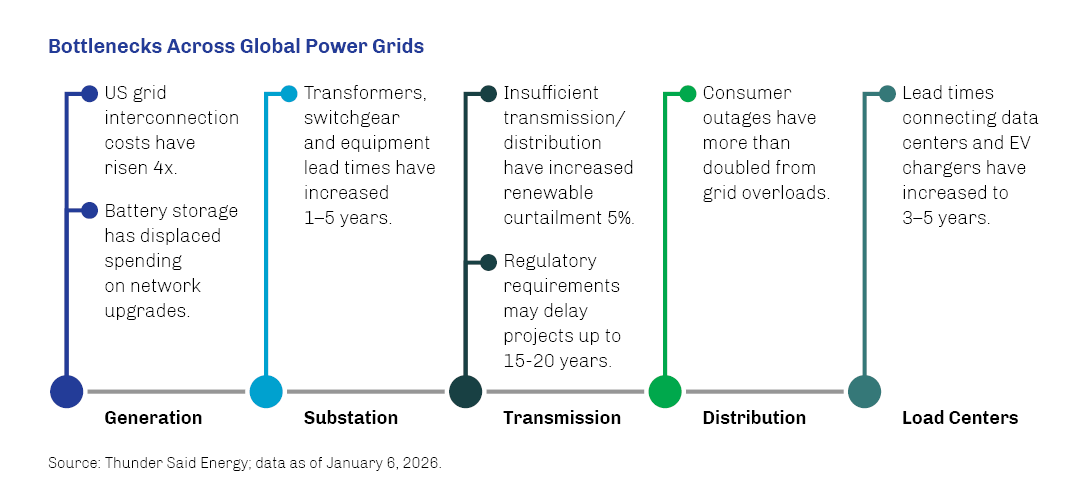
Third, infrastructure is the bottleneck. Electrification scales not only through generation but through the grid—transmission, substations, transformers, distribution upgrades, interconnections and charging. The hardest challenges are local and practical: urban constraints, permitting, labor and reliability, plus grid hardware and control systems to keep power stable as load electrifies.
While rising oil prices may reinvigorate short-term consumer interest in EVs, we believe this revolution is fundamentally a real assets buildout story. In our view, greater EV adoption will require significant capital formation in infrastructure, advantaged materials and processing, and grid equipment to increase capacity and ensure reliability. In our view, companies who are essential enablers of this buildout with scarce, advantaged assets are well-positioned to participate in this multi-decade investment cycle.

Over the last several years, a handful of mega-cap technology companies, widely known as the “Magnificent 7” or “Mag 7,” have carried the weight of equity market returns. In the US, the Mag 7 accounted for roughly 63% of S&P 500 Index returns in 2023 and 55% in 2024, underscoring how concentrated market leadership had become. However, more recently, that concentration has started to ease, with share of returns falling to roughly 43% in 2025 as performance broadened beyond the small handful of names.1
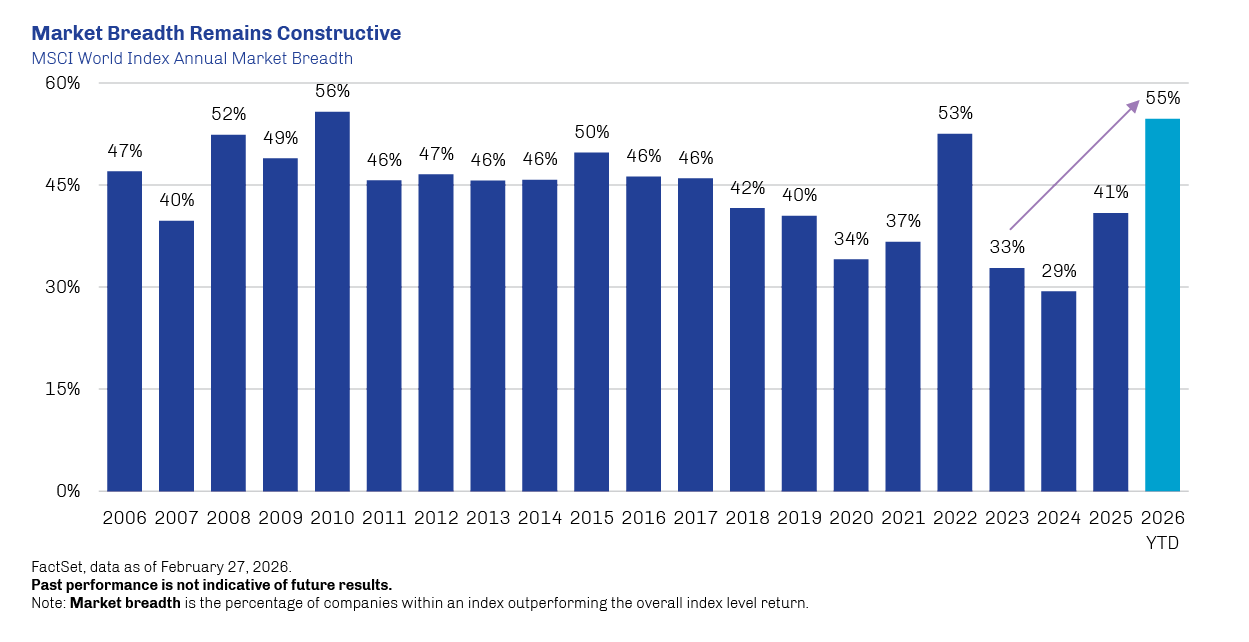
This shift in market leadership has also been seen in global equity markets. Within the MSCI World Index, the percentage of companies outperforming the overall index return rose to 61% year to date in 2026, a notable improvement from 29% in 2024 and 41% in 2025.2 This increase suggests market participation is becoming healthier and more balanced, with gains being supported by a much wider range of companies rather than concentrated in a narrow leadership group.
A supportive macro backdrop may also be driving broader market participation. Possible key factors include earnings growth expectations widening beyond the handful of megacap names, a weaker US dollar and relatively more attractive valuations seen outside the US supporting international equities.3 This shift may be creating a more balanced environment, one in which stock selection could matter more than having exposure to a handful of dominant names.
As more companies and sectors contribute to earnings growth and market leadership, we believe the opportunity set for active, selective investors has become much more favorable, particularly for investors focused on identifying durable, quality businesses beyond the famous Mag 7. Selective investors may also be better positioned to uncover differentiated businesses that may have been overlooked during the periods of narrow market leadership.