BLOGThe Bird's Eye View
Timely Perspectives, Unconventional Thinking
We’re excited to share timely market insights, thoughtful perspectives and expert commentary as part of our commitment to providing modern investment solutions to modern challenges.
BLOGThe Bird's Eye View
Timely Perspectives, Unconventional Thinking
We’re excited to share timely market insights, thoughtful perspectives and expert commentary as part of our commitment to providing modern investment solutions to modern challenges.
The Overlooked Risk in the Strait of Hormuz

Portfolio Manager and Senior Research Analyst
Geopolitical shocks in the Middle East are typically viewed through the lens of oil and gas, but this may overlook a more important consequence: agriculture. Global food production depends on a tightly interconnected chain of energy, fertilizer and crops. The Strait of Hormuz sits at the center, with roughly one-third of global seaborne fertilizer trade.1 When that flow is disrupted, its impact extends well beyond energy prices and into food supply.
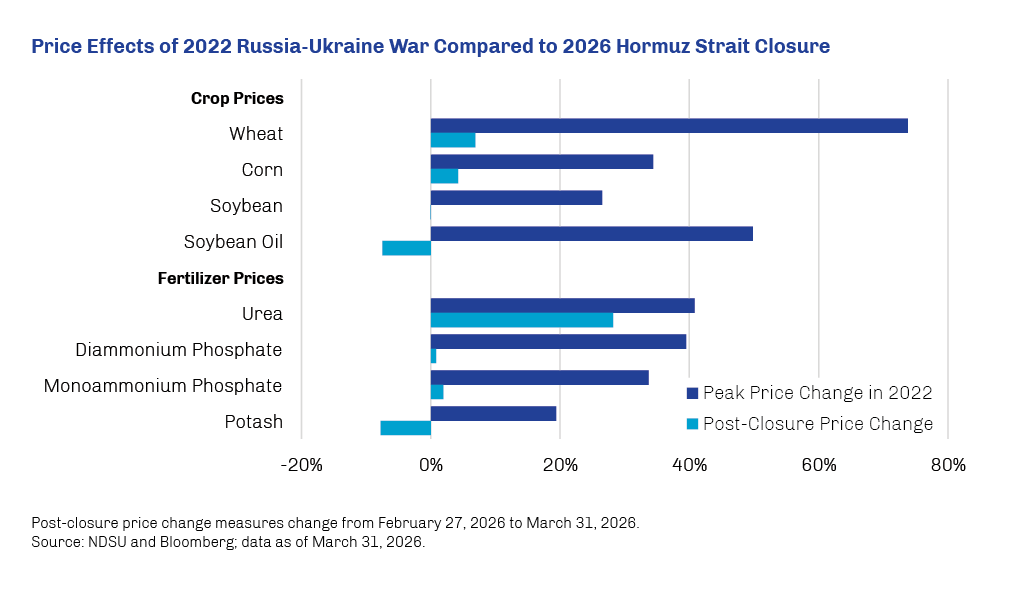
We have already begun to see early signs of strain in the fertilizer market with a sharp rise in nitrogen prices.2 While this does not yet resemble the broad-based disruption that followed Russia’s invasion of Ukraine in 2022, such shocks tend to build over time as supply chains tighten and buyers secure inventory.3 The risk extends beyond export disruptions because Gulf producers are critical suppliers of nitrogen, phosphates and sulfur—key inputs in global fertilizer production. When those flows are constrained, production capacity tightens across regions, potentially turning localized disruptions into a global agricultural issue.
Against this backdrop, we believe North America is more resilient than most regions. The US benefits from domestic natural gas, strong nitrogen production and secure potash supply from Canada.4 However, the region is not immune to global fertilizer dynamics, and even partial disruptions can raise domestic input costs, particularly during the spring planting season.
As a result, even small cost increases can influence farmer behavior, affecting application rates, margins and ultimately crop yields. North America plays a critical role within this fragile system because its scale, productivity and relative security of inputs position the region as a stabilizing force in the global food supply when other regions face constraints. In our view, this underscores the role that reliable agricultural producers and equipment manufacturers that support producers—such as those in the US and Canada—play in resilient portfolios as geopolitical risks continue to escalate.

Following a five-year period of large cap dominance, small caps appear to be amid a resurgence, with a year-to-date return of 0.7% in the Russell 2000 Index compared to a decline of 5.1% for the S&P 500 Index.1 While small caps have not been immune to the recent volatility caused by the outbreak of war in the Middle East, we believe this nascent revival may have durable support from a sustained acceleration in earnings.
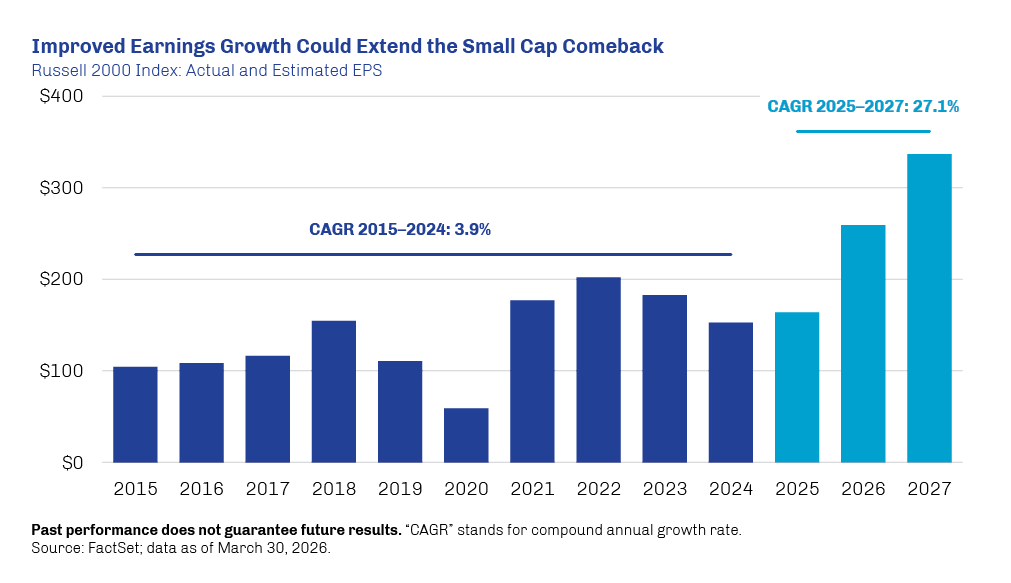
Small cap earnings growth is expected to accelerate to an annual rate of 27.1% over the next three years following nine years of 3.9% annualized earnings growth, as shown in the chart below.2 Such earnings would be supportive of improved small cap performance even without multiple expansion; meanwhile, with the Russell 2000’s forward P/E of 18.0x well below the S&P 500’s 21.8x, valuations provide a favorable risk-reward backdrop for small caps.3
In the face of a prolonged oil shock, we note that inflationary periods historically have not been a death knell for small caps.4 Smaller companies typically have a much larger domestic revenue base, and the US economy is less sensitive to global oil shocks compared to economies that are reliant upon energy imports.
Amid such fertile grounds, we believe it’s vital to distinguish between companies that are cheap for a reason from those with solid businesses and catalysts for improvement.