


BLOGThe Bird's Eye View
Timely Perspectives, Unconventional Thinking
We’re excited to share timely market insights, thoughtful perspectives and expert commentary as part of our commitment to providing modern investment solutions to modern challenges.
BLOGThe Bird's Eye View
Timely Perspectives, Unconventional Thinking
We’re excited to share timely market insights, thoughtful perspectives and expert commentary as part of our commitment to providing modern investment solutions to modern challenges.
Is Energy Volatility the New Normal?

Portfolio Manager and Senior Research Analyst
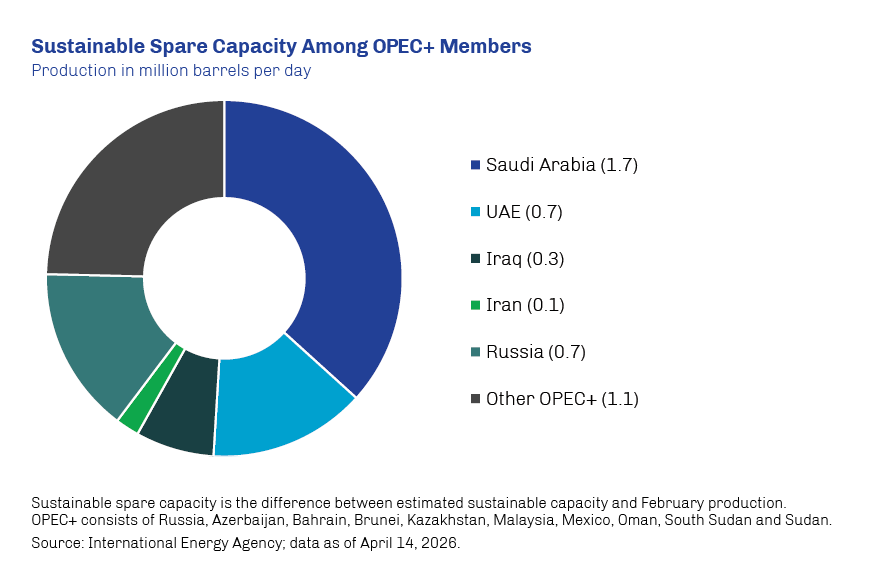
The recent announcement from the United Arab Emirates (UAE) that it will exit the Organization of Petroleum Exporting Countries (OPEC) on May 1 highlights the growing supply vulnerability and persistent volatility of the global oil market.
Founded in 1960 by Iran, Iraq, Kuwait, Saudi Arabia and Venezuela, OPEC was created to coordinate production and manage global oil prices. Driven by strategic national interests and a desire to increase production, the UAE’s departure will reduce the cartel’s ability to steady the global oil market, in our view. In addition to having meaningful spare production capacity, the UAE is also able to reroute oil transportation through the Abu Dhabi Crude Oil Pipeline directly to the Port of Fujairah on the Gulf of Oman, thereby bypassing the blockages at the Strait of Hormuz.1
We believe this latest development is a reminder why oil, the world’s most consumed commodity, has value as a potential geopolitical hedge and why energy security is paramount to government interest as geopolitical tensions escalate.2 The recent string of geopolitical shocks shows that volatility is not just a short-term event risk. With numerous geopolitical conflicts since the formation of OPEC, we think ongoing disruptions—such as attacks on infrastructure and disrupted transportation routes—are likely to persist. This ongoing risk reinforces the critical importance of reliable and secure sources of energy. While not immune to the impact of global oil prices, we believe recent events highlight the value of energy production in the US and Canada, which are linked by dozens of pipelines and transportation routes.
Within the energy sector, we continue to favor global integrated energy companies and service businesses that operate across stable jurisdictions and have the logistics scale to keep product moving when trade routes are disrupted. In our view, these companies are better positioned to maintain production and distribution in an increasingly uncertain landscape.
MMDL Spreads Widen Amid Slower Volume

Senior Managing Director and Chief Investment Officer of Direct Lending, Napier Park Global Capital
Activity in the middle market direct lending (MMDL) space during the first quarter was reminiscent of second quarter 2025, only with artificial intelligence and the war with Iran replacing tariffs as the primary headwinds to issuance.
After a record 2025, first quarter new issuance of $61 billion represented a 14% year-over-year decline. While dividend recapitalizations and refinancings were markedly lower during the quarter across deal sizes, financing to support M&A rose to its highest share of overall deal count since fourth quarter 2023. While volume in the lower middle market also slowed, its share of overall M&A activity by deal count fell to its lowest level since third quarter 2024.1
Many of 2025’s borrower-friendly trends showed signs of improvement in first quarter 2026. New-issue spreads widened across all deal sizes, with spreads for larger deals moving the most. Though spreads for lower middle market deals—borrowers whose earnings before interest, taxes, depreciation and appreciation are in the $5–25 million range—widened by only two basis points, we believe sustained widening in the large cap market may likely trickle down into smaller markets over time. Meanwhile, spread per turn of leverage among lower middle market loans ended the quarter at its widest level since August 2024 and maintained an attractive premium to larger deals.2
Many of 2025’s borrower-friendly trends showed signs of improvement in first quarter 2026.
We continue to believe that direct lending in the lower middle market can provide lenders and their investors an attractive combination of yield, leverage and structure.