BLOGThe Bird's Eye View
Timely Perspectives, Unconventional Thinking
We’re excited to share timely market insights, thoughtful perspectives and expert commentary as part of our commitment to providing modern investment solutions to modern challenges.
BLOGThe Bird's Eye View
Timely Perspectives, Unconventional Thinking
We’re excited to share timely market insights, thoughtful perspectives and expert commentary as part of our commitment to providing modern investment solutions to modern challenges.
Housing Desirability Remains Durable

Senior Managing Director, Head of US Real Estate and Consumer Debt Strategies, Napier Park Global Capital
After falling steadily for most of the past 12 months, mortgage rates rebounded with the outbreak of the Iran war, sending the spring homebuying season off to a sluggish start. Though it slipped below 6% toward the end of February, the rate on 30-year fixed-rate mortgages ended the quarter at 6.47%, and this uptick combined with economic uncertainty appears to have weighed on housing market activity thus far in 2026.1
Despite the short-term ebb and flow of the housing market, we believe that secular tailwinds—such as undersupply of housing in the US and the ongoing need for capital to refurbish existing homes and to develop lots for new homes—remain intact. Housing market dynamics combined with the retreat of traditional banks from construction lending, in our view, have created a supportive backdrop for nonbank providers of capital to the real estate industry. This includes capital to finance residential transitional loans (RTLs)—short-duration, value-add renovation loans—and builder financing transactions—off-balance-sheet financing provided to homebuilders for the acquisition and development of entitled and permitted land.
In our view, housing market dynamics have created a supportive backdrop for nonbank providers of capital to the real estate industry.
Notably, RTLs are backed by hard assets whose values are transparent and subject to frequent validation through the sale of similar properties, limiting the potential for an abrupt markdown by lenders. We see significant opportunity to lend capital to experienced developers that can renovate homes within existing communities with desirable characteristics like top school districts, walkability and proximity to jobs, with a focus on markets that exhibit stronger-than-average household incomes, population growth and housing supply constraints relative to the broader US—attributes that, in our view, support more resilient demand and home values. We believe this reinforces the importance of distinguishing between the national “housing market” and a more localized “market of homes.”
Record Issuance Meets Resilience

Head and Chief Investment Officer of Municipal Credit Team
During the first quarter, municipal issuance set another new record with $119 billion in tax-exempt bonds and $128 billion overall.1 In the face of complicated and rapidly evolving dynamics that included the outbreak of war, spiking energy prices, renewed inflation concerns, whipsawing policy expectations and acute Treasury volatility, we were impressed by the municipal market’s ability to absorb significant issuance; in our view, it is a testament to steady investor interest in the asset class and the appealing yields on offer.
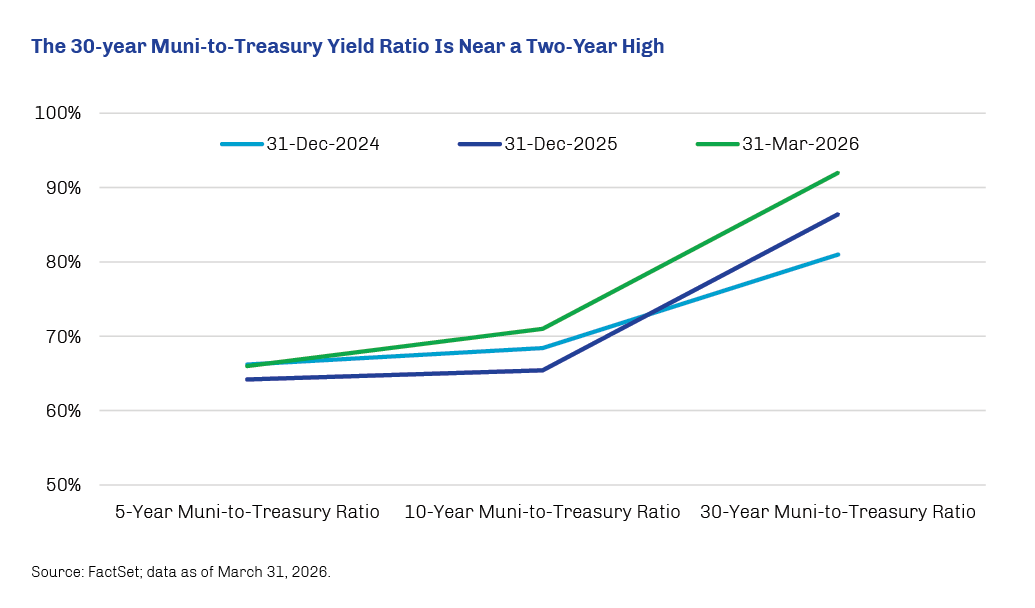
Municipal bond yields mostly followed the trend of Treasuries during the first quarter, easing across the curve early in the year before rising sharply in March as a shock to the global energy supply chain brought on by the war with Iran sent energy prices sharply higher and raised concerns about renewed inflation. The end result was a bear steepening of the muni curve in which longer-term yields increased more than short-term yields, and, as shown in the chart below, the 30-year municipal-to-Treasury yield ratio increased to a nearly two-year high.2
Meanwhile, issuer fundamentals continue to be supportive, as state budgets for fiscal 2026 overall reflect a healthy environment, general fund balances remain well above the historical average,3 and pension funding continued to improve.4 These dynamics have supported muni bond ratings activity, which has remained positive even as the ratio of upgrades to downgrades continued to moderate.5 Both defaults and first-time distressed debt remained very low in the first quarter.6