


Macro & Market Views
Trade War 2.0
Trade War 2.0
Donald Trump campaigned on promises to introduce tariffs on imports from friends and foes alike; less than two weeks into his presidency, he launched the first salvo in what is shaping up to be a new trade war.
On February 1, the White House announced new tariffs on imports from its three top trading partners, Canada, Mexico and China, effective February 4. (Note that as we go to press there are reports that Trump has agreed to delay the implementation of tariffs on Mexico for one month.) Below, we provide the key takeaways from the announcement and our initial thoughts about the potential impact. In short, we believe tariffs of this magnitude on the country’s largest trading partners are likely to raise US consumer prices, lower US GDP growth and strengthen the dollar while increasing uncertainty and weighing on risk appetites globally.
As of writing before US trading opens on February 3, global equites were broadly lower, with notable weakness among automakers, while futures indicated a lower opening for US stocks. The dollar strengthened against a range of currencies, including the Canadian dollar, Mexican peso, euro and Chinese yuan. The US Treasury yield curve flattened, as investors sought a perceived safe haven in longer government paper. Safe-haven buying also drove the gold price to new nominal highs, while major cryptocurrencies were down sharply. Oil prices were higher, as was the CBOE Volatility Index.1
New Tariffs, New Uncertainties
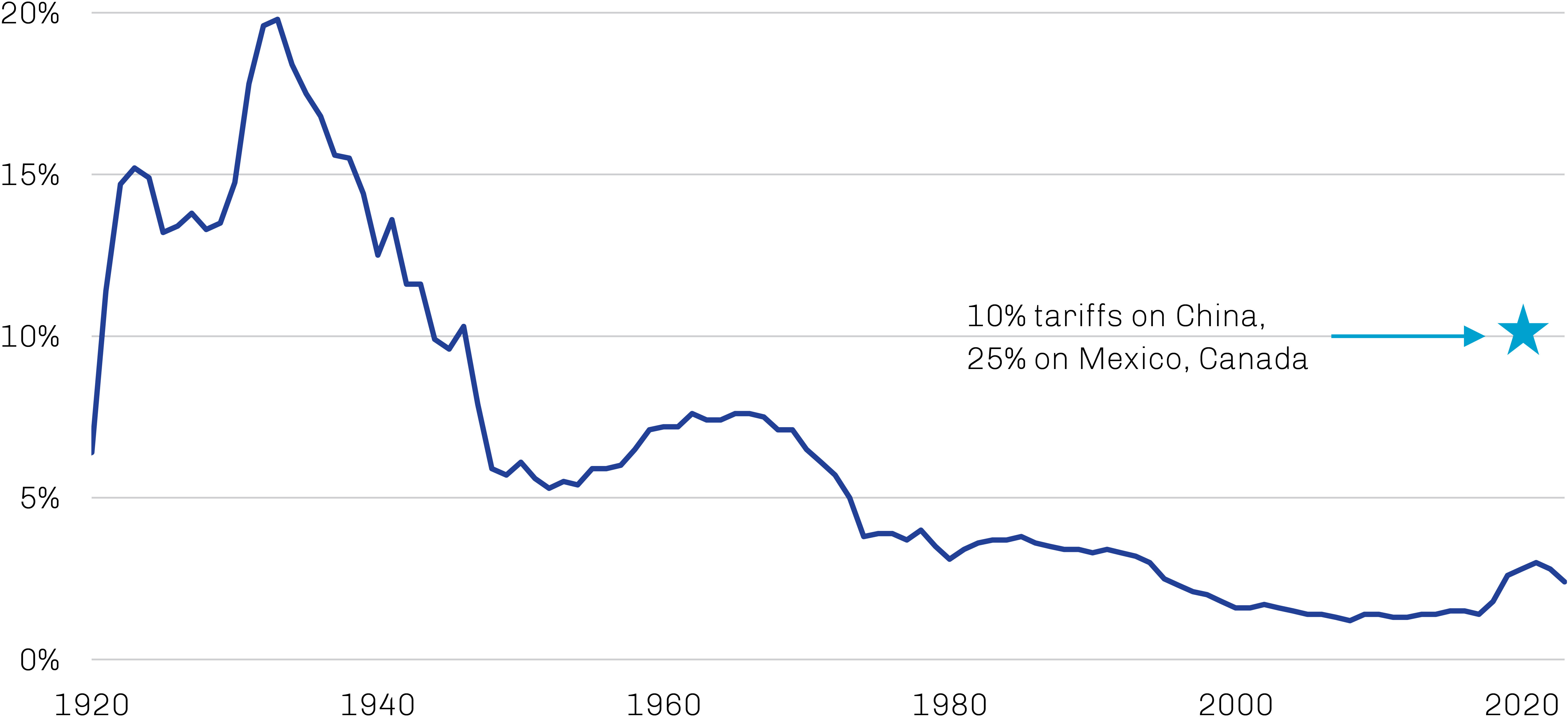
On February 1, the White House announced new tariffs on imports from Canada, Mexico and China, its three top trading partners who in aggregate accounted for more than 40% of US imports during the first 11 months of 2024.2 The tariffs included 25% on neighbors Canada and Mexico—except for Canadian energy products, which face a 10% tariff—and an additional 10% on top of already-existing levies against China. No carve outs have been included in the initial plan, and the action also removed the de minimis exemption for shipments into the US under $800, which have surged in recent years, especially from China.3 The new tariffs bring the effective US tariff rate to about 10%, a level not seen since the 1940s, as shown in Exhibit 1.
Exhibit 1. Latest Action Brings Effective Tariff Rate to 1940s Levels
US Total Effective Tariff Rate, 1920 to 2023
Source: US International Trade Commission, Evercore, First Eagle Investments; data as of February 3, 2025.
The tariffs were implemented under the International Emergency Economic Powers Act (IEEPA), which grants the president authority to impose tariffs in a response to a national emergency for 120 days, after which they can be extended. The White House cited the “extraordinary threat posed by illegal aliens and drugs” as the requisite national emergency.4 The decision came despite officials from both Canada and Mexico recently stepping up dialogue with their US counterparts on the issues of fentanyl smuggling and illegal immigration while also taking additional actions to secure the north and south US borders.5 It’s unclear what the countries need to do to force a reconsideration of the tariffs; a White House official said the best metric would be that Americans “stop dying from made-in-China, distributed-by-Mexico-and-Canada fentanyl,” but offered no concrete benchmarks for measuring success.6 To us, the uncertainty surrounding the duration of the new tariff framework represents a significant risk.
Canada was the first country to respond with specific retaliatory plans, quickly announcing 25% tariffs on imports from the US to be introduced in two waves. The first wave, to take effect on February 4, impacts $20 billion in goods including alcohol, clothing and shoes, furniture and household appliances; the second wave, which will be applied 21 days after the first, target $85 billion of goods like cars and trucks, agricultural products, steel and aluminum, and aerospace. Rather than sweeping new tariffs on all US exports, Canada has opted for precision strikes targeting politically sensitive goods produced in Republican-oriented parts of the US and industries they believe may hold sway with the Trump administration.7
Both Mexico and China have indicated that retaliatory measures would be forthcoming, though neither has released details; China’s response may be delayed due to the Lunar New Year celebration. The US has said any retaliation could lead to additional tariffs.
Color Us Surprised
We find the Trump administration’s actions surprising, for several reasons:
- The tariffs will be detrimental to North America as a whole, hamstringing the US economy and potentially pushing the country’s top two trading partners into recession. In the 12 months to November 2024, the US imported $410 billion of goods from Canada and $503 billion from Mexico (1.4% and 1.7% of US GDP, respectively). Canada and Mexico are much more dependent on the US market, with exports to the US amounting to 18% of Canadian GDP and 27% of Mexican GDP.8
- Financial markets had not priced in tariff actions of this severity, figuring the executive-level bluster was more likely a negotiating tool than a viable plan given the negative impact it would have on the US economy. We expect broad risk aversion and dollar strengthening will result from the announcement. The Canadian dollar and Mexican peso are likely to weaken dramatically, and it would not be surprising to see those countries’ authorities intervene in local markets.
- Trump’s initial executive orders suggested to us that his administration likely would adopt a more process driven approach to evaluating trade practices and imposing tariffs. The February 1 tariff announcement upends this notion and raises the risk that tariffs could be imposed on other trade partners at any time.
- This represents the first time IEEPA was invoked for the purpose of imposing tariffs, and the legality of doing so is unclear.9 Lawsuits are likely from firms or industries likely to be negatively impacted; while it’s uncertain whether such actions would be successful, this only adds to the ambiguity.
- Also unclear is whether the tariffs violate the US/Mexico/Canada (USMCA) free-trade agreement, which replaced the North American Free Trade Agreement (NAFTA) during Trump’s first term and is scheduled to be renegotiated in 2026. Given the negligible adjustment time for companies accustomed to shipping goods between the US, Mexico and Canada with limited restrictions, significant bottlenecks at the US borders appear likely.
Tariffs Likely to Have Local and Global Impacts
In addition to promising tariffs, Trump also campaigned on lowering consumer prices, and it’s unclear how the administration’s recent actions are consistent with this goal. The price of day-to-day consumer items—from groceries to gasoline—are likely biased higher as a result of the latest trade war.
Estimating the impact of the tariffs is difficult, as the costs will be borne by some combination of producers, importers and end consumers. And because many of these goods are produced by complex supply chains linked across multiple countries and companies, costs could be spread out further. Considering only these first-order effect of the tariffs underestimates their true economic cost, however, as second-order effects can be powerful. For example, the uncertainty surrounding the recently introduced tariffs and the potential for future tariffs on these or other countries—which Trump has strongly hinted at in recent press interactions—may cause businesses worldwide to restrain investment and encourage consumers to become more cautious with their spending, with likely global macroeconomic reverberations.
A trade war adds another investment risk to what we view as an already considerable pile of them, highlighted by market complacency in the face of unrelenting geopolitical tensions and unrestrained government debt. To us, a greater frequency of nonlinear market moves seems likely, reflecting freeform market uncertainty rather than quantifiable statistical risk that can be modeled and managed. We continue to believe that exposure to assets with the potential to demonstrate resilience across multiple states of the world represents a favorable investment path forward in the current environment.