


Macro & Market Views
The Return of Real Assets
The Return of Real Assets
The West optimized for efficiency. The next decade may reward resilience.
- The prior economic regime among Western economies valued capital-light businesses that relied on efficiency, outsourcing and just-in-time logistics with the assumption that essential inputs would always be cheap and available.
- A series of events, such as the Covid-19 pandemic and geopolitical conflicts, has revealed the limitations of relying on distant, fragile or potentially adversarial sources of supply.
- As Western economies seek self-sufficiency and supply-chain resilience, we believe this is likely to shift spending toward physical capacity in sectors like energy, mining and minerals, infrastructure and industrial capacity.
- In this new economic regime, we believe that owners of advantaged assets may gain pricing power, reinvestment opportunities and more durable earnings power.
Western economies spent decades maximizing efficiency by pushing production to the lowest-cost locations, minimizing inventories, stretching supply chains across oceans and relying on global markets for energy, minerals, components and manufactured goods. This model was successful as costs fell, margins improved and capital-light businesses became the clear winners in public equity markets.
With the assumption that essential inputs would be always cheap and available, this system became more dependent on distant, fragile or potentially adversarial sources of supply, like energy, critical minerals, semiconductors, industrial components, defense inputs, fertilizers and manufacturing know-how. But a series of events—the pandemic, Russia’s war in Ukraine, strategic competition with China and disruptions in the Middle East—have exposed the vulnerabilities of this system and prompted the need for strategic autonomy and self-reliance.
As Western economies rebuild resilience, this may entail increasing investment in defense production, semiconductors, critical minerals, battery manufacturing, energy generation, electrical grids, transportation networks and domestic industrial capacity. Artificial intelligence (AI) spending has accelerated this transition by driving demand for power, land, steel, cooling systems, chips, transformers and transmission capacity.
We think capital is likely to flow toward investments in physical capacity as resilience becomes a strategic priority. Where that capacity is scarce, owners of advantaged assets may gain pricing power, reinvestment opportunities and more durable earnings power. However, current benchmark weightings still reflect the capital-light era, which potentially leaves passive investors underexposed to these opportunities.1
Capital-Light Economy Still Needs Physical Capacity
Real asset businesses are those that own or operate essential physical assets that support economic activity, like mines, energy systems, pipelines, ports, railroads, power infrastructure, industrial facilities, real estate and other tangible assets. In contrast, asset-light businesses derive more of their value from software, data, intellectual property, services, networks and brands. While both are essential to economic growth, the past 30 years have rewarded efficiency far more than resilience.
During this period, the efficiency regime focused on keeping design, brands, software and customer relationships close as production, inventory, environmental burdens, labor intensity and commodity exposures were pushed elsewhere. In a world of low inflation, cheap transportation, open trade and relative geopolitical calm, optimizing for efficiency and lowest cost made corporate sense.
This redistribution of industrial capacity was visible in global manufacturing data. According to World Bank data, the US share of global manufacturing value added fell from 21.9% in 2004 to 15.4% in 2021 as China’s share rose from 8.5% to 30.3% over the same period. While we caution that current-dollar shares should not be overread as a complete measure of industrial capability, it is clear that capacity, supplier depth and practical know-how moved abroad.2
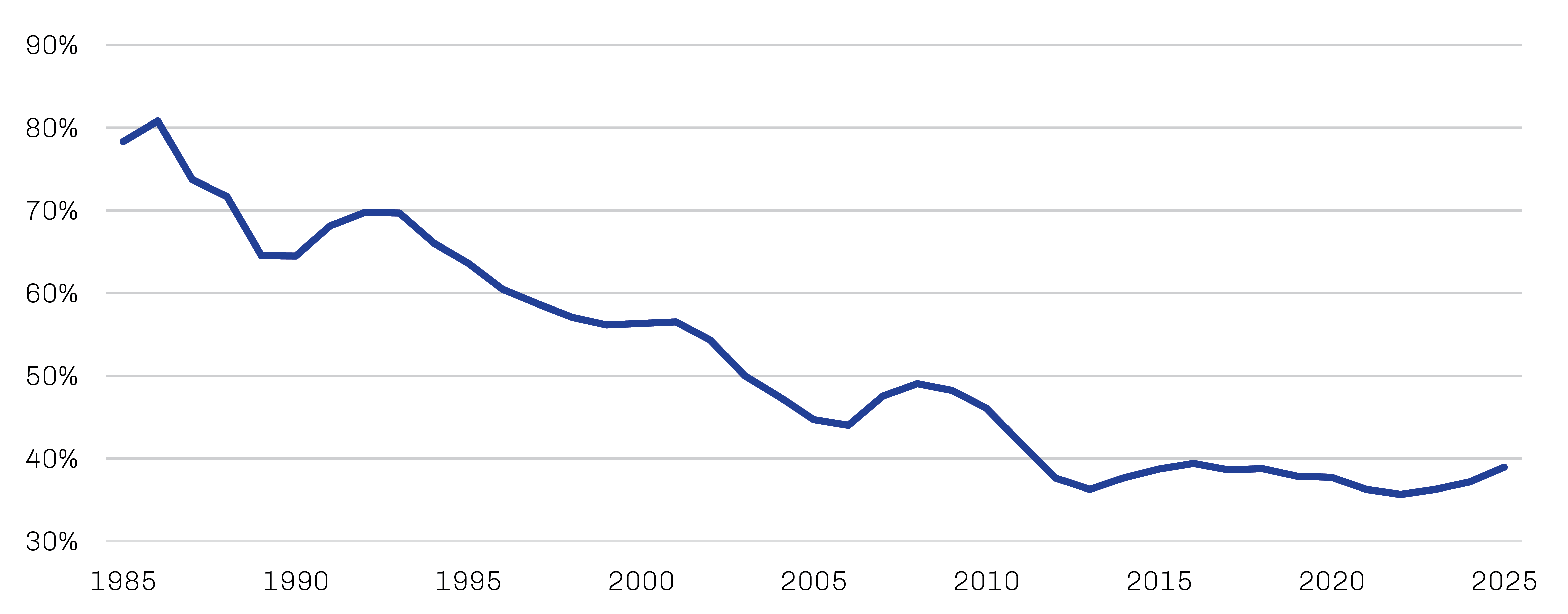
At the same time, public companies also became less capital-intensive as production, industrial capacity and commodity exposure were outsourced. On a five-year rolling average basis, the constituents of the S&P 500 Index reinvested roughly 70% of operating cash flow into capital expenditures during the 1980s and early 1990s, as shown in Exhibit 1. By 2021–2022, that figure had fallen into the mid-30% range before rising to about 39% in 2025. The longer history shows that public markets spent decades becoming less exposed to physical investment before the recent uptick.3
Public companies became less capital intensive as production, industrial capacity and commodity exposures were outsourced.
Exhibit 1. Capital Intensity Fell for Decades Before a Recent Uptick
Five-Year Rolling Average of Capital Expenditures as a Percentage of Operating Cash Flow for the S&P 500 Index
Source: Bloomberg; data as of May 8, 2026 (most recent available).
Resilience Means Spending
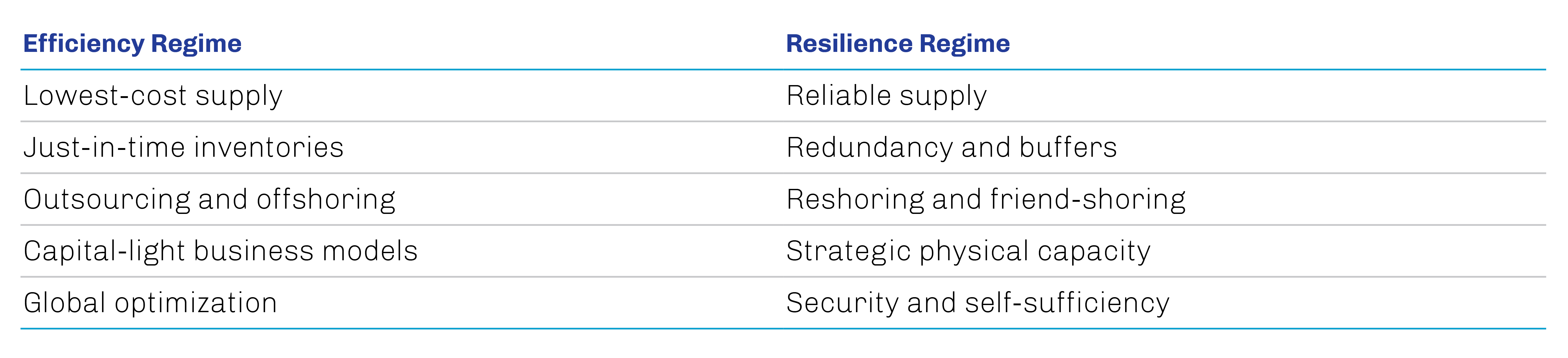
However, a supply chain optimized for the lowest delivered cost leaves little room for disruption. A series of large-scale events—such as the Covid-19 pandemic, energy supply shocks from the invasion of Ukraine, the economic decoupling of the US and China, and the recent outbreak of hostilities in the Middle East—revealed the vulnerabilities of focusing primarily on efficiency, low costs and just-in-time inventories.
Exhibit 2. The Regime Shift from Efficiency to Resilience
But an economy that outsources heavy industry cannot rebuild an entire ecosystem of skilled labor, supplier networks and operating knowledge overnight. Policy has already begun to move in response in many Western economies. The US is expanding domestic semiconductor manufacturing and strengthening critical-mineral supply chains. Defense supply chains are being reassessed after years in which inventories and production capacity were sized for a more benign world. Europe has had to rethink energy security. The International Energy Agency (IEA) expects global energy investment to reach $3.4 trillion in 2026, including $1.6 trillion for electricity supply and infrastructure. Clean energy investment is projected at $2.2 trillion, almost twice the level of fossil fuel investment.4
The energy transition is advancing, but scale, reliability, storage, permitting and grid constraints still shape the pace of change that is possible. We believe security, reliability and diversification are becoming as important as cost in capital allocation decisions.
Security, reliability and diversification are becoming as important as cost in capital allocation decisions.
Sources of critical minerals are even more concentrated in geopolitically sensitive regions. In its Global Critical Minerals Outlook 2025, the IEA reported that China was the dominant refiner for 19 of 20 energy-related strategic minerals, with an average market share of around 70%. In our view, this concentration is a strategic risk for economies trying to electrify, rearm or manufacture more domestically.5
Commodity chokepoints add another layer of fragility. UN Trade and Development estimated that the Strait of Hormuz carries around a quarter of global seaborne oil trade and significant volumes of liquefied natural gas (LNG) and fertilizers, including roughly one-third of global seaborne fertilizer trade.6 The disruption of the Strait of Hormuz illustrates how an abstract supply-chain risk becomes a real supply shock. Because energy security and food security still depend on physical trade routes, physical assets and physical inventories, localized disruptions may reverberate quickly through the global economy.
AI Exposes Physical Constraints
Artificial intelligence (AI) has exposed the physical constraints of the efficiency regime and the consequences of decades of underinvestment in infrastructure because the most sophisticated digital businesses in the world now require enormous amounts of hard infrastructure. Data centers need land, steel, cooling systems, backup power and grid connections. Advanced chips require specialized fabrication plants, rare gases, ultrapure chemicals, precision equipment and secure supply chains.
According to the IEA, global data-center electricity demand grew 17% in 2025, with the portion of AI-focused data centers up 50%. The agency also expects total data-center electricity consumption to roughly double from 2025 to 2030. Power demand from AI is arriving in a grid that was not built for this pace of load growth.7
Technology companies may remain strong businesses, but they are increasingly dependent on the physical economy. Their success may also increase the value of the scarce inputs and infrastructure they require.
The Benchmark Mismatch
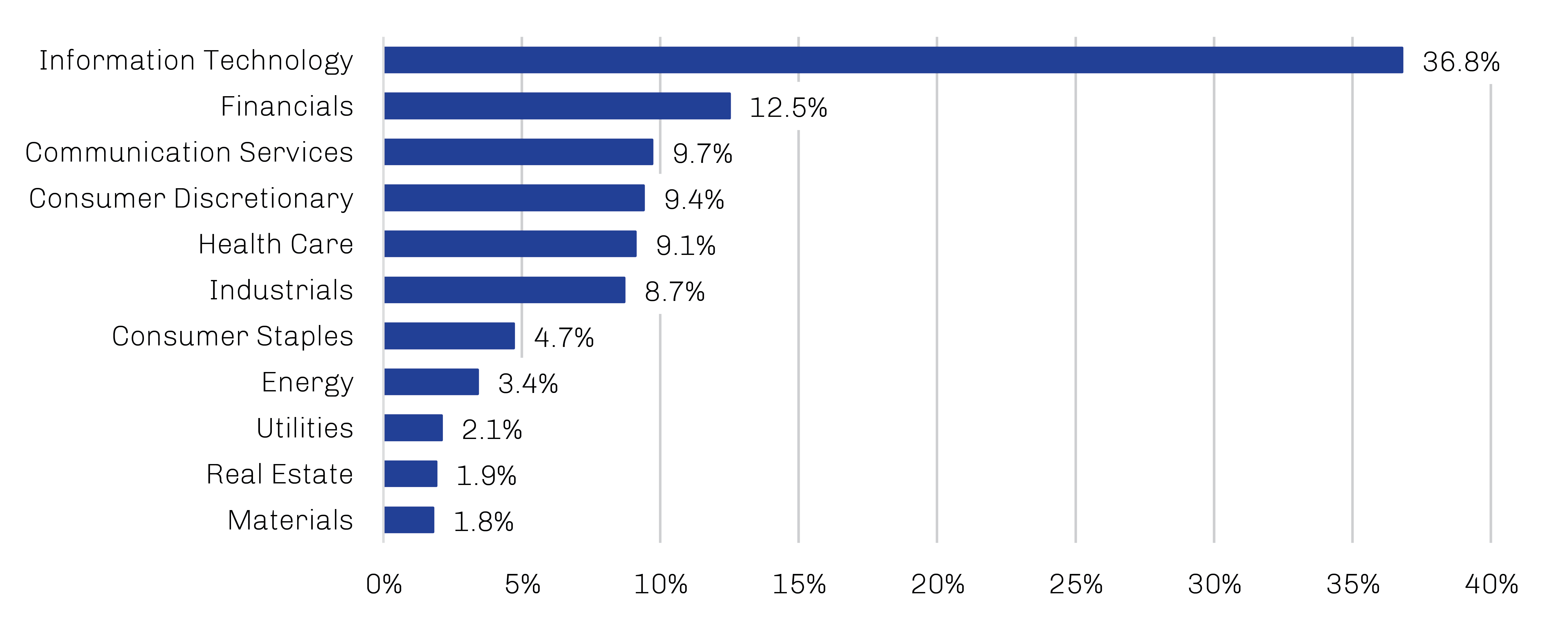
This resurgence in capital spending is beginning from an unusual place. Sectors traditionally associated with real assets—energy, materials, industrials and real estate—accounted for a little over 14% of the S&P 500, near their historical record lows. Excluding industrials, the exposure is currently at approximately 6%, less than the weight of Nvidia alone. Information technology and communication services together represented roughly 46% of the index.8
Those weights reflect the extraordinary value created by asset-light businesses. But we also believe these exposures have become backward-looking, especially for passive investors with far more exposure to the winners of the prior era than to the owners of scarce physical capacity. As a result, a benchmark-based market portfolio may have more exposure to companies that are creating demand for infrastructure while holding much smaller positions in the companies that control the constrained supply needed to meet it.
Exhibit 3. Real Asset Sectors Are a Small Share of the S&P 500
Real Asset Sectors Include Energy, Materials, Industrials and Real Estate
Source: S&P Global; data as of July 31, 2026.
Scarcity Is the Filter
Despite the secular trends supporting reindustrialization and infrastructure spending, we do not think this automatically implies that real assets are good investments. Some capital-intensive businesses overbuild while others, like commodity producers, destroy value. In other instances, regulated assets earn inadequate returns or management teams may extrapolate a favorable cycle too far. As a result, we think the case for real assets should be selective.
The assets we find most interesting tend to share five traits: they serve essential needs; they have limited substitutes; they are difficult to replicate because of geology, permitting, capital intensity, location or accumulated know-how; they sit in advantaged positions on the cost curve; and they are owned by companies with disciplined capital allocation.
We focus on real asset equities rather than commodity exposure alone. Although the shift to resilience has drawn attention to demand for copper, uranium, rare earths, energy infrastructure and certain industrial inputs, we think the investment implication of strategic resilience is more rooted in availability of supply. Demand can quickly rise and fall, but adding new supply usually entails longer cycles. Mines take years to permit and build. Grid equipment and industrial facilities depend on skilled labor and specialized supply chains. Higher prices create incentives for new projects but expanding the supply of real assets is usually slow and far from guaranteed because they’re capital intensive and require expertise and extensive regulatory approval.
Last, valuation discipline remains essential because we do not think that strategic importance justifies any price. We seek to acquire scarce assets at meaningful discounts to intrinsic value, measured through normalized earnings power, net asset value, replacement cost or long-term free cash flow.9 Balance-sheet strength and management behavior matter, especially in cyclical industries.
Higher prices create incentives for new projects but expanding the supply of real assets is usually slow and far from guaranteed.
The Role of Scarce Real Assets
The past several decades taught investors to prize scalability, intangibles and capital efficiency. Those lessons remain useful but the next decade may require a wider lens. In an environment of greater volatility and heightened geopolitical tensions, we believe the reliability and security of supply chains matter as much as cost. In our view, industrial capacity is being judged by strategic value as well as return on capital. Energy, minerals, infrastructure and manufacturing know-how have returned to the center of economic policy.
The West spent decades optimizing for efficiency. It is now being forced to rebuild resilience. The process will take years, perhaps decades, and it will require large amounts of capital. Scarce real assets—essential, difficult to replicate and supported by durable demand—may deserve a more deliberate role in portfolios built for the world ahead.