Macro & Market Views
The Tide Is High
The Tide Is High
Reflections 2024-2025
While the underperformance of small cap stocks relative to larger names over the past decade-plus has been disappointing, a range of factors may be coalescing to ease what has been a key breakwater for the market segment: middling bottom-line growth. Bill Hench, head of the Small Cap team, ponders the forces that in the years ahead could unleash a wave of earnings growth, including lower interest rates, a more benign regulatory environment and reenergized mergers and acquisitions and capital markets activity.
Growth Has Been Elusive, but Change May Be Afoot
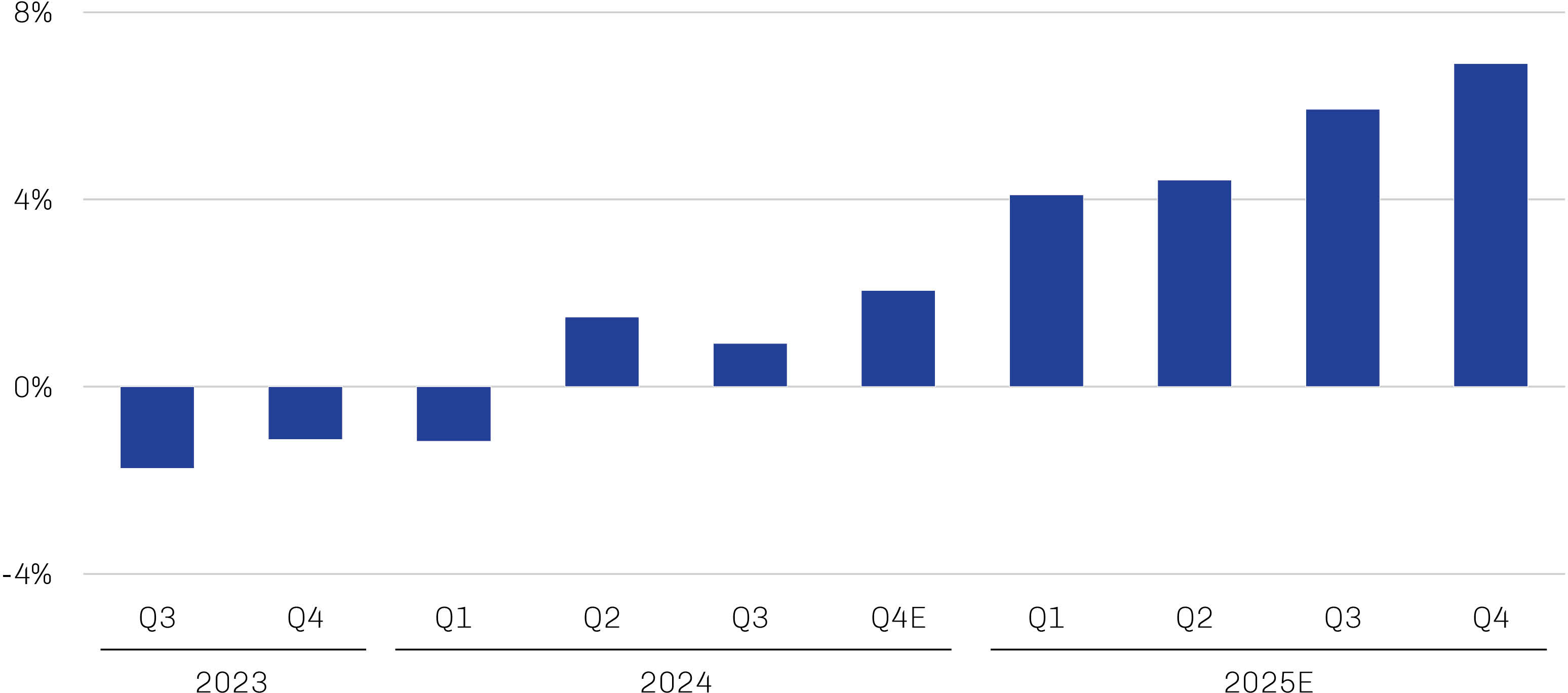
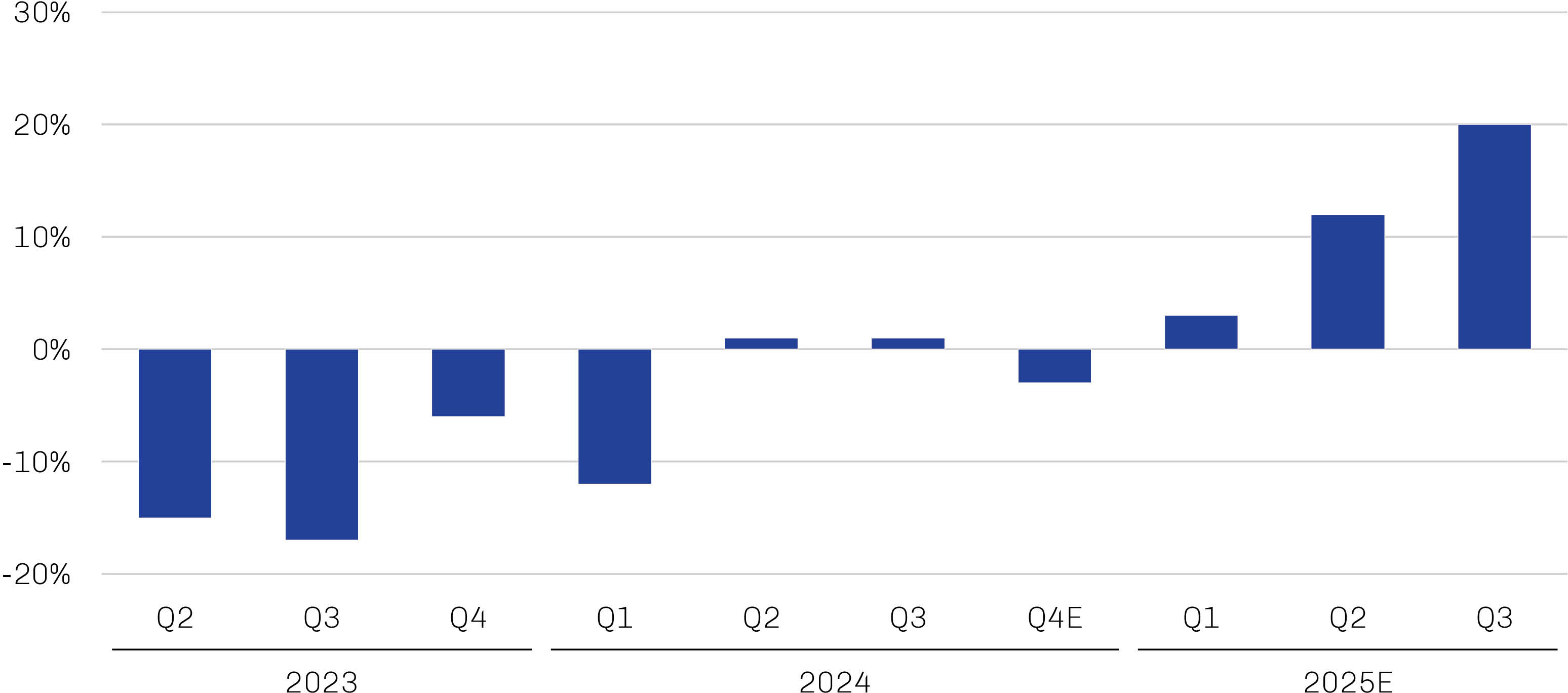
Given the increasing number of money-losing small cap companies since the global financial crisis— 45% of the Russell 2000 Index lost money on a trailing-12-month basis through the end of the third quarter—lackluster earnings at the benchmark for relative under-performance as market capitalization preferences.1 However, there are reasons to believe resuscitated earnings may finally be in prospect for 2025 as accelerating top-line growth and continued margin improvements filter through to the bottom line, as shown in Exhibit 1 and Exhibit 2. As we discuss below, multiple forces at the industry level could amplify company-specific earnings momentum.
Exhibit 1. Sales Growth Is Forecast to Accelerate in 2025…
Realized and Estimated Russell 2000 Index Year-Over-Year Sales Growth, Third Quarter 2023 through Fourth Quarter 2025
Source. Furey Research Partners, FactSet; data as of November 14, 2024.
Exhibit 2 …Boosting Margins and Earnings Growth
Realized and Estimated Russell 2000 Index Year-Over-Year Earnings Growth, Second Quarter 2023 through Third Quarter 2025
Source: Furey Research Partners, FactSet; data as of November 14, 2024.
As small caps overall are more leveraged to floating-rate debt than larger companies, further Federal Reserve policy easing beyond the 100 basis points worth of rate cuts in 2024 would have a meaningfully positive incremental impact on these businesses’ interest expenses. While we won’t hazard a guess at the trajectory of Fed policy going forward, the latest dot plot Federal Open Market Committee forecasts suggest an additional 50 basis points of cuts are on tap in 2025.2 A reduced cost of capital across the US economy—for both consumers and levered small cap companies—could trigger a resurgence in small cap stocks, especially those in the housing, consumer discretionary and energy sectors. In addition to reducing borrowing costs and buoying economic activity, lower rates historically have lured investment capital in from the sidelines, propelling small caps higher.3
Even without further rate relief, however, small cap balance sheets are the strongest they’ve been since the global financial crisis, in our view. Improved supply-chain management post-Covid has helped managers rationalize inventories and reduce working capital. Some companies have been able to leverage the proliferation of cloud applications to reduce the capital intensity of their businesses and improve operating leverage; specifically, what had been large, fixed-hardware infrastructure investments financed through capital expenditures become variable operational costs.
Policy Changes and Regulatory Reform May Have an Outsized Impact on Smaller Companies
In addition to wider operating margins, strengthened balance sheets and potentially lower rates, prospective policy changes and easier regulations facilitated by the 2024 Republican sweep of the November US elections could serve as an additional tailwind to earnings growth for US-domiciled companies. This could be especially true for smaller companies, in our view. Not only do large companies have the scale to monitor and adapt to regulatory changes, their lobbying muscle often enables them to influence regulations at the design stage to their benefit. Smaller companies, in contrast, usually are left to “play it as it lays” and bear the fixed costs of compliance over a smaller base. A less restrictive regulatory environment may have an amplified salutary impact on small companies.
Tariffs. Given that we already operate in a trade-protected world, the impact of any new tariffs will be incremental rather than de novo, potentially limiting their overall effect. That said, any redomestication of manufacturing would likely benefit US-centric producers, including the small cap companies that in the aggregate source about 90% of revenue from home.4
Taxes. While many of the provisions of the Tax Cuts and Jobs Act of 2017 affecting individual taxpayers are set to expire at the end of 2025 barring Congressional intervention—which seems likely given the results of the US election—changes to the corporate tax code were made permanent at the time of the bill’s passage. That said, Trump on the campaign trail proposed further easing of corporate taxes, including lowering them to 15% for domestic production.5 As corporate taxes tend to be regressive, US-focused small cap companies may be particularly well positioned for tax savings that could be redirected to reducing fixed costs and thus enhancing margins and productivity.
Regulations. As president, Trump reportedly is prepared to nullify “thousands” of rules and regulations he and his team deem to represent executive overreach.6 Generally speaking, such a dismantling of the regulatory state would reduce outlays on compliance—with consumer protection laws, for example, or environmental requirements— and thus operating costs, boosting margins and profitability. Meanwhile, looser antitrust provisions could unleash a spate of mergers and acquisitions (M&A), potentially triggering buyout premiums for targeted small cap companies.
Enhanced Efficiency/Reduced Government Spending. Improved efficiency and the elimination of unnecessary federal expenditures could reduce government spending and Treasury issuance, enabling assets that would otherwise be invested in government debt to be put to better use in the private sector. That said, discretionary nondefense spending represents only about 15% of total federal outlays; efforts to rein in government spending without reform to popular and politically untouchable entitlements like Social Security, Medicare and Medicaid seem unlikely to have a meaningful impact on the country’s fiscal trajectory.7
Industry-Specific Trends Could Lift a Narrower Swath of Small Cap Companies
Beyond the potentially broad sweep of policy changes under the new administration, industry-specific developments could benefit a more focused range of small cap companies.
Artificial Intelligence (AI). AI could be even more meaningful over a long cycle than the dawn of the internet was in 2000, transforming companies across industries and capitalizations into more efficient digital- and data-driven operations, resulting in reduced costs and faster innovation. Sectors already deep in the digital space like finance, healthcare and logistics could be especially well positioned to benefit from emerging technologies. Additionally, much as the telcos had early-mover advantage into broadband communications in the 1980s, many smaller companies may be able to tweak their business models for relevance in a new AI-driven world rather than embark upon a whole-scale reinvention. For example, one small cap manufacturer in the Midwest has leveraged its century-plus of expertise in thermal management for trucks and tractors to produce cooling systems for data centers.8
Energy/Industrials. AI’s broad penetration across industries is driving a spike in demand for energy; data centers are projected to account for 11–12% of US power demand by 2030, up from 3–4% today.9 Meeting this demand will present opportunities for an array of businesses, from drillers and oil servicers to the providers of power infrastructure.
Biotech. Well represented by small caps, the biotech industry is almost purely domestic and therefore leveraged to positive effects from regulatory easing. Looser policies for developing and approving new drugs could facilitate major improvements—perhaps even breakthrough discoveries—in a range of treatment and therapies, unleashing heretofore unseen earnings power.
Financials. While potential regulatory reform and lower capital requirements could compromise the balance sheets of small banks over the long term, a less burdensome regulatory environment likely would reduce compliance costs in the short term. Separately, continued market share gains by private capital providers could squeeze out the weakest local banks, forcing mergers and/or closures and paving the way for a new breed of small cap banks—notably, semi-regionals centered in the South and lower-tax states—with higher profitability and faster growth.
Security Selection and Price Discipline Underpin Resilience
Within the context of a long period of relative small cap underperformance, it’s worth remembering that small caps historically have been the most rewarding sector of the market over the long run back to 1927.10 Although a lagging market can be unsettling in the short term, it can also provide opportunity to buy good companies at attractive valuations. Should growth prospects broaden beyond a narrow cohort of megacap tech stocks, thoughtful active management rather than passive beta exposure may once again be the key to investment success.11
Regulatory Shift May Result in Both More Takeouts and New Names
The installation of more business-friendly leadership in such US offices as the Department of Justice and Federal Trade Commission may grease the wheels for M&A activity, as well-financed businesses perceive fewer impediments to growth through strategic acquisitions of smaller companies. Initial public offerings (IPOs), too, could see an uptick. For example, reduced regulation may facilitate the development of new drugs/therapeutics, increasing private market valuations for biotech companies and incenting early investors to cash out through a public listing. In the industrial space, new “pick and shovel” companies may emerge to provide essential services and support to facilitate the propagation of new technologies like AI, not unlike the late-1990s facilitators of the internet boom. On the demand side, investors previously skeptical of AI could reevaluate the opportunity cost of their lack of exposure to the sector, supporting a wave of IPO interest.
1. Source: FactSet; data as of September 30, 2024.
2. Source: Federal Reserve; data as of December 18, 2024.
3. Source: JP Morgan; data as of July 22,2024.
4. Source: Cambridge Associates; data as of May 1, 2024.
5. Source: S&P Global; data as of November 12, 2024.
6. Source: The Wall Street Journal; data as of November 20, 2024.
7. Source: US Department of the Treasury; data as of December 12, 2024.
8. Source: Company reports; data as of September 11, 2024.
9. Source: McKinsey & Company; data as of September 1, 2024.
10. Source: Fama-French Data Library; data as of November 30, 2024.
11. Source: Morningstar; data as of December 31, 2024.
The opinions expressed are not necessarily those of the firm. These materials are provided for informational purposes only. These opinions are not intended to be a forecast of future events, a guarantee of future results, or investment advice. Any statistics contained herein have been obtained from sources believed to be reliable, but the accuracy of this information cannot be guaranteed. The views expressed herein may change at any time subsequent to the date of issue hereof. The information provided is not to be construed as a recommendation to buy, hold or sell or the solicitation or an offer to buy or sell any fund or security.
Past performance is not indicative of future results.
Risk Disclosures
All investments involve the risk of loss of principal.
There are risks associated with investing in securities of foreign countries, such as erratic market conditions, economic and political instability and fluctuations in currency exchange rates.
A principal risk of investing in value stocks is that the price of the security may not approach its anticipated value or may decline in value. “Value” investments as a category, or entire industries or sectors associated with such investments, may lose favor with investors as compared to those that are more “growth” oriented.
The value and liquidity of portfolio holdings may fluctuate in response to events specific to the companies or markets, as well as economic, political or social events in the US or abroad. During periods of market volatility, the value of individual securities and other investments at times may decline significantly and rapidly. The securities of small and micro-size companies can be more volatile in price than those of larger companies and may be more difficult or expensive to trade.
There are risks associated with investing in foreign investments (including depositary receipts). Foreign investments, which can be denominated in foreign currencies, are susceptible to less politically, economically and socially stable environments; fluctuations in the value of foreign currency and exchange rates; and adverse changes to government regulations.
Investment in gold and gold-related investments present certain risks, including political and economic risks affecting the price of gold and other precious metals, like changes in US or foreign tax, currency or mining laws; increased environmental costs; international monetary and political policies; economic conditions within an individual country; trade imbalances; and trade or currency restrictions between countries. The price of gold, in turn, is likely to affect the market prices of securities of companies mining or processing gold and, accordingly, the value of investments in such securities may also be affected. Gold-related investments as a group have not performed as well as the stock market in general during periods when the US dollar is strong, inflation is low and general economic conditions are stable. In addition, returns on gold-related investments have traditionally been more volatile than investments in broader equity or debt markets. Investment in gold and gold-related investments may be speculative and may be subject to greater price volatility than investments in other assets and types of companies.
Municipal bonds are subject to credit risk, interest rate risk, liquidity risk and call risk. However, the obligations of some municipal issuers may not be enforceable through the exercise of traditional creditors’ rights. The reorganization under federal bankruptcy laws of a municipal bond issuer may result in the bonds being cancelled without payment or repaid only in part or in delays in collecting principal and interest.
The information is not intended to provide and should not be relied on for accounting or tax advice. Any tax information presented is not intended to constitute an analysis of all tax considerations.
Diversification does not guarantee investment returns and does not eliminate the risk of loss.
Alternative Investment Risks
Alternative investments can be speculative and are not suitable for all investors. Investing in alternative investments is only intended for experienced and sophisticated investors who are willing and able to bear the high economic risks associated with such an investment. Investors should carefully review and consider potential risks before investing. Certain of these risks include:
• Loss of all or a substantial portion of the investment;
• Lack of liquidity in that there may be no secondary market or interest in the strategy and none is expected to develop;
• Volatility of returns;
• Interest rate risk;
• Restrictions on transferring interests in a private investment strategy;
• Potential lack of diversification and resulting higher risk due to concentration within one or more sectors, industries, countries or regions;
• Absence of information regarding valuations and pricing;
• Complex tax structures and delays in tax reporting;
• Less regulation and higher fees than mutual funds;
• Use of leverage, which magnifies the potential for gain or loss on amounts invested and is generally considered a speculative investment technique and increases the risks associated with investing in the strategy;
• Carried interest, which may cause the strategy to make more speculative, higher-risk investments than would be the case in absence of such arrangements; and
• Below investment grade loans, which may default and adversely affect returns.
Indexes are unmanaged and one cannot invest directly in an index.
Bloomberg Municipal Bond Index (Gross/Total) measures the performance of the US municipal tax-exempt investment grade bond market. A total-return index tracks price changes and reinvestment of distribution income.
Bloomberg US Aggregate Bond Index (Gross/Total) measures the performance of the investment grade, US dollar-denominated, fixed-rate taxable bond market in the US, including Treasuries, government-related and corporate securities, fixed-rate agency MBS (agency fixed-rate and hybrid ARM passthroughs), ABS and CMBS. A total-return index tracks price changes and reinvestment of distribution income.
Bloomberg US Corporate Bond Index (Gross/Total) measures the performance of investment grade, fixed-rate, taxable corporate bond market. It includes US dollar denominated securities publicly issued by US and non-US industrial, utility and financial issuers. A total-return index tracks price changes and reinvestment of distribution income.
Bloomberg US Corporate High Yield Bond Index (Gross/Total) measures the US dollar-denominated, high yield, fixed-rate corporate bond market. Securities are classified as high yield if the middle rating of Moody’s, Fitch and S&P is Ba1/BB+/BB+ or below. A total-return index tracks price changes and reinvestment of distribution income.
Cliffwater Direct Lending Index is an asset-weighted index of US middle market direct loans.
Consumer price index (CPI) (Price) measures inflation as experienced by consumers in their day-to-day living expenses by capturing the average change over time in the prices paid for a representative basket of consumer goods and services. A price-return index only measures price changes.
Fannie Mae Home Purchase Sentiment Index (HPSI) (Gross/Total) distills consumer responses to Fannie Mae’s monthly National Housing Survey into a single indicator designed to provide signals on future housing outcomes. A total-return index tracks price changes and reinvestment of distribution income.
ICE BofA AA-BBB US Fixed Rate Automobile ABS Index (Gross/Total) measures the performance of asset-backed securities collateralized by automobile loans with a middle rating in a range of AA/Aa to BBB/Baa as measured Moody’s, Fitch and S&P. A total-return index tracks price changes and reinvestment of distribution income.
ICE BofA AA-BBB US Floating Rate Credit Card ABS Index (Gross/Total) measures the performance of asset-backed securities collateralized by credit card loans with a middle rating in a range of AA/Aa to BBB/Baa as measured Moody’s, Fitch and S&P. A total-return index tracks price changes and reinvestment of distribution income.
ICE BofA AA-BBB US Floating Rate Student Loan ABS Index (Gross/Total) measures the performance of asset-backed securities collateralized by student loans with a middle rating in a range of AA/Aa to BBB/Baa as measured Moody’s, Fitch and S&P. A total-return index tracks price changes and reinvestment of distribution income.
ICE BofA Current 10-Year US Treasury Index measures the performance of US Treasury securities with a remaining maturity exceeding seven years and less than or equal to 10 years. A total-return index tracks price changes and reinvestment of distribution income.
Morningstar LSTA US Leveraged Loan Index (Gross/Total) is a market value-weighted index that measures the performance of the US leveraged loan market. A total-return index tracks price changes and reinvestment of distribution income.
MSCI China Index (Net) measures the performance of large and midcap representation across China A shares, H shares, B shares, Red chips, P chips and foreign listings. A net-return index tracks price changes and reinvestment of distribution income net of withholding taxes.
MSCI World Index (Net) measures the performance of large and midcap equities across developed markets. A net-return index tracks price changes and reinvestment of distribution income net of withholding taxes.
Palmer Square CLO AAA Index (Gross/Total) is a subindex of the Palmer Square CLO Debt Index that tracks only CLOs originally rated AAA. A total-return index tracks price changes and reinvestment of distribution income.
Palmer Square CLO BBB Index (Gross/Total) is a subindex of the Palmer Square CLO Debt Index that tracks only CLOs originally rated BBB. A total-return index tracks price changes and reinvestment of distribution income.
Russell 2000® Index (Gross/Total) measures the performance of the small cap segment of the US equity universe. It includes approximately 2,000 of the smallest securities based on a combination of their market cap and current index membership. A total-return index tracks price changes and reinvestment of distribution income.
S&P 500 Index (Gross/Total) measures the performance of 500 of the top companies in the leading industries of the US economy and is widely recognized as a proxy for the US market as a whole. A total-return index tracks price changes and reinvestment of distribution income.
S&P Municipal Bond High Yield Index (Gross/Total) measures the performance of bonds in the S&P Municipal Bond Index that are not rated or whose ratings are below investment grade. A total-return index tracks price changes and reinvestment of distribution income.
S&P Municipal Yield Index (Gross/Total) measures the performance of high yield and investment grade municipal bonds. A total-return index tracks price changes and reinvestment of distribution income.
Definitions
A 10-year Treasury note is a debt obligation of the US government with a maturity of 10 years upon issuance.
AA credit rating—as used by S&P Global Ratings and Fitch Ratings—is an investment grade rating on a bond considered to have a very strong capacity to meet its financial commitments. The equivalent rating from Moody’s Investors Service is Aa.
AAA credit rating—as used by S&P Global Ratings and Fitch Ratings—is an investment grade rating on a bond considered to have an extremely strong capacity to meet its financial commitments. The equivalent rating from Moody’s Investors Service is Aaa.
Asset-based lending (ABL) is corporate borrowing supported by specific assets of the borrower rather than its cash flows.
BBB credit rating—as used by S&P Global Ratings and Fitch Ratings—is an investment grade rating on a bond considered to have adequate capacity to meet its financial commitments but that is more susceptible to adverse business, financial and economic conditions. The equivalent rating from Moody’s Investors Service is Baa.
Beta is a measure of an investment’s price volatility relative to that of the overall market.
A bull market is generally defined as a period during which a securities market index rises by 20% or more.
A business development company is a closed-end investment vehicle that invests in early stage and/or distressed small and medium- sized companies.
Collateralized loan obligations (CLO) are financial instruments collateralized by a pool of corporate loans.
Collective investment funds (CIFs), also known as collective investment trusts (CITs), are bank-administered trusts that hold commingled assets.
A credit rating is an assessment provided by a nationally recognized statistical rating organization (NRSRO) of the creditworthiness of an issuer with respect to debt obligations, including specific securities, money market instruments or other bonds. Ratings are measured on a scale that generally ranges from AAA/Aaa (highest) to D/RD (lowest); ratings are subject to change without notice. Not rated (NR) indicates that the debtor was not rated and should not be interpreted as indicating low quality.
Credit-risk transfer (CRT) securities are synthetic securitizations that reference the credit risk of a designated group of mortgage loans guaranteed by Fannie Mae or Freddie Mac.
Currency debasement refers to the reduction of a currency’s purchasing power.
Direct lending refers to a loan agreement between a borrower and single lender or small group of lenders. Direct lending can also be referred to as “private credit” or “private lending.”
Exchange-traded funds (ETFs) are listed investment vehicles that seek to provide exposure to a benchmark, index or actively managed strategy.
Federal funds rate is the interest rate at which depository institutions (banks and credit unions) lend reserve balances to other depository institutions overnight on an uncollateralized basis.
General obligation bonds are municipal securities in which payments are backed by the full faith and credit of the issuer and by extension its ability to tax its residents.
A Goldilocks economic scenario refers to a level of growth that is neither strong enough to promote inflation pressures nor weak enough to suggest recession may be near.
Government-sponsored enterprises (GSEs) were established and chartered by the US federal government for public policy purposes. They are private companies, and their securities are not backed by the full faith and credit of the federal government.
High yield municipal bonds are debt securities issued by states, cities, counties and other public entities that offer a higher rate of interest due to their perceived higher risk of default.
An interval fund is a pooled investment vehicle that offers investors periodic liquidity at an interval specified in its prospectus.
Moody’s Investors Service is a nationally recognized statistical rating organization (NRSRO) of the creditworthiness of an issuer with respect to debt obligations, including specific securities, money market instruments or other bonds. Ratings are measured on a scale that generally ranges from Aaa (highest) to RD (lowest); ratings are subject to change without notice.
Mortgage-backed securities (MBS) are debt securities whose payments of principal and interest are backed by the cash flow generated by pools of mortgage loans.
Net orderly liquidation value (NOLV) is the estimated proceeds from selling a borrower’s collateral assets in an orderly manner, including a reasonable amount of time to find a buyer, after all costs related to the sale.
Not rated (NR) indicates that the debtor was not rated and should not be interpreted as indicating low quality.
A private fund is a pooled investment vehicle that is not required to be registered or regulated as an investment company under the Investment Company Act of 1940, as amended.
Revenue bonds are municipal securities whose payments are backed not by a government’s taxing power but by revenues from a specific project or source, such as highway tolls or lease fees.
Secured Overnight Financing Rate (SOFR) is a broad measure of the cost of borrowing cash overnight collateralized by Treasury securities.
A separately managed account (SMA) is a portfolio of securities that is managed by a professional investment firm.
A soft landing refers to a gradual economic slowdown that comes to an end without triggering a recession.
Sovereign debt refers to debt obligations issued by a country’s government as a means to borrow capital.
S&P Global Ratings is a nationally recognized statistical rating organization (NRSRO) of the creditworthiness of an issuer with respect to debt obligations, including specific securities, money market instruments, or other bonds. Ratings are measured on a scale that generally ranges from AAA (highest) to D (lowest); ratings are subject to change without notice.
A tranche is a portion of a security issue with its own unique risk/reward characteristics and credit rating.
Undertakings for Collective Investment in Transferable Securities (UCITs) are pooled investment vehicles registered in countries in the European Union.
Volatility represents the degree to which an investment’s price has deviated from its average over time.
A yield curve is a graphical representation of interest rates on debt of equal credit quality across a range of maturities.
FEF Distributors, LLC (“FEFD”) (SIPC), a limited purpose broker-dealer, distributes certain First Eagle products. FEFD does not provide services to any investor, but rather provides services to its First Eagle affiliates. As such, when FEFD presents a fund, strategy or other product to a prospective investor, FEFD and its representatives do not determine whether an investment in the fund, strategy or other product is in the best interests of, or is otherwise beneficial or suitable for, the investor. No statement by FEFD should be construed as a recommendation. Investors should exercise their own judgment and/or consult with a financial professional to determine whether it is advisable for the investor to invest in any First Eagle fund, strategy, or product.
First Eagle Investments is the brand name for First Eagle Investment Management, LLC and its subsidiary investment advisers.
©2025 First Eagle Investment Management, LLC. All rights reserved.