Macro & Market Views

The Small Idea: Who Took Away the Punchbowl?

The Small Idea: Who Took Away the Punchbowl?

Small Cap Team

You think the party is just getting started, and then poof!

After a 20%-plus run for small caps concentrated in the second quarter, the elation fizzled in the third quarter. The Russell 2000 Index fell more than 7% as investor preference swung back to large cap growth, particularly those companies associated with the artificial intelligence (AI) buildout; the NYSE FANG+ Index rose 13% in the quarter.1

The usual suspects squelched the joy.

Persistent inflation and ballooning government debt triggered a Fed rate hike in September, and Treasury yields spiked to multidecade highs.2 With that hike came fears of higher-for-longer rates, a rapid turnaround given that markets were discounting an accommodative Fed earlier this year. Fear of higher rates ignited concerns about a possible recession, though—thankfully—activity has remained quite resilient thanks to robust business and consumer spending. Macroeconomic and geopolitical uncertainty further weighed, increasing investor appetite for defensive cash buffers of magnitudes impossible for small caps to match.

The hardest hit sectors during the third quarter included “growthy” small cap names in technology and industrials—including smaller data-center construction and supply-chain firms—as capital expenditures were concentrated among the hyperscalers. Similarly, yet-to-be profitable/early-stage businesses with long duration prospects—including biotech—suffered as higher discount rates muted projected cash flows.3

Although rising interest rates and crowding out—by hyperscalers and the US Treasury—curtailed easy access to capital and dampened hopes for speculative mergers and acquisitions premiums, strategic acquisitions of small caps continued apace.

Color us stubborn, but we’re hanging in for another round.

While punishing to heavily indebted companies of any market cap, protractedly high rates may sound only a selective death knell and may not, by definition, be a bad thing overall. Approximately one-third of companies in the Russell 2000 Index have more cash than debt, with half of the index’s total debt is concentrated in just 12% of market cap.4 Thus, nimble stock pickers in the small cap space may be able to avoid leveraged laggards, instead focusing on self-financing, cash-flow positive names.


Higher rates, by definition, may not be a bad thing overall.

And remember that high interest rates often coincide with robust economic activity, providing an environment conducive to corporate earnings growth. This tailwind may be especially impactful for smaller companies; given the relatively high operating leverage of such companies, even a modest uptick in revenues can flow disproportionally to the bottom line.

Earnings ultimately drive equity returns. When strong fundamentals outweigh the headwind of higher borrowing costs, positive returns can coexist alongside rising yields, as they have for small cap stocks in eight of the ten rising-rate periods since 1987, as shown in Exhibit 1.
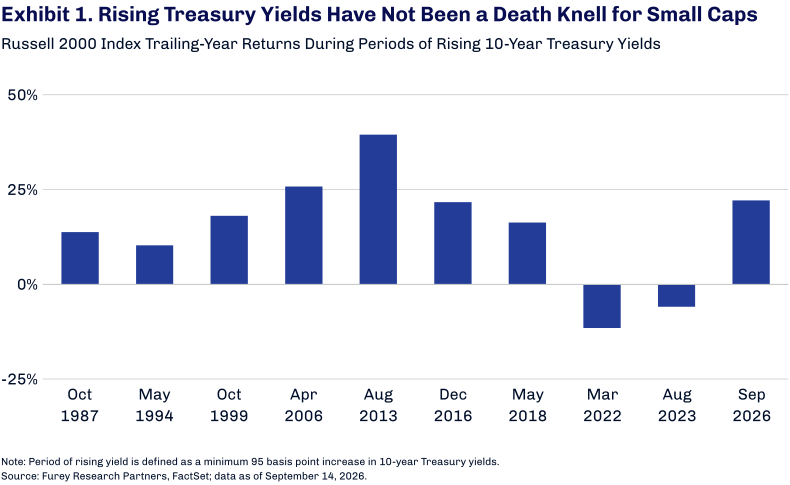


Beyond the tailwind from a still-strong economy, the domestic orientation of small caps provides both a shield and a boost in the current policy environment. Tariffs and onshoring benefit small cap industrials, heavy-equipment suppliers and engineering firms that also may be seeing a structural boost from new tax rules allowing 100% year-one depreciation on certain property.

All of these catalysts can coalesce into higher earnings—historically a strong tonic for returns. Earnings growth for small companies in the Russell 2000 Index is projected to exceed the S&P 500 Index into the fourth quarter and through 2028—with room, still, for multiple expansion.5 Based on forward projections, and excluding negative earners, the Russell 2000 Index trades at a 19% price-earning multiple discount to the S&P 500 Index.6

Opportunity Beckons

With small cap earnings inflecting higher and still-noteworthy valuation discrepancies, we continue to perceive opportunity.

Some small cap energy companies remain at single-digit earnings multiples while benefiting from rapid growth in power consumption—including consumption by AI data centers—higher commodity-price floors and strong cash-flow generation. Geopolitical conflicts and tight petroleum/gas supplies continue to support global commodity export markets, boosting cash flows for upstream and midstream operators.


With earnings inflecting higher and persistent valuation discrepancies, we continue to perceive opportunity in small caps.

And despite recent fallout, AI can remain both an opportunity and a tool for some small cap companies. Even as hyperscalers dominate headlines, data center/ infrastructure buildouts require substantial physical input from small providers of specialized hardware, HVAC equipment and industrial components. At the same time, integrating AI tools to automate overhead can trigger margin expansion for smaller companies previously unavailable even through scale.

We also continue to seek opportunity in non-biotech healthcare. Valuations remain compressed even as cost structures normalize, operations strengthen and earnings accelerate. After long underperformance, investor focus may shift to—and reward—fundamentals over the speculative narratives propelling some other sectors.

The recent downdraft in small cap stocks may present ample opportunity to acquire positions in small companies at prices we believe are unmoored from underlying financial strength. We believe the headwinds weighing on these stocks are likely to moderate at some point. In our view, inflation eventually will abate, the interest-rate cycle will improve and geopolitical tensions will ease. Investor attention could return to fundamental value—to the potential benefit of a range of currently undervalued small companies.

Meanwhile and always, we position ourselves to potentially maximize upside. We remain focused on targeting good companies while managing the one variable we control—the price we pay. Unable to predict which names will disproportionately contribute, we spread our bets and diversify the portfolio, exercising price discipline to slowly build positions.

So, take away the punch bowl. I don’t even need ice. Just give me dibs at whatever behind the bar looks enticing. Here’s to good times.


1. Source: Bloomberg; data as of September 30, 2026.
2. Source: Bloomberg; data as of September 17, 2026.
3. Source: Bloomberg; data as of September 30, 2026.
4. Source: Furey Research Partners; data as of September 30, 2026.
5. Source: LSEG I/B/E/S; data as of September 30, 2026.
6. Source: Bloomberg; data as of October 29, 2026.

The information contained in this material is provided by First Eagle Investment Management, LLC (“FEIM”) and its global subsidiaries (collectively, “First Eagle”). FEIM is an investment adviser registered with the US Securities and Exchange Commission (SEC). Registration with the SEC does not imply a certain level of skill or training.

This material is for informational purposes only and reflects prevailing conditions and the judgment of the author(s) as of the date of publication, all of which are subject to change. This material should not be relied upon as investment advice; it does not constitute a recommendation to buy or sell a security or other investment; and it is not intended to predict or depict the performance of any investment. This material is not being provided in a fiduciary capacity and is not intended to recommend any investment policy or investment strategy or consider the specific objectives or circumstances of any investor. We consider the information in this material to be accurate, but we do not represent that it is complete or should be relied upon as the sole source of appropriateness for investment.

Prospective investors should inform themselves and consult with an investment, tax or legal professional as to any applicable legal requirements, taxation and exchange control regulations in the countries of their citizenship, residence or domicile that may be relevant prior to investing.

This material does not constitute an offer or solicitation in any jurisdiction where or to any person to whom it would be unauthorized or unlawful to do so.

All investments involve the risk of loss of principal.

Diversification does not guarantee investment returns and does not eliminate the risk of loss.

Small- and mid-capitalization issues tend to be more volatile and less liquid than large-capitalization issues.

The value and liquidity of portfolio holdings may fluctuate in response to events specific to the companies or markets, as well as economic, political or social events in the United States or abroad. During periods of market volatility, the value of individual securities and other investments at times may decline significantly and rapidly. The securities of small and micro-size companies can be more volatile in price than those of larger companies and may be more difficult or expensive to trade.

Strategies whose investments are concentrated in a specific industry or sector may be subject to a higher degree of risk than funds whose investments are diversified and may not be suitable for all investors.

Past performance does not guarantee future results, which may vary. The value of investments and the income derived from investments will fluctuate and can go down as well as up. A loss of principal may occur.

10-year Treasury yield is the interest rate paid on a US Treasury bond with a maturity of 10 years upon issuance.

NYSE FANG+ Index is an equal-weighted equity benchmark designed to track the performance of 10 highly traded growth stocks of technology and tech-enabled companies in the technology, media & communications and consumer discretionary sectors.

Russell 2000® Index (Gross/Total) measures the performance of the small-cap segment of the US equity universe. It includes approximately 2,000 of the smallest securities based on a combination of their market cap and current index membership. A total-return index tracks price changes and reinvestment of distribution income.

S&P 500 Index (Gross/Total) measures the performance of 500 of the top companies in the leading industries of the US economy and is widely recognized as a proxy for the US market as a whole. A total-return index tracks price changes and reinvestment of distribution income.

Indexes are unmanaged and do not incur management fees or other operating expenses. One cannot invest directly in an index.

The information presented does not reflect the performance of any fund, strategy or account managed or serviced by First Eagle, and there is no guarantee that investors will experience the type of performance reflected. There is no guarantee that any market forecast set forth in this material will be realized. There is no guarantee that any historical trend referenced herein will be repeated in the future, and there is no way to predict precisely when such a trend will begin. The mention of specific securities is not a recommendation or solicitation to buy, sell or hold any particular security and should not be relied upon as investment advice.

Availability of the products or services described may be restricted by law in certain jurisdictions. This material may not be distributed, published or used by any person or entity in any jurisdiction or country where such distribution or use would be contrary to local law or regulation.

United Kingdom: Napier Park Global Capital Ltd. is authorized and regulated by the Financial Conduct Authority (FRN: 541427).

Middle East: This material is for information purposes only and has not been, and will not be, registered with or reviewed or approved by any regulator located in the Middle East. It does not constitute or form part of any marketing initiative, any offer to issue or sell, or any solicitation of any offer to subscribe to or purchase, any products, strategies or other services, nor shall it, or the fact of its distribution, form the basis of, or be relied on in connection with, any contract resulting therefrom. In the event that the recipient of this material wishes to receive further information regarding any products, strategies or other services, it shall specifically request the same in writing from an authorized financial adviser.

Canada: Pursuant to the international adviser registration exemption in National Instrument 31-103, First Eagle Investment Management, LLC. is informing you that: (i) First Eagle Investment Management, LLC. is not registered in Canada and is advising you in reliance upon an exemption from the adviser registration under National Instrument 31-103; (ii) First Eagle Investment Management, LLC’s jurisdiction of residence is New York, USA; (iii) there may be difficulty enforcing legal rights against First Eagle Investment Management, LLC. because it is a resident outside of Canada and all or substantially all of its assets may be situated outside of Canada.

FEF Distributors, LLC (“FEFD”) (SIPC), a limited purpose broker-dealer, distributes certain First Eagle products. FEFD does not provide services to any investor but rather provides services to its First Eagle affiliates. As such, when FEFD presents a fund, strategy or other product to a prospective investor, FEFD and its representatives do not determine whether an investment in the fund, strategy or other product is in the best interests of, or is otherwise beneficial or suitable for, the investor. No statement by FEFD should be construed as a recommendation. Investors should exercise their own judgment and/or consult with a financial professional to determine whether it is advisable for the investor to invest in any First Eagle fund, strategy or product.

First Eagle Investments is the brand name for First Eagle Investment Management, LLC and its subsidiary investment advisers.

©2026 First Eagle Investment Management, LLC. All rights reserved.