


Macro & Market Views
Securitization in Focus: October 2026
Securitization in Focus: October 2026
Diamond Hill
Headlines
Headlines
3Q26 Earnings Recap1
Numerous consumer asset-backed securities (ABS) sponsors reported third quarter results in late October, with earnings supporting a positive outlook for consumer credit.
Auto Lenders
- Ally CEO Michael Rhodes shared “The higher-end consumers seem to have plenty of discretionary expenses" although there's a segment of customers that are involved in "cash sorting"—prioritizing where they're putting their dollars—"against that backdrop, unemployment is quite constructive..."
- General Motors CFO Paul Jacobson said "When you look at a lot of the consumer sentiment surveys, they really have become disaggregated from consumer behavior on the ground… It's even evident in what we see in GMF, where no—noticeable shifts in delinquencies, defaults, etc. So, I think the consumer has held up remarkably well." Management indicated they will continue to monitor consumer sentiment but expect consumer conditions to remain stable.
- M&T Bank management said "Gasoline prices remain high, but consumer spending has held up well in spite of energy shocks. We see households as having managed the shock by reducing spending in other areas."
Credit Cards
- American Express CEO Stephen Squeri noted "Customer behavior looks very similar to what we've seen over the past year. Strong and consistent spend growth, especially in the T&E categories, balanced growth in line with spend, high retention rates, and excellent credit performance….US consumer spending was up 9.4% this quarter, reflecting the continued strength in our premium customer base."
- Capital One CEO Richard Fairbank said "Credit has been improving relative just a little bit kind of every month or every quarter… we are in a very good place with respect to credit." Management has been “trimming on the margins of Discover's credit policies in areas where we are less comfortable with the resiliency of the underlying customers, like high-balance revolvers."
- Bread Financial President and CEO Ralph Andretta reported "Consumer behaviors remained resilient, though spending was increasingly intentional. Higher credit quality cardholders remain a consistent source of strength, while consumers with lower credit risk scores showed greater selectivity in their purchasing patterns."
Consumer Resilience Meets Emerging ABS Risks2
- Consumer credit remained a core discussion topic at the ABS East conference, but there was little evidence of widespread concern about a broad-based deterioration in household fundamentals. Rather, focus remains on bifurcation within the consumer cohort—prime/near prime versus non-prime borrowers, strong versus weak sponsors and disciplined versus aggressive underwriting. There was some concern around the potential impact of AI-driven employment shifts, particularly for white-collar workers, which could pose a risk to higher-quality borrowers over the long run.
- Data center ABS remained a key discussion topic, with investors questioning the impact of power availability, technological obsolescence and long-term demand.
- Discussions also focused on sponsor quality, servicing, workouts and credit enhancement protections. As newer asset classes enter the securitized markets, evaluating management quality and emphasizing downside protection become increasingly important.
In a near reversal from September, Treasury yields rallied and spread levels (with the exception of agency residential mortgage-backed securities) moved wider, symptomatic of the flight-to-quality trade in October. All major category spread sectors ended October at month-end highs for the year-to-date period.
Exhibit 1: October Flight to Quality: Treasury Yields Declined as Credit Spreads Widened
| Credit Card Asset-Backed Securities | Auto Asset-Backed Securities | Non-Agency Commercial Mortgage-Backed Securities | Agency Residential Mortgage-Backed Securities | Investment Grade Corporates | High Yield Corporates | |
|---|---|---|---|---|---|---|
| Dec 31 2025 | 32.5 | 53.7 | 121.0 | 21.8 | 77.4 | 268.1 |
| Jan 31 2026 | 31.1 | 48.8 | 111.7 | 15.7 | 72.5 | 263.6 |
| Feb 28 2026 | 29.9 | 49.3 | 113.6 | 20.9 | 83.7 | 292.8 |
| Mar 31 2026 | 32.4 | 53.9 | 119.1 | 23.9 | 88.7 | 320.2 |
| Apr 30 2026 | 32.4 | 51.6 | 113.3 | 21.3 | 79.4 | 274.7 |
| May 31 2026 | 29.9 | 47.2 | 108.9 | 22.0 | 71.3 | 256.2 |
| Jun 30 2026 | 26.2 | 44.3 | 109.5 | 24.5 | 73.5 | 264.4 |
| Jul 31 2026 | 25.1 | 42.9 | 110.8 | 31.0 | 77.8 | 279.4 |
| Aug 31 2026 | 28.1 | 44.7 | 109.9 | 29.3 | 77.1 | 260.9 |
| Sep 30 2026 | 25.8 | 42.7 | 110.3 | 43.2 | 79.7 | 312.8 |
| Oct 31 2026 | 37.0 | 54.0 | 123.1 | 33.7 | 89.4 | 344.7 |
| YTD Minimum | 23.7 | 39.4 | 105.3 | 13.8 | 70.6 | 247.7 |
| YTD Maximum | 37.0 | 56.4 | 123.1 | 44.6 | 92.7 | 344.7 |
| YTD Average | 29.4 | 47.8 | 112.0 | 24.9 | 78.0 | 278.4 |
| 10-year Minimum | 16.2 | 24.1 | 69.4 | 7.0 | 70.6 | 247.7 |
| 10-year Maximum | 263.1 | 378.3 | 347.9 | 132.3 | 381.1 | 1,099.1 |
| 10-year Average | 40.2 | 58.8 | 123.7 | 37.9 | 108.7 | 368.4 |
Source: Bloomberg; data as of October 31, 2026.
Asset-Backed Securities Issuance1
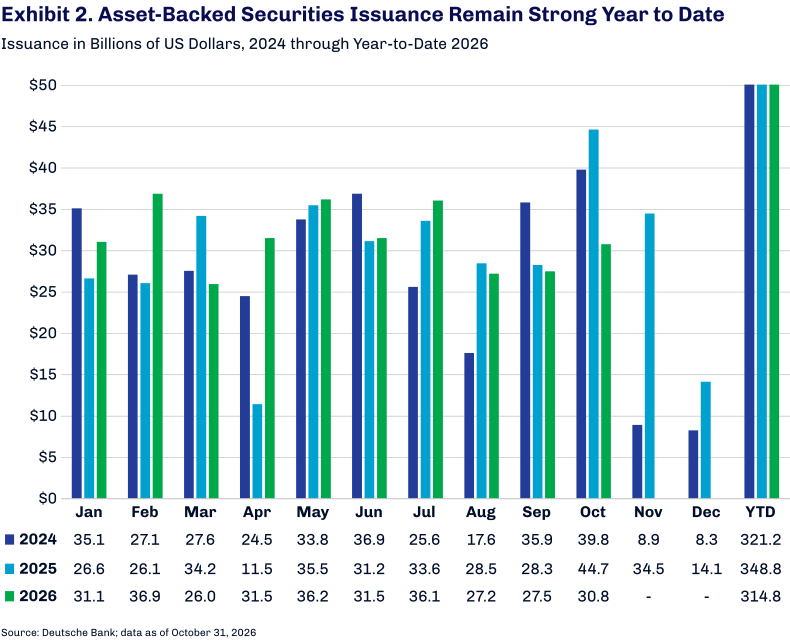
- ABS issuance increased modestly in October to $30.8 billion, compared to an average of $27.4 billion over the prior two months. Year-to-date issuance for 2026 ($314.8 billion) remains well ahead of similar time periods for 2025 ($300.1 billion) and 2024 ($304.0 billion). As year end approaches, issuance is expected to slow slightly, following a similar trend to 2025 (final two-month average of $24.3 billion) and ahead of 2024’s average ($8.6 billion).
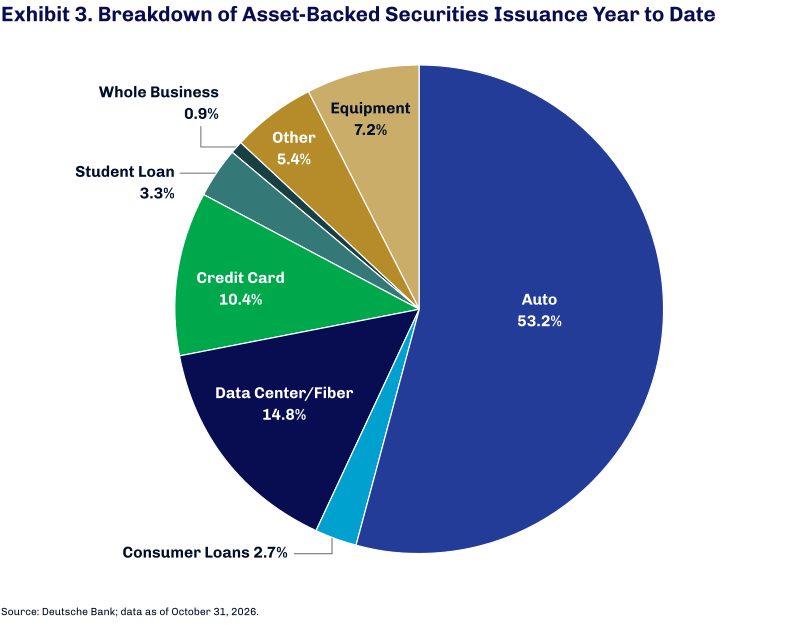
- Auto ABS remains the dominant sector from an issuance standpoint, representing more than half of October’s issuance (53.2%). Data center/fiber represented nearly 15% of new issuance with six new data center deals and three fiber deals, and credit card and equipment coming in at 10.4% and 7.2%, respectively.
Commercial Mortgage-Backed Securities (CMBS) Trends in October3
Sector trends
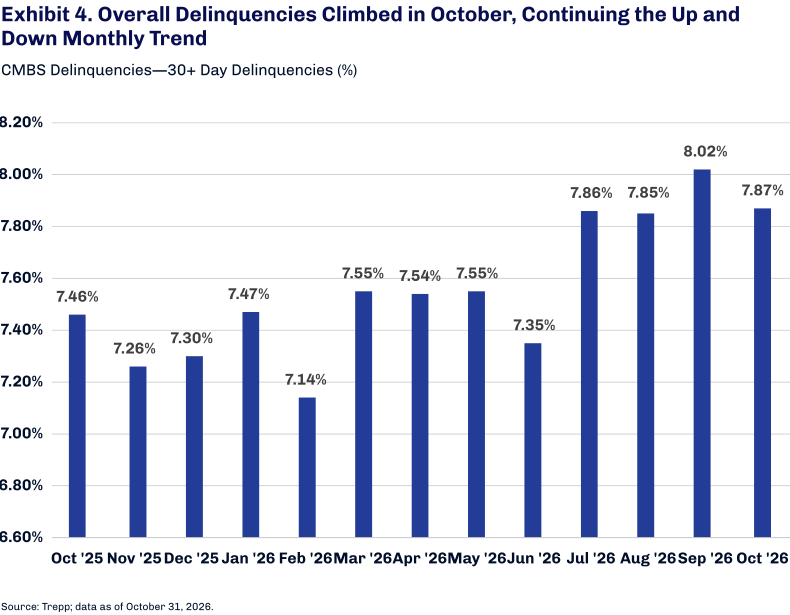
- Delinquency rate. Year over year +0.41% (7.46% to 7.87%).
- Serious delinquency rate. -0.16% month over month (7.87% to 7.71%). Represents the percentage of loans that are 60+ days delinquent, in foreclosure, real estate owned or non-performing.
- Office led new delinquencies during the month, with the largest newly delinquent loans including an office property in Los Angeles and an apartment property in the San Francisco area.
By property type level
- Multifamily. +0.05% to 8.09%.
- Office. +0.17% to 12.33%.
- Lodging. -0.24% to 5.94%.
- Retail. +0.63% to 7.21%.
- Industrials. -0.04% to 1.10%.
Issuance
- Year-to-date non-agency CMBS supply reached $149 billion, surpassing 2024’s full-year total of $112 billion and running 16% ahead of the same period in 2025.
Non-Agency Residential Mortgage-Backed Securities (RMBS)4
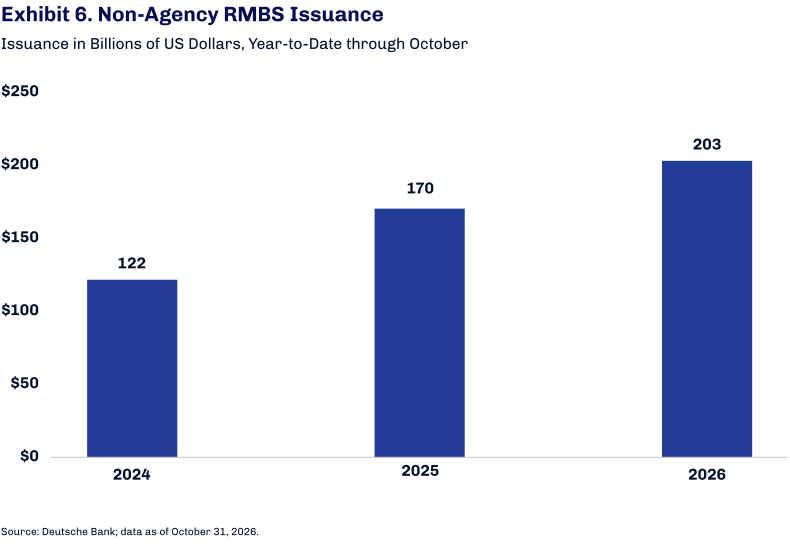
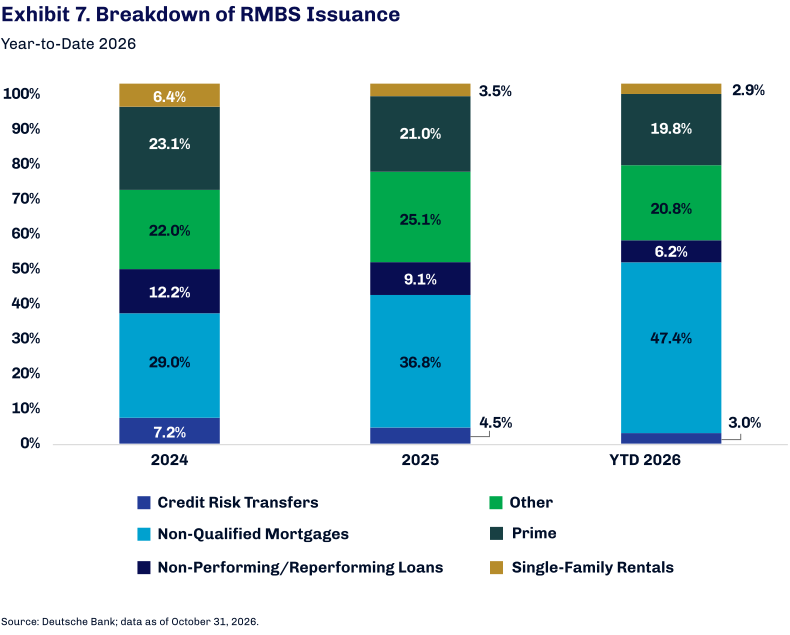
Non-agency RMBS issuance reached $203 billion year-to-date through October, up 19% from the same period in 2025 and 67% from 2024. Non-qualified mortgage (non-QM) issuance has been the main driver of growth, increasing 54% from 2025 and a staggering 173% from 2024 levels. As a reminder, non-QM RMBS do not meet guidelines set forth by the Consumer Financial Protection Bureau and offer more flexibility for eligibility and documentation criteria.
Meanwhile, issuance in the other category, primarily consisting of home equity lines of credit, home equity loans and reverse mortgages, has slowed to levels in line with 2025 but remains well above 2024.
1 Source: Barclays; data as of October 23, 2026.
2 Source: Barclays; data as of October 22, 2026.
3 Source: Trepp; data as of October 31, 2026.
4 Source: Deutsche Bank; data as of October 31, 2026.
The information contained in this material is provided by First Eagle Investment Management, LLC (“FEIM”) and its global subsidiaries (collectively, “First Eagle”). FEIM is an investment adviser registered with the US Securities and Exchange Commission (SEC). Registration with the SEC does not imply a certain level of skill or training.
This material is for informational purposes only and reflects prevailing conditions and the judgment of the author(s) as of the date of publication, all of which are subject to change. This material should not be relied upon as investment advice; it does not constitute a recommendation to buy or sell a security or other investment; and it is not intended to predict or depict the performance of any investment. This material is not being provided in a fiduciary capacity and is not intended to recommend any investment policy or investment strategy or consider the specific objectives or circumstances of any investor. We consider the information in this material to be accurate, but we do not represent that it is complete or should be relied upon as the sole source of appropriateness for investment.
Prospective investors should inform themselves and consult with an investment, tax or legal professional as to any applicable legal requirements, taxation and exchange control regulations in the countries of their citizenship, residence or domicile that may be relevant prior to investing.
This material does not constitute an offer or solicitation in any jurisdiction where or to any person to whom it would be unauthorized or unlawful to do so.
All investments involve the risk of loss of principal.
Investments in bonds are subject to interest-rate risk and can lose principal value when interest rates rise, while they typically increase their principal values when interest rates decline. Bonds are also subject to credit risk, in which the bond issuer may fail to pay interest and principal in a timely manner, or that negative perception of the issuer’s ability to make such payments may cause the price of that bond to decline.
Strategies whose investments are concentrated in a specific industry or sector may be subject to a higher degree of risk than funds whose investments are diversified and may not be suitable for all investors.
Diversification does not guarantee investment returns and does not eliminate the risk of loss.
Past performance does not guarantee future results, which may vary. The value of investments and the income derived from investments will fluctuate and can go down as well as up. A loss of principal may occur.
Spread typically is used to express the difference between two interest rates.
Mortgage-backed securities (MBS) are debt securities whose payments of principal and interest are backed by the cash flow generated by pools of mortgage loans.
Residential mortgage-backed securities (RMBS) are debt securities whose payments of principal and interest are backed by the cash flow generated by pools of residential mortgage loans.
Asset-backed securities (ABS) are debt securities whose payments of principal and interest are backed by the cash flow generated by pools of income-producing credit assets.
Commercial mortgage-backed securities (CMBS) are debt securities secured by cash flows from commercial real-estate mortgages.
Investment grade corporate bonds are debt securities issued by corporations perceived to have a relatively low risk of default.
High yield bonds (also called junk bonds) are bonds deemed by rating agencies to have a higher risk of default and thus offer investors a higher interest rate than investment grade bonds.
The information presented does not reflect the performance of any fund, strategy or account managed or serviced by First Eagle, and there is no guarantee that investors will experience the type of performance reflected. There is no guarantee that any market forecast set forth in this material will be realized. There is no guarantee that any historical trend referenced herein will be repeated in the future, and there is no way to predict precisely when such a trend will begin. The mention of specific securities is not a recommendation or solicitation to buy, sell or hold any particular security and should not be relied upon as investment advice.
Availability of the products or services described may be restricted by law in certain jurisdictions. This material may not be distributed, published or used by any person or entity in any jurisdiction or country where such distribution or use would be contrary to local law or regulation.
United Kingdom: Napier Park Global Capital Ltd. is authorized and regulated by the Financial Conduct Authority (FRN: 541427).
Middle East: This material is for information purposes only and has not been, and will not be, registered with or reviewed or approved by any regulator located in the Middle East. It does not constitute or form part of any marketing initiative, any offer to issue or sell, or any solicitation of any offer to subscribe to or purchase, any products, strategies or other services, nor shall it, or the fact of its distribution, form the basis of, or be relied on in connection with, any contract resulting therefrom. In the event that the recipient of this material wishes to receive further information regarding any products, strategies or other services, it shall specifically request the same in writing from an authorized financial adviser.
Canada: Pursuant to the international adviser registration exemption in National Instrument 31-103, First Eagle Investment Management, LLC. is informing you that: (i) First Eagle Investment Management, LLC. is not registered in Canada and is advising you in reliance upon an exemption from the adviser registration under National Instrument 31-103; (ii) First Eagle Investment Management, LLC’s jurisdiction of residence is New York, USA; (iii) there may be difficulty enforcing legal rights against First Eagle Investment Management, LLC. because it is a resident outside of Canada and all or substantially all of its assets may be situated outside of Canada.
FEF Distributors, LLC (“FEFD”) (SIPC), a limited purpose broker-dealer, distributes certain First Eagle products. FEFD does not provide services to any investor but rather provides services to its First Eagle affiliates. As such, when FEFD presents a fund, strategy or other product to a prospective investor, FEFD and its representatives do not determine whether an investment in the fund, strategy or other product is in the best interests of, or is otherwise beneficial or suitable for, the investor. No statement by FEFD should be construed as a recommendation. Investors should exercise their own judgment and/or consult with a financial professional to determine whether it is advisable for the investor to invest in any First Eagle fund, strategy or product.
First Eagle Investments is the brand name for First Eagle Investment Management, LLC and its subsidiary investment advisers. Diamond Hill is the brand name for Diamond Hill Capital Management, LLC, an investment adviser.
©2026 First Eagle Investment Management, LLC. All rights reserved.