


Macro & Market Views
Railcar Leasing for Insurers: The HALO Effect
Railcar Leasing for Insurers: The HALO Effect
Napier Park Global Capital
Railcars are mission critical to the North American industrial and agricultural economy, transporting food, fuel, fertilizer and countless other essentials across the continent.
- Investments in railcar leasing may represent an attractive option for insurers, offering steady, diversified, contractual income streams with risk characteristics comparable to higher-grade credit along with embedded potential upside through lease repricing, residual value realization and active asset management.
- Accelerated depreciation and capital-efficient investment structures can potentially amplify after-tax cash yields and internal rates of return for domestic insurers.
- Perpetual capital structures enable long-term asset ownership, reducing the need for forced sales, enhancing compounding through ongoing reinvestment and tax efficiency, and supporting asset-liability management.
- Underpinned by long-lived physical assets that provide stipulated cash flows, maintain durable residual values and possess little risk of obsolescence, railcar leasing historically has generated returns differentiated from public markets and positively correlated to inflation and interest rates.1
- We believe that scale, risk management and operational knowledge, as provided by highly experienced real assets teams, may help maximize the opportunities potentially available through railcar leasing.
In our view, railcars represent one of the most durable of the HALO (heavy asset, low obsolescence) sectors bridging the analog past to the digital present. Owning and leasing railcars to the producers of these critical goods presents an attractive opportunity to generate a differentiated return stream that has historically exhibited low correlation to traditional financial markets while maintaining resilience across economic cycles.
Railcar leasing combines contractual, credit-like cash flows with long-lived assets that retain residual value and benefit from cyclical repricing. For investors, the result is downside mitigation we believe is comparable to investment grade credit, durability similar to infrastructure, and embedded upside through lease rate resets and asset management. For insurers, investments in railcar leasing may support asset-liability management (ALM) through exposure to long-lived assets, favorable tax treatment and capital-efficient structures.
Despite many appealing characteristics, railcar leasing remains structurally under-allocated in many insurance portfolios. As discussed here, however, we believe a range of short- and long-term secular trends favor railcar lessors and their insurance investors.
Insurers May Further Benefit from Accelerated Depreciation and Capital Efficiency
Though railcar leasing has a long track record of success, tax legislation enacted in 2025 provided what we view as an additional boost to the investments’ appeal. Although railcars typically have useful lives of 40–50 years, the tax code now dictates that qualifying new and used railcars acquired after January 19, 2025, may be eligible for 100% first-year bonus depreciation.2 By accelerating deductions that otherwise would be recognized over many years, this treatment can be viewed as providing tax-deferral comparable to interest-free financing from the government. It can convert a portion of an insurer’s current taxable railcar leasing income into a deferred tax liability, enhancing near-term after-tax cash flows and potentially improving long-term investment returns.
The impact can be material for certain investors. Allocated depreciation may reduce—or initially exceed—the taxable income associated with cash distributions from railcar-leasing operations. For an insurer with the income capacity to use the full value of these deductions, this tax provision may bolster after-tax cash yield and after-tax internal-rates-of-return above investments generating the same pre-tax cash return but without depreciation benefits.
An actively managed strategy may enhance the durability of the depreciation benefit. As the manager acquires additional qualifying new or used railcars, new depreciation deductions can replenish the pool of tax deductions while older railcars remain in the portfolio and continue generating lease income. This combination of consistent cash flow and recurring depreciation can help support a more persistent tax-efficient income profile than ownership of a static pool of assets.
For insurers in particular, investing in railcar-leasing strategies can enhance capital efficiency under specific conditions. While direct investments in funds typically default to the National Association of Insurance Commissioners (NAIC) “Schedule BA: Other Invested Assets” for statutory accounting purposes with risk-based capital charges (RBC) of 45% (for life insurers), certain look-through frameworks may qualify for a substantially lower regulatory capital charge based on the economically more resilient underlying assets.
Owning Serial Numbers, not CUSIPs
Railcars represent an asset that offers a stable income profile similar to some higher grade fixed income securities combined with the total return potential of some alternative assets. Underpinned by long-lived physical assets—not securities—that provide contractual cash flows and maintain durable residual values, investments in railcars historically have generated a return profile characterized by:
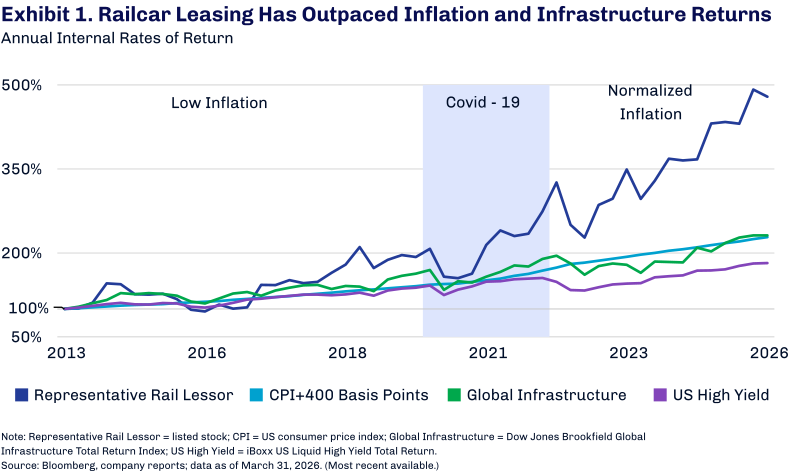
- Outperformance relative to inflation and global infrastructure benchmarks, as shown in Exhibit 1.
- A low correlation to traditional financial markets and low sensitivity to idiosyncratic macroeconomic or geopolitical disruptions.3
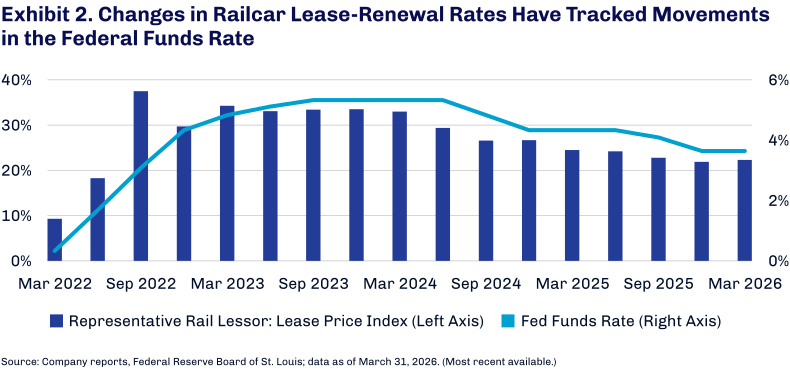
- Lease renewal rates that keep pace with changes in the federal funds rate, as shown in Exhibit 2.
- Low historical writeoffs for industry-leading lessors.4
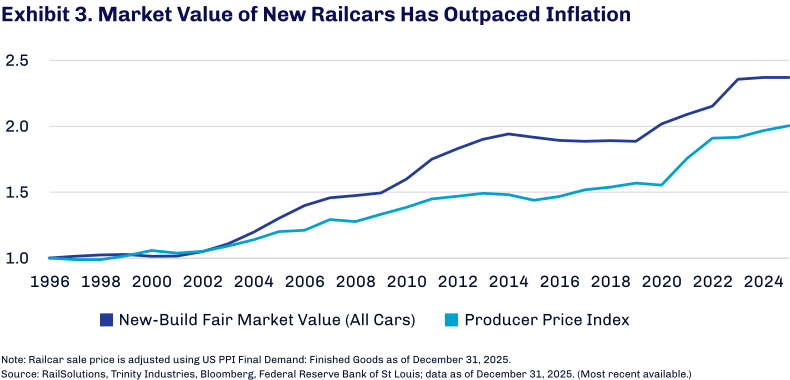
- New-build fair market value increases that exceed inflation, as shown in Exhibit 3.
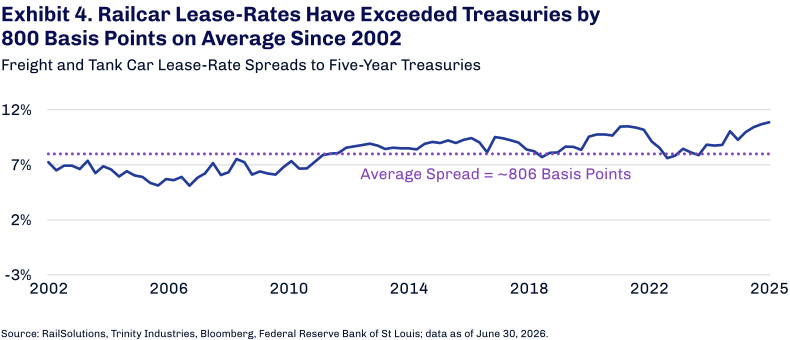
- Lease-rate spreads that historically have exceeded interest rates, as shown in Exhibit 4.
- Insulation from technological trends like artificial intelligence (AI) that have buffeted other investments.
Diversification Targeted through Allocations to Alternative Fixed Income/Credit
Potentially offering consistent yields, backed by tangible, essential infrastructure assets with low correlation to public equities and robust inflation-hedging characteristics, an allocation to railcar leasing may provide meaningful diversification benefits for insurers within the fixed income or alternative credit segment of a portfolio. A diversified portfolio of railcars carries exposure to nearly every agricultural or industrial manufacturing market in North America, providing end-market diversity and a potential mitigation of certain inflationary pressures.
Railcar leasing funds may serve as a higher-yielding substitute for traditional public corporate bonds. Multiyear, contractually-backed leases—often with investment-grade corporate counterparties—provide debt-like cash flows. In compressed spread environments, leased rail assets may deliver yield enhancement without introducing incremental credit risk or equity volatility. Thoughtfully structured railcar leasing portfolios—with look through to underlying assets and leases—may achieve lower and more stable overall RBC burdens than less transparent private credit vehicles.
Railcar leasing combines features of both real asset and traditional private credit investing, offering contractual income from higher quality (BBB) lease counterparties alongside tangible asset backing and potential participation in asset value appreciation. The relatively modest unit cost per railcar and tradability can also support portfolio construction in managing exposure across the broader alternatives spectrum. Within a strategic asset allocation framework, these attributes may complement traditional direct lending and other private credit strategies, potentially broadening diversification across collateral types and return drivers.
Napier Park’s Competitive Advantages: Scale, Risk Management and Operational Flexibility*
Through decades of investment and operational experience, Napier Park’s Real Assets team has developed railcar expertise on both sides of the balance sheet. Combining scale with flexible risk management, we leverage our expertise to focus on generating stable returns for investors with inherent inflation risk mitigation.
Scale and diversification. With a fleet of over 30,000 railcars and more than 50 railcar types carrying a range of commodities, our aggregate portfolio is well-diversified to mitigate sector-specific volatility. This scale is underpinned by a diversified customer base of more than 450 counterparties across 30 industries layered across tens of industrial verticals. Our counterparties have a strong average credit rating of BBB+ and staggered lease maturities that ensure stable cash flows.
Focus on downside mitigation. Our investment approach seeks to obtain value from diversity—across types of railcars, counterparties and sectors served—aimed to create a durable, resilient and downside- mitigated return through market cycles that allows investors to effectively match long-dated liabilities.
Differentiated sourcing and information edge. Our scale and deep industry relationships provide real-time visibility into pricing, lease rates and utilization across the market. This data-driven insight supports disciplined underwriting and enables us to identify relative value across equipment types, counterparties and transaction structures.
Our reputation as a reliable solutions-oriented capital provider, combined with the absence of public-market deployment pressure, positions us to access a broad range of opportunities across new build, secondary acquisitions and portfolio transactions. Our repeated access—across market cycles—enhances selectivity and supports consistent capital deployment into attractively priced assets.
Operational leverage and agility. Through our nimble, variable-cost model, we strive to bolster margins and increase operating leverage, facilitating potential return expansion during market upswings while shielding against cyclical lulls. At the same time, deep industry relationships provide market insight and access to transactions across new build, secondary and portfolio acquisitions, supporting consistent deployment across market cycles.
* Source: Napier Park Global Capital; data as of September 30, 2026.
The New Old Thing
For nearly 200 years, rail shipping has been a foundational component to the development of the US economy. Today, the freight network covers almost 135,000 miles of rail across North America, efficiently hauling 1.5 billion tons of raw materials and finished goods in a typical year at a lower cost and with a lower environmental impact than the alternatives.5
While financial markets in recent years have been focused on the asset-light information economy and, more recently, the potentially disruptive impacts of advancements in AI, so-called HALO businesses have emerged as the new old thing. Rail stands out within this shift, representing infrastructure that is both essential and difficult to replace; if anything, rail networks may be enhanced by AI as it optimizes routes, improves network utilization and enables predictive maintenance.
Potential resilience in the face of AI is only one reason a real-economy investment like railcars has returned to the collective consciousness. Several structural factors also reinforce demand for rail transport. Continued US economic growth supports freight volumes, while ongoing efforts by US manufacturers to retool their supply chains—including expansions of their domestic footprints—in the aftermath of disruptive events like Covid-19 and the Trump administration tariffs have increased domestic transportation needs. 6,7 At the same time, elevated labor and materials costs have inflated new railcar prices, while higher capital costs have raised the cost of ownership, a combination that has suppressed new supply, bolstered residual values of existing cars and reinforced the appeal of leasing for shippers. And with one gallon of fuel able to move one ton of freight 500 miles by rail, rail produces 75% less greenhouse gas emissions than trucking, and its environmentally friendly profile is well-aligned with the increasing popularity of green logistics.8
With the utilization rate of lessor-owned railcar fleets already running above 95%, and averaging 96% over the last 20 years, we believe these short- and long-term secular trends, combined with more normal interest rates, bode well for railcar leasing fundamentals.9 As shown in Exhibit 2, lease renewals have historically occurred at rates above those of the expiring leases they replace, with changes generally tracking movements in the federal funds rate.10
The Enduring Role of Railcar Leasing
The current environment underpins the case for railcar leasing. The supply of railcars is constrained due to elevated manufacturing and financing costs, while demand is supported by resilient end markets, onshoring trends and the continued need for cost-efficient bulk transport. Higher interest rates have increased the cost of ownership for industrial users, making leasing more attractive and reinforcing pricing power for lessors. At the same time, rail remains one of the most cost-efficient and environmentally favorable modes of bulk transportation, supporting long-term demand.
While technological innovation continues to dominate financial headlines, the functioning of the US economy still depends on the physical infrastructure that moves essential goods across the country. Rail networks remain a critical backbone of this system, transporting food, fuel, chemicals and raw materials at scale.
In our opinion, railcars represent one of the most durable segments within what have been described as HALO sectors. These are asset classes defined by long useful lives, limited technological displacement risk and persistent real-economy demand.
Owning and leasing railcars to the industries that produce broadly needed goods enables investors to generate diversified, contractually obligated income streams from long-lived, essential-use equipment with the potential to preserve residual value over time. The end result is an income profile that combines investment grade-like risk characteristics with total return potential typically associated with higher yielding strategies. Moreover, the dynamics of railcar-market technicals historically have translated into a low correlation to other financial assets and a positive correlation to inflation and interest rates, among other attractive characteristics.11
Income from railcar leasing combines investment grade-like risk characteristics with the return potential of some higher yielding strategies.
Although the ebb and flow of next-gen technologies like AI may continue to disrupt investments across asset classes and industries, we believe railcars are structurally insulated from many of these forces—in both the short and long terms—as secular trends continue to favor railcar lessors and investment in the space. Specialized teams with decades of expertise investing in, operating and managing railcar fleets may be well-positioned to help sophisticated investors access this attractive sector of the old economy.
Market Technicals Favor Railcar Owners/Lessors
The US railcar market is dominated by lessors. These entities control about 70% of the 1.6 million rail cars in the system, with a heavy concentration (about 75%) among the five largest players.12 Lessors of railcars lease their rolling stock to the producers of raw materials or finished goods to facilitate distribution via the North American rail network. Lessors and their investors benefit from contractual cash flows, steady residual values and substantial depreciation-based tax benefits.
Rail lessors benefit from contractual cash flows, steady residual values and potential tax benefits.
Lessees—a highly fragmented group of companies participating in hundreds of industrial subsectors from agriculture and chemicals to food and energy—are able to transport their goods while keeping the very large capital outlays associated with building a fleet of railcars off their balance sheets. Further, they can do so cost-effectively, as the value of goods shipped typically is many multiples of the leasing cost; for example, a large grain car leasing for $650 per month might haul $120,000 per month in revenue.13 This also contributes to price insensitivity by lessees, and lessors typically have little difficulty passing along rising costs as contracts turn over.
The largest rail-freight shippers are North American industrials—many have strong investment grade credit ratings, and even those without public debt profiles are often of high quality.14 Reflecting the essential-use nature of railcars to lessees, historical write-offs for industry-leading lessors have averaged only 18 bps of revenue annually since 2007.15
Inflation and higher capital costs have not only bolstered demand for leased railcars but also have underpinned prices for new railcars, as shown in Exhibit 3, which has suppressed new supply of these long-lived assets. With the size of the railcar fleet having remained essentially flat over the past 30 years, supply and demand dynamics in the rail transport industry have been biased toward lessors.16
Railcar leasing has historically demonstrated resilience across economic cycles. Demand is supported by the transportation of essential goods, while diversified exposure across industries reduces reliance on any single sector. During periods of economic stress, lease rates may adjust—historically to levels above Treasuries, as shown in Exhibit 4—while high utilization levels and the ability to redeploy assets have historically supported continued cash flow generation.
Actively Managing Credit Risk Within the Fleet While Seeking to Maximize Residual Value
Railcar investments have generally demonstrated strong resilience to intermittent macro and geopolitical events, such as economic slowdowns, higher interest rates, regulatory tightening and trade conflicts. The two primary investment-risk exposures for railcar lessors—which affect both their cost of capital to finance equipment and potential risk-adjusted returns—are lease-counterparty risk and residual value risk.
Counterparty risk can be mitigated by assessing and monitoring the creditworthiness of lessees, balancing the investment grade/sub-investment grade mix, and avoiding concentrations in any single obligor or industry —facilitated by scale and diversification—as shown in Exhibit 5. Understanding the interplay between counterparties and the potential impacts of systemic shocks on seemingly unrelated lessees is key, as is structuring lease terms to manage duration across the portfolio. With a much lower average ticket size than other transportation classes, building a diversified fleet of railcars—not only by counterparty but also industry, geography and car type—is quite achievable.17
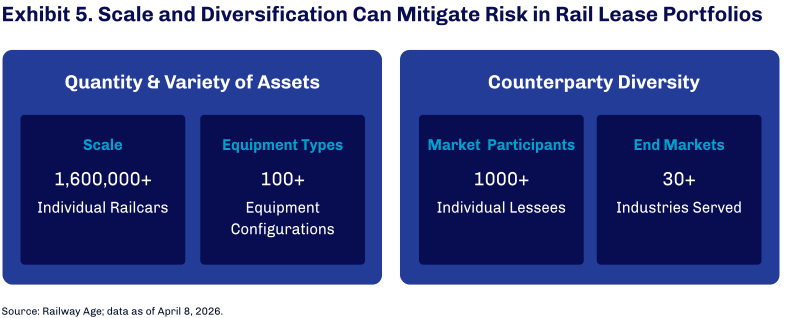
In addition to the structural provisions of industry-standard leases to help preserve the residual value of rail assets, active fleet management can help maximize residual value potential. To this end, railcar lessors model the useful life and physical durability of their equipment to understand longevity while analyzing economic depreciation and elasticity of lease rates as assets age. Technological obsolescence, which is relatively minimal in the world of fungible railcars, is nonetheless gauged to evaluate replacement risk in the face of value-diminishing innovation. Finally, original-equipment manufacturing production capacity is monitored to understand fluctuating supply. All of this is done within the context of examining how the economics of different equipment types move together to evaluate prospective benefits of diversifying the fleet.
With a highly liquid secondary market for railcars—approximately 2-3% of the 1.6 million car fleet turns over annually—strategic opportunities for lessors to optimize fleet configurations and maximize tax benefits may prevail.18
Mapping Long-Duration Capital to Long-Lived Assets for Potentially Enhanced Outcomes
Structural alignment between long-lived assets and long-duration capital enhances the potential to generate higher risk-adjusted returns through improved asset management and capital efficiency.
Unlike structural short-term ownership with needs to manage liquidity, asset sales in long-term portfolios need occur only when economically prudent. By avoiding forced sales, long-term ownership allows investors to capture the full economic life of assets, maintain tax advantages where applicable and benefit from continuous reinvestment, providing a structural source of return enhancement over multiple cycles.
For those allocators that are able to avail of the tax benefits associated with North American railcar ownership, another valuable consideration for long-term exposure to these assets is that it prevents triggering the tax liabilities that accompany the end of typical forced short-term ownership periods. As a result, long-term ownership of leased railcar assets does more than just help move freight across the continent: it can also provide stable, counter-cyclical ballast in investment portfolios.