


Macro & Market Views
The Mortgage Market's Interest Rate Dilemma
The Mortgage Market's Interest Rate Dilemma
Diamond Hill
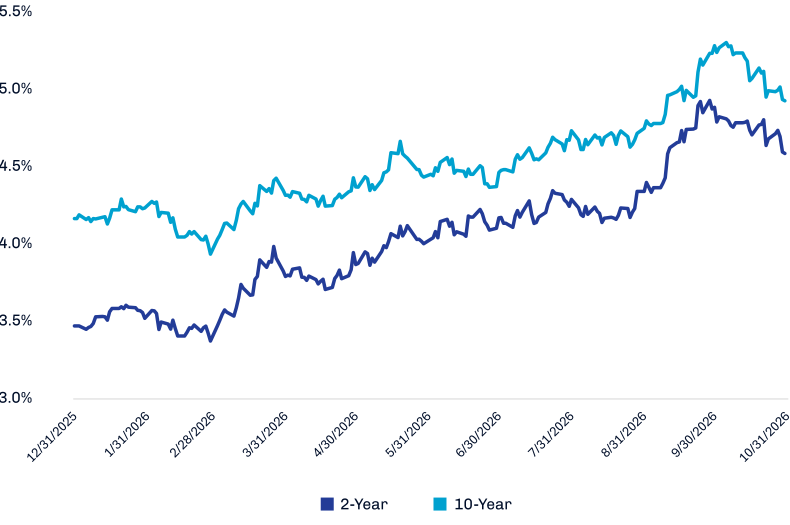
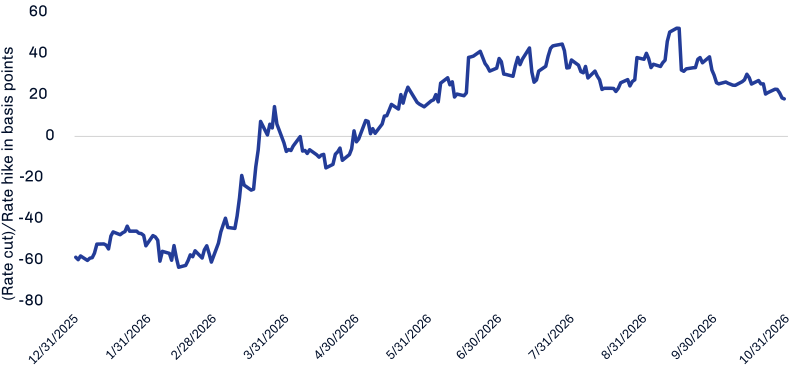
Interest-rate volatility has been a defining feature of fixed-income markets in 2026, with the mortgage market experiencing particularly pronounced effects. Expectations for Federal Reserve policy have shifted dramatically since the beginning of the year, moving from anticipated rate cuts to a more hawkish outlook following the Fed's first rate increase since 2023 in September (Exhibit 1). Persistent inflationary pressures, driven in part by rising energy prices associated with the conflict in Iran and concerns surrounding the ongoing AI infrastructure buildout, have complicated the outlook for monetary policy.
While rising interest rates create near-term challenges for fixed-income investors as bond prices decline, higher yields can also provide greater income opportunities over time. As discussed in a recent insight, Rising Rates: Lessons from 2022, an important distinction between the historic fixed-income market selloff of 2022 and the current environment is the substantially higher starting yield entering 2026. This additional income provides a greater cushion against rising rates than investors experienced four years ago.
Despite this improved starting point, the impact of higher rates has not been uniform across fixed-income sectors. Agency mortgage-backed securities (MBS) have been particularly sensitive to changing interest-rate expectations (Exhibit 2), reflecting the unique prepayment and extension risks embedded in these investments. At the same time, elevated mortgage rates have reinforced the housing market's lock-in effect, discouraging homeowners from selling or refinancing and further complicating the outlook for mortgage investors.
Together, these dynamics highlight both the challenges facing the mortgage market and the importance of understanding how different mortgage structures respond to changing interest-rate conditions.
Exhibit 1. Yields on 2-Year and 10-Year Treasuries Year to Date
Source: Bloomberg, data as of October 31, 2026.
Exhibit 2. Market Expectations for Federal Reserve Action by Year-End 2026
Source: Bloomberg, data as of October 31, 2026.
Mortgages as an Investment
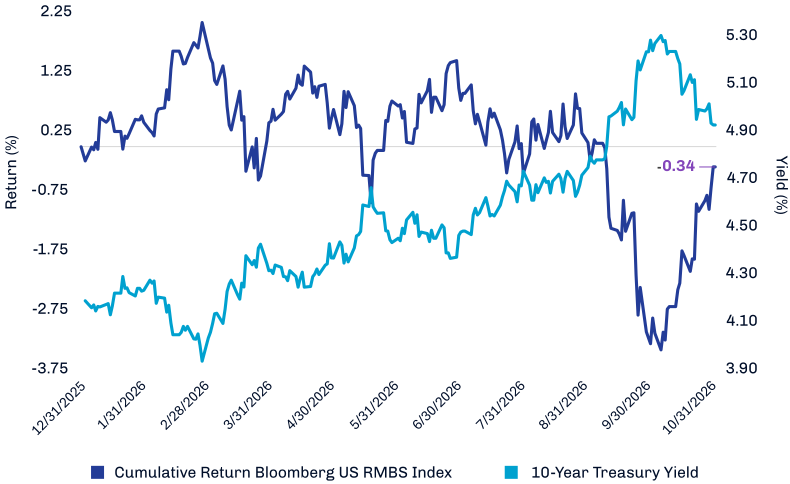
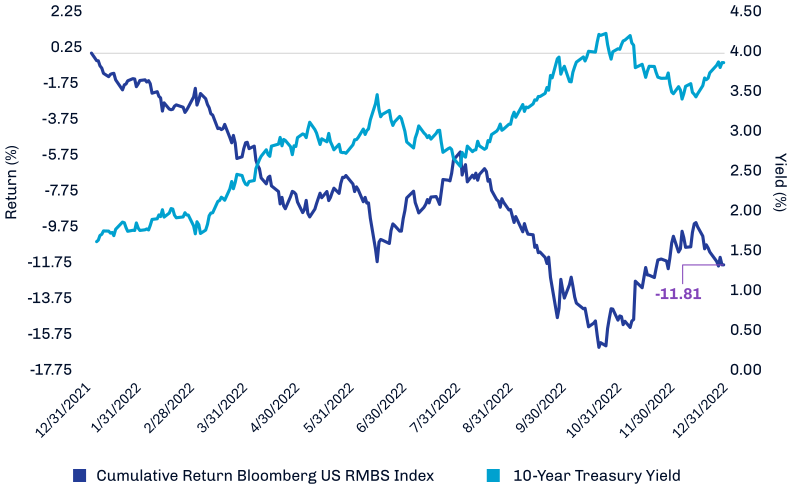
As rates have pushed higher across the yield curve in 2026, the mortgage market (as measured by the Bloomberg US MBS Index) has experienced greater pressure than other areas of the market such as asset-backed securities, investment grade corporate debt and commercial mortgage-backed securities. Agency passthrough mortgages carry a higher sensitivity to interest rate movements as the optionality that they carry adjusts to the current interest rate environment. When rates move higher, mortgage holders are less likely to refinance and pay off their current mortgage, thus extending the life of the mortgage and increasing duration or sensitivity to interest rate movements. Conversely, when rates drop, homeowners will look to refinance out of a higher mortgage rate, paying off their mortgage and saddling investors with excess cash in a lower rate environment. Exhibit 3 illustrates how the shift in interest rates in 2026 has impacted the cumulative return of the Bloomberg US MBS Index and Exhibit 4 provides a comparison to market movements in 2022.
Exhibit 3. 2026 Illustrates the Impact of Rates Moves on Mortgages
Source: Bloomberg; data as of October 31, 2026.
Exhibit 4. 2022 Was a Different Story
Source: Bloomberg; data as of October 31, 2026.
An examination of the Bloomberg US MBS Index illustrates how the mortgage market has shifted over the last 20 years, with rising interest rates driving a substantial shift into higher-coupon mortgages. Exhibit 5 illustrates how the mortgage market has evolved over time, highlighting a pronounced shift into higher-coupon mortgages over the past 10 months. With the current national 30-year mortgage rate above 7%, expectations for any kind of prepayment wave for the mortgages held in the index are highly unlikely. This is most apparent when we break down the overall mortgage market, not just mortgages held in the index. The share of index MBS with coupons of 5% or higher increased from approximately 32.1% in 2025 to 37.4% in October 2026, illustrating how the composition of the agency MBS market is gradually shifting toward higher-coupon mortgages, even as lower-coupon mortgages remain a substantial portion of the index.1
Exhibit 5. Mortgage Coupon of Index Mortgage-Backed Securities
| Coupon | 2006 | 2016 | 2025 | October 2026 |
|---|---|---|---|---|
| 2.0% | 0.0% | 0.6% | 21.9% | 19.9% |
| 2.5% | 0.0% | 6.5% | 16.5% | 14.8% |
| 3.0% | 0.0% | 30.3% | 10.4% | 9.2% |
| 3.5% | 0.1% | 30.3% | 7.6% | 6.9% |
| 4.0% | 2.2% | 17.2% | 6.1% | 5.7% |
| 4.5% | 9.5% | 7.6% | 5.5% | 6.2% |
| 5.0% | 28.1% | 3.8% | 8.1% | 11.8% |
| 5.5% | 31.3% | 2.2% | 10.8% | 13.2% |
| 6.0% | 19.2% | 1.3% | 8.9% | 8.7% |
| 6.5% | 7.1% | 0.3% | 3.5% | 3.1% |
| 7.0% | 1.8% | 0.0% | 0.7% | 0.6% |
| 7.5% | 0.5% | 0.0% | 0.1% | 0.0% |
| 8.0% | 0.2% | 0.0% | 0.0% | 0.0% |
Source: Bloomberg; data as of October 31, 2026.
But is there an alternative to the volatility and uncertainty that comes with interest rate-sensitive mortgages? For investors seeking exposure to the agency mortgage market while managing the impact of interest rate fluctuations, collateralized mortgage obligations (CMOs), a special purpose entity that owns the mortgages in the pool and organizes them into classes based on their risk profile, offer an alternative with distinct cash flow characteristics. Income received from the mortgage pool is passed to investors based on a predetermined set of rules and those investors receive money based on the specific slice of mortgages they are invested in (called a tranche). One of the most common examples of this type of security is the planned amortization class (PAC), a tranche that receives a primary payment schedule and is, to a certain extent, protected from both prepayment and extension risk.
The Golden Handcuffs of Mortgage Lock-In
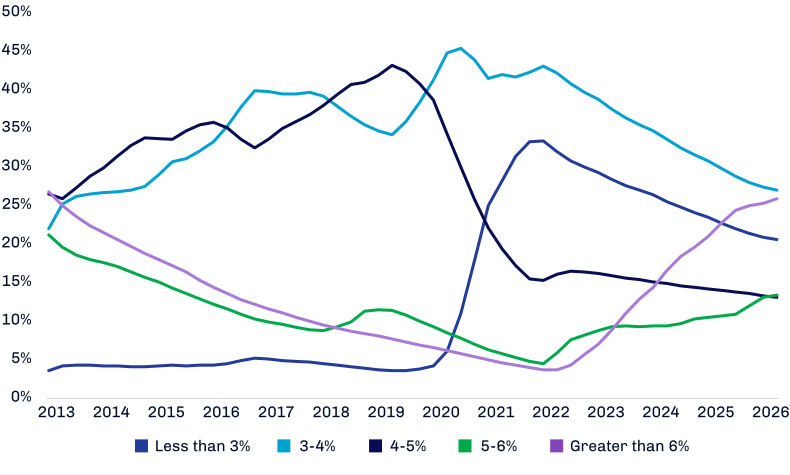
Elevated mortgage rates have created an unprecedented lock-in effect in the US housing market, as homeowners with historically low mortgage rates are reluctant to sell and take on substantially higher borrowing costs. An analysis of data available from the Federal Housing Finance Agency’s National Mortgage database indicates that as of the end of the second quarter 2026 (most recent data available), roughly 74.1% of outstanding mortgages in the United States carry an interest rate below 6%, with nearly half of all mortgages below 4%. Exhibit 6 illustrates the shift in outstanding mortgage coupon rates since 2013, with recent increases in mortgages carrying greater than 6% coupons due to the shift higher in rates. With current mortgage rates hovering above 7%, the term “golden handcuffs” describes the reluctance of homeowners with significantly lower mortgage rates to move or refinance, given the prospects of substantially higher borrowing costs.2
This dynamic has constrained housing supply, reduced mobility and contributed to elevated home prices despite higher borrowing costs. By comparison, in early 2022, approximately 75.6% of mortgages were 4% or lower, yet refinancing opportunities remained, with Bankrate.com’s U.S. Home Mortgage 30-year Fixed National Average at 3.27% at the end December 2021. Unlike previous tightening cycles, the magnitude and duration of the current rate increase have made the lock-in effect particularly severe, with a meaningful decline in mortgage rates likely necessary to restore housing market activity.3
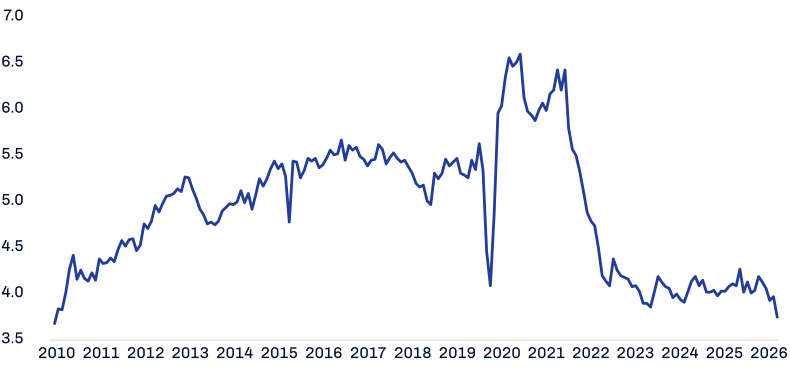
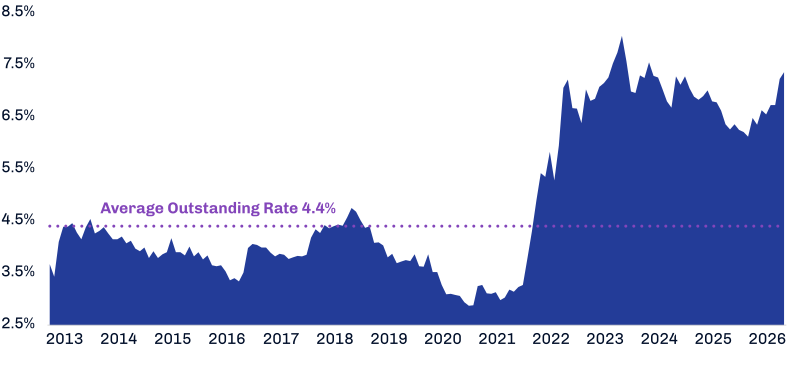
The October 2026 report from the National Association of Realtors showed a 5.5% decline in existing home sales to 3.75 million (Exhibit 7). This marks the strongest decline since January 2026 and the lowest activity level since August 2010, when the economy was still working through the housing bubble bursting and fallout from the financial crisis. On a year-over-year basis, sales dropped nearly 9% this year, the largest year-over-year drop since 2023. Exhibit 8 demonstrates the move higher in the 30-year fixed rate mortgage with the average outstanding rate of 4.4% since 2013, exacerbating the golden handcuffs effect that discourages homeowners from moving.3,4
Exhibit 6. Shift in Outstanding Mortgage Interest Rates
Percent of Market Outstanding (%)
Source: FHFA, National Mortgage Database; data as of June 30, 2026.
Exhibit 7. Existing Home Sales
Millions of Sales
Source: National Association of Realtors, Bloomberg; data as of October 31, 2026.
Exhibit 8. Bankrate.com US Home Mortgage 30-Year Fixed Rate
Source: Bankrate.com, Bloomberg; data as of October 31, 2026.
The combination of elevated mortgage rates, limited refinancing incentives and constrained housing market activity presents a challenging environment for mortgage-backed securities. With a substantial portion of outstanding mortgages carrying coupons well below prevailing market rates, prepayment activity is likely to remain subdued unless interest rates decline meaningfully. For investors, this reinforces the importance of managing extension risk and understanding the cash flow characteristics of their mortgage exposure.
While traditional agency passthrough securities remain vulnerable to changes in interest-rate expectations, carefully selected CMO structures, including planned amortization classes, may offer opportunities to achieve more predictable cash flows within specified prepayment assumptions. In an environment where interest-rate uncertainty remains elevated, security selection and an understanding of mortgage structure will continue to play an important role in fixed-income portfolio construction.