


Macro & Market Views
The Mortgage Market Mosaic: Understanding Modern Mortgage-Backed Securities
The Mortgage Market Mosaic: Understanding Modern Mortgage-Backed Securities
Diamond Hill
- The development of mortgage-backed securities transformed the mortgage market, connecting mortgage lending with institutional capital, increasing liquidity and expanding the availability of funding for housing.
- From pass-through securities to collateralized mortgage obligations (CMO), the market has developed structures designed to meet a range of investor needs.
- Mortgage securities carry distinct interest rate and cash flow risks. Changes in interest rates can alter borrower refinancing behavior, exposing MBS investors to prepayment and extension risk as well as negative convexity.
- Diamond Hill’s approach to MBS emphasizes bottom-up analysis and valuation to leverage idiosyncratic opportunities in a complex market, with a historical preference for CMOs over plain-vanilla MBS.
To understand today’s mortgage market, it’s helpful to examine its history and how it has grown into a $14.9 trillion market.1
The emergence of the mortgage-backed securities (MBS) market effectively decoupled the mortgage-lending activity of banks from mortgage investing, creating a new asset class and expanding the funds available for housing.
A Brief History of the US Mortgage-Finance Market
Potential homebuyers in the early part of the twentieth century faced significant hurdles to securing their piece of the American Dream. Mortgage loans at the time were largely funded by local banks and savings institutions, typically requiring down payments of up to 50% and structured with terms of 10 years or less and large balloon payments. Interest rates, meanwhile, tended to be high, reflecting the illiquidity of mortgages and their unhedgeable risks. Lacking a national capital market, mortgages also demonstrated significant regional disparities. As a result of these factors, homeownership rates stood only about 46% in 1930.2
With bank insolvency and mortgage defaults on the rise as a result of the Great Depression, Congress introduced a number of programs that ultimately served as the foundation for the modern US mortgage system.3 Among these was the 1934 creation of the Federal Housing Authority (FHA) to promote mortgage lending by insuring mortgages made by private-sector lenders. Four years later, the Federal National Mortgage Association (Fannie Mae) was launched to provide a liquid secondary market for these bank mortgages, enabling originators to sell newly minted mortgages to Fannie Mae and use the proceeds to underwrite additional mortgages.
In 1968, Fannie Mae was split into two separate agencies. The rechartered Fannie Mae became a privately owned government-sponsored enterprise (GSE) tasked with purchasing private mortgages, including those not insured by the FHA if they met certain criteria (these are known as conforming loans). The new Government National Mortgage Association (Ginnie Mae) resided within the Department of Housing and Urban Development and focused on acquiring FHA-insured mortgages as well as mortgages insured by the Department of Veterans Affairs and USDA Rural Development program. In 1970, the Federal Home Loan Mortgage Corporation (Freddie Mac) was created as a GSE targeting mortgages originated by savings and loan organizations, though its mandate has since converged with that of Fannie Mae.4
Emergence of Mortgage-Backed Securities
The creation of the GSEs and Ginnie Mae markedly improved liquidity in the secondary market for mortgages, promoting significantly increased lending activity. However, the ability of these agencies to finance their balance sheets remained a natural constraint on lending activity.
Enter securitization. By bundling loans and converting them into tradeable securities, agencies could tap into the deep capital stores of institutional investors like insurance companies, banks and asset managers to finance mortgage origination.
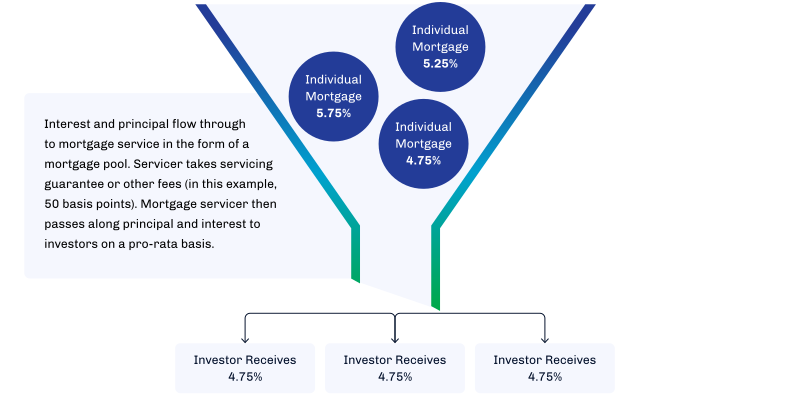
Initial MBS issuance was in the form of pass-through securities in which principal and interest payments from homeowners were passed through to investors on a pro-rata basis, as illustrated in Exhibit 1. Ginnie Mae was the first to act, issuing a mortgage pass-through consisting of FHA-guaranteed loans in 1970. Freddie Mac followed up in 1971 with a mortgage participation certificate—a type of pass-through MBS—made of mortgages not backed by a government pledge, meaning Freddie Mac itself was effectively guaranteeing timely payment.
Exhibit 1. Pass-Through Structure Distributes Cash Flows on Pro-Rata Basis
Source: Diamond Hill; data as of September 30, 2026.
Agency MBS are generally considered to have minimal credit risk. MBS issued by Ginnie Mae are backed by the “full faith and credit” of the US government. While there is no explicit guarantee on the securities issued by Fannie Mae and Freddie Mac, given their status as GSEs, consensus has been that these securities maintain an implied federal guarantee that would prevent a disastrous default.
The non-agency MBS market began to emerge in the late 1970s as an alternative to the government-backed MBS market. There was little private issuance until the mid-1980s, however, due to a number of regulatory and tax constraints. This changed with the passage of two laws: the Secondary Mortgage Market Enhancement Act of 1984 and the Tax Reform Act of 1986. The former removed many of the regulatory constraints limiting the ability of the private sector to participate in the secondary mortgage market, including state and federally regulated financial institutions. The latter eliminated the double taxation—at both the trust level and the investor level—that complex structures with subordinated classes previously had been subjected to.
This opened the door to CMOs as an alternative to the agency pass-through market that offered investors more tailored risk/return exposures. It also provided private issuers a way to level the playing field between themselves and the guaranteed issuance of the GSEs and Ginnie Mae.5
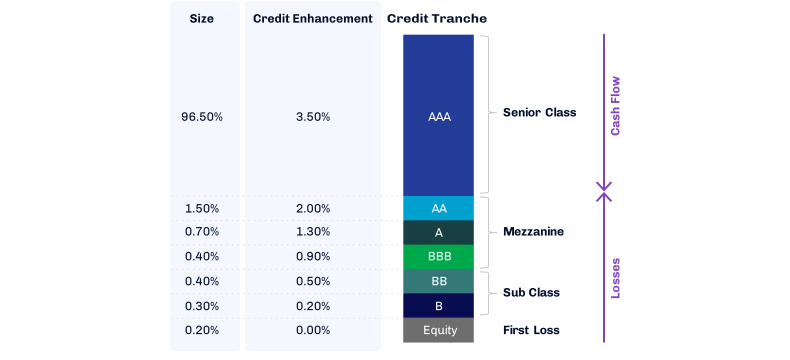
Lacking the payment guarantees of MBS issued by the GSEs and Ginnie Mae, private issues must rely on various forms of credit enhancement to attract investors. The CMO structure enables them to divide mortgage pools into tranches that stratify risk based on seniority. The initial CMOs were structured as sequential-pay bonds, in which the most senior tranche received all principal payments from the underlying loans until it was paid in full (Exhibit 2). At that point, the second tranche would begin receiving principal payments until it was fully retired, with subsequent tranches following in sequence. Throughout this time, all tranches receive pro-rata shares of monthly interest payments. The result of this structure is series of bonds with short, intermediate and long maturities that investors could choose from according to their specific needs.
Exhibit 2. Tranche Structure Creates Opportunities Across Risk/Reward Spectrum
Source: Diamond Hill; data as of September 30, 2026.
Today, the MBS market is significantly biased toward agencies. The market for non-agency MBS grew to more than $2 trillion in the mid-2000s but contracted sharply during the housing crisis and has yet to rebound meaningfully, standing at $573 billion in the latest reading, or 3.8% of the total market.6
Developments in CMOs
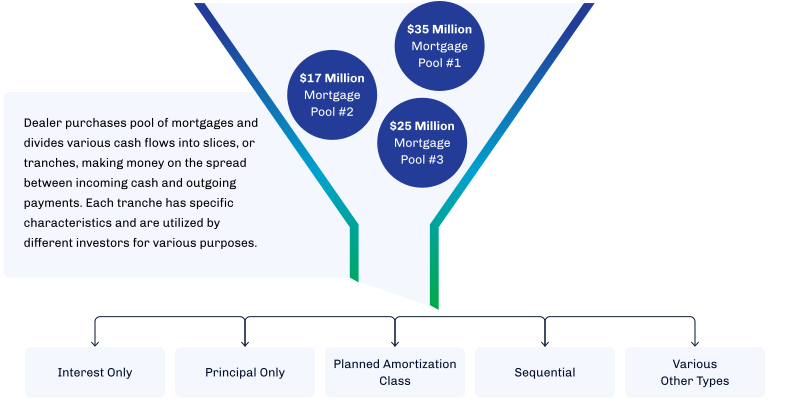
The CMO market has since evolved beyond sequential pay to include a variety of structures, as illustrated in Exhibit 3.
Exhibit 3. CMO Structures Evolved Over Time
Source: Diamond Hill; data as of September 30, 2026.
Principal-only/interest-only tranches. As indicated by their names, interest-only and principle-only tranches of MBS focus solely on the interest and principal cash flows from a pool of mortgages. Due to the unique nature of these cash flows, these securities have significantly different characteristics from other CMOs and mortgage securities.
For an interest-only security, the interest amount received is directly tied to the outstanding principal balance, which depends on the prepayment rate of the underlying mortgages. Due to the relationship between principal and interest balances, the size of the payments from an interest-only bond will move in the same direction as rates. Thus, the value of an interest-only bond falls as rates decline and increases as rates rise, and these bonds have negative duration.
In contrast, a principal-only CMO tranche receives only principal payments from the underlying mortgage pool. It has positive duration; when interest rates rise and prepayments slow, the bond’s value decreases, and when rates fall and prepayments accelerate, the bond increases in value.
Collateralized planned amortization class (PAC) tranches. PAC bonds were first issued in 1986 and represented some of the most innovative work in the CMO market. Unlike a pass-through mortgage, a PAC bond is designed to have a favorable weighted average life profile if prepayments and extensions remain within a specified range.
PAC bonds have a specified principal payment schedule and are given priority for principal paydowns over other bonds in the pool (aptly named companion bonds). In a falling interest rate environment, borrowers who refinance to take advantage of the lower rates flood the mortgage deal with additional cash. Companion bonds to a PAC bond will absorb some of these extra cash flows to maintain the stability of the PAC bond’s cash flows.
Conversely, suppose interest rates are climbing, and less money is coming into the pool due to a decline in refinancing. In that case, companion tranches will forgo some of their cash flows to maintain the stability of the PAC bond. Because of this symbiotic relationship between PAC bonds and companion tranches, PAC bonds can prove to be more stable in a volatile interest rate environment; as expected, companion bonds have more sensitivity to interest rate fluctuations and are more volatile.
Targeted amortization class (TAC). These bonds are similar to PAC bonds, but instead of protecting against prepayment and extension risk, TACs safeguard against increasing prepayment speeds. Reverse TACs protect against a slowdown in speeds (extension risk).
Floaters. A CMO structured so that its coupon resets regularly (usually monthly) and follows a specific index plus a spread, often subject to a cap or floor.
Inverse floaters. These are similar to floaters but with a coupon that moves in the opposite direction of a pre-determined index.
Risks to MBS Investment
All mortgage-backed securities are susceptible to a number of key risks, including prepayment, extension and interest rate risk. CMOs can mitigate some of these risks with cash flow structures that differ significantly from plain-vanilla mortgage pass-throughs.
Prepayment risk. As interest rates decrease and homeowner refinancing activity accelerates, the rate at which MBS principal is returned increases, shortening the average life and effective duration of the investment. This presents reinvestment risk, or the risk that cash received from the MBS must be reinvested at lower prevailing interest rates.
Extension risk. As interest rates increase and homeowner refinancing activity slows, the rate at which MBS principal is returned decreases, extending the average life and effective duration of the investment. Investors end up holding bonds yielding less than prevailing rates for longer than originally expected.
Interest rate risk. Convexity and duration are both used to assess the interest rate risk of fixed income investments. Duration illustrates a bond’s sensitivity to interest rate movements and assumes a linear relationship between rates and price—when rates rise, price decreases at a constant rate (and vice versa). Convexity, on the other hand, recognizes that the relationship between bond prices and interest rates is typically sloped or convex and captures the curvature in the price/rate relationship by measuring the change in duration as rates move higher or lower.
While duration provides insight into how a bond behaves from a pricing standpoint due to small moves in interest rates, convexity is a better measure for large fluctuations in interest rates.
If a bond’s duration increases as yields increase and the opposite occurs as rates decrease, the bond has negative convexity. An example would be a plain vanilla pass-through mortgage: as rates rise, the bond’s duration extends as prepayments slow down. As rates decrease, the bond’s duration shortens as prepayments increase and borrowers refinance their mortgages.
Managing Mortgage-Backed Securities
MBS is a complex asset class that we believe is particularly well suited to bottom-up security selection.
An effective technique to value bonds with embedded options entails decomposing the bond into its parts. For mortgage-backed securities, we conduct a creation-value analysis. During this process, we use various tools, including Bloomberg and Citigroup Yield Book, as well as proprietary valuation methodologies that provide secondary verification of the primary analysis conducted with Yield Book. We believe securities selected after applying this analysis offer better relative returns than similarly structured securities.
Our focus on bottom-up security selection differentiates Diamond Hill’s process from universal benchmarks and other managers in the fixed income universe. Our approach to investing in MBS has historically led to a significant overweight to CMOs instead of investing in the standard mortgage-backed securities held by the benchmark. A strict capacity discipline enhances our ability to continue exploiting inefficiencies in the mortgage market while larger managers turn to the to-be-announced market for their exposure to mortgages.