


Commentaries
Gold Fund Commentary
Gold Fund Commentary
Portfolio Review
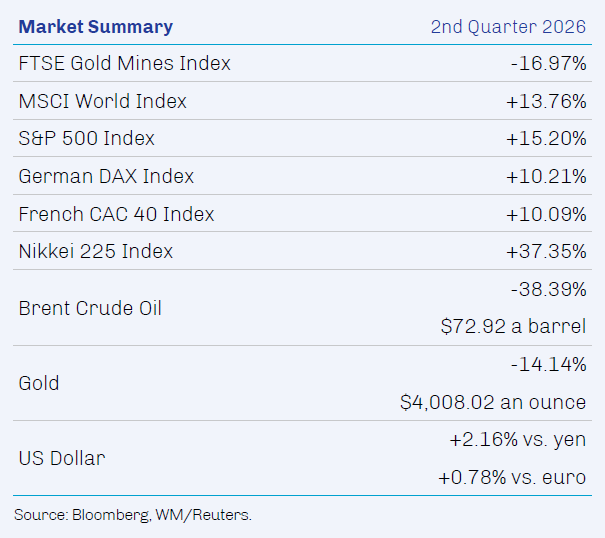
Gold Fund A Shares (without sales charge*) posted a return of -16.62% in second quarter 2026. Gold bullion and gold-related equities both detracted from performance. The Gold Fund outperformed the FTSE Gold Mines Index in the period. Reflecting negative dynamics for gold pricing, all positions in the First Eagle Gold Fund this quarter detracted. The strongest performers included Pan American Silver Corp Contingent Value Rights 2019-22.02.29, Industrias Peñoles SAB de CV, B2Gold Corp., Fresnillo PLC and Ora Banda Mining Ltd.
Leading contributors in the First Eagle Gold Fund this quarter included Pan American Silver Corp Contingent Value Rights 2019-22.02.29, Industrias Peñoles SAB de CV, B2Gold Corp., Fresnillo plc and Ora Banda Mining Ltd.
Pan American Silver is a Canadian mining company with large silver endowments and a diversified portfolio of producing mines. We hold small positions in both its contingent value rights (CVRs) and equity. Price changes in the company’s CVRs reflect expectations of the prospective reopening of the company’s shuttered Escobal silver mine in Guatemala, which remains on care and maintenance pending compliance with Indigenous consultation guidelines.
A subsidiary of Grupo BAL, Peñoles is a world leader in refined silver production and a top producer of gold, zinc and lead in Mexico. Peñoles derives a significant portion of earnings from its 75% stake in the precious metals group Fresnillo. The company reported strong headline results during the quarter. Operating leverage and cost-cutting initiatives position Peñoles for continued margin expansion and cash flow growth.
B2Gold is a Canadian mining company that owns and operates gold mines in Mali, Namibia, the Philippines and Canada. Shares were strong during the quarter on the strategic asset sale of B2Gold’s 70% stake in Fingold Ventures to Agnico. The company continued to demonstrate operational excellence as a fire at the Goose Project in Canada reduced production during the quarter but did not affect full-year targets. Additionally, B2Gold smoothly negotiated a transition in senior management.
The leading detractors in the quarter were gold bullion, Agnico Eagle Mines Limited, Wheaton Precious Metals Corp, Alamos Gold Inc. and Newmont Corporation.
The factors driving the performance of gold were discussed in detail in the Market Overview section of this report, and silver bullion was subjected to the same dynamics.
Agnico Eagle is the world’s second-largest gold producer. Although the company reported record operational results for its most recent quarter, shares of Agnico traded down with gold bullion prices. We continue to like the company’s strong balance sheet, healthy pipeline of projects, cost-efficient operations and focus on returning cash to shareholders.
Shares of Wheaton, a Canadian streaming and royalty company, were pressured during the quarter by lower precious metals prices and margin contraction at partner mines. Wheaton benefits from operational expertise and a consistent track record of robust cash flow conversion. Longer term, Wheaton’s precious-metals streaming contract at the Antamina mine in Peru could prove transformational for the company. Wheaton’s growth potential is supported by its strong balance sheet and recent seamless leadership transition.
* Performance for Class A shares without the effect of sales charges and assumes all distributions have been reinvested, and if a sales charge was included values would be lower.
1. Source: Bloomberg; data as of June 30, 2026.
2. Source: Bloomberg; data as of July 7, 2026.
3. Source: World Gold Council; data as of April 2, 2026.
4. Source: World Gold Council; data as of June 16, 2026.
5. Source: World Gold Council; data as of June 30, 2026.
6. Source: Bloomberg; data as of June 30, 2026.
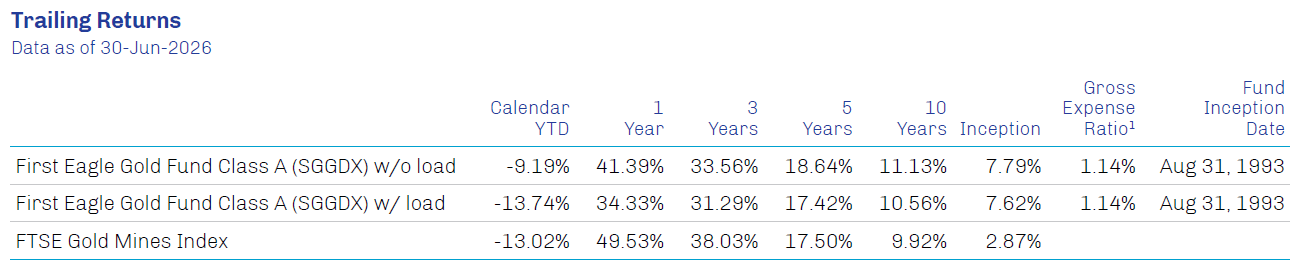
The performance data quoted herein represents past performance and does not guarantee future results. Market volatility can dramatically impact the fund’s short term performance. Current performance may be lower or higher than figures shown. The investment return and principal value will fluctuate so that an investor’s shares, when redeemed may be worth more or less than their original cost. Past performance data through the most recent month end is available at www.firsteagle.com or by calling 800-334-2143. The average annual returns are historical and reflect changes in share price, reinvested dividends and are net of expenses. “With sales charge” performance for Class A Shares gives effect to the deduction of the maximum sales charge of 3.75% for periods prior to March 1, 2000, and of 5.00% thereafter. The average annual returns for Class C Shares reflect a CDSC (contingent deferred sales charge) of 1.00% in the year-to-date and first year only. Class I Shares require $1MM minimum investment and are offered without sales charge. Class R6 Shares are offered without sales charge. Operating expenses reflect the Fund’s total annual operating expenses for the share class as of the Fund’s most current prospectus, including management fees and other expenses.
1. The annual expense ratio is based on expenses incurred by the fund, as stated in the most recent prospectus.
Investments are not FDIC insured or bank guaranteed and may lose value.
Risks
All investments involve the risk of loss of principal.
Diversification does not guarantee investment returns and does not eliminate the risk of loss.
There are risks associated with investing in securities of foreign countries, such as erratic market conditions, economic and political instability and fluctuations in currency exchange rates. These risks may be more pronounced with respect to investments in emerging markets. Investment in gold and gold-related investments present certain risks, including political and economic risks affecting the price of gold and other precious metals like changes in US or foreign tax, currency or mining laws, increased environmental costs, international monetary and political policies, economic conditions within an individual country, trade imbalances and trade or currency restrictions between countries. The price of gold, in turn, is likely to affect the market prices of securities of companies mining or processing gold and, accordingly, the value of investments in such securities may also be affected. Gold related investments as a group have not performed as well as the stock market in general during periods when the US dollar is strong, inflation is low and general economic conditions are stable. In addition, returns on gold related investments have traditionally been more volatile than investments in broader equity or debt markets. Investment in gold and gold related investments may be speculative and may be subject to greater price volatility than investments in other assets and types of companies. Funds whose investments are concentrated in a specific industry or sector may be subject to a higher degree of risk than funds whose investments are diversified and may not be suitable for all investors.
Definitions
Federal funds rate is the interest rate at which depository institutions (banks and credit unions) lend reserve balances to other depository institutions overnight on an uncollateralized basis.
Exchange-traded funds (ETFs) are listed investment vehicles that seek to provide exposure to a benchmark, index or actively managed strategy. MSCI World Index (Net) measures the performance of large and midcap equities across developed markets countries. A net-return index tracks price changes and reinvestment of distribution income net of withholding taxes. FTSE Gold Mines Index (Price) measures the performance of gold mining companies worldwide that have a sustainable, attributable gold production of at least 300,000 ounces a year and that derive 51% or more of their revenue from mined gold. A price-return index only measures price changes. S&P 500 Index (Gross/Total) measures the performance of 500 of the top companies in the leading industries of the US economy and is widely recognized as a proxy for the US market as a whole. A total-return index tracks price changes and reinvestment of distribution income. Nikkei 225 is a price-weighted index composed of 225 stocks in the Prime Market of the Tokyo Stock Exchange. It is widely recognized as a proxy for the Japanese equity market as a whole. German DAX® Index measures the performance of the 40 largest companies listed on the Frankfurt Stock Exchange that fulfil certain minimum quality and profitability requirements. It is widely recognized as a proxy for the German equity market as a whole. CAC 40® Index is a free-float market capitalization-weighted index that measures the performance of the 40 largest and most actively traded shares listed on Euronext Paris.
Indexes are unmanaged and do not incur management fees or other operating expenses. One cannot invest directly in an index.
These holdings represent the top five contributors and detractors to performance for the First Eagle Gold Fund as of 06/30/2026: Pan American Silver Corp Contingent Value Rights 2019-22.02.29 0.08%; Industrias Peñoles SAB de CV 1.12%; B2Gold Corp. 0.77%; Fresnillo plc 0.94%; Ora Banda Mining Ltd. 1.10%; gold bullion 24.74%; Agnico Eagle Mines Limited 7.05%; Wheaton Precious Metals Corp 11.06%; Alamos Gold Inc. 3.98%; Newmont Corporation 6.84%.
Additional Disclosures
This commentary represents the opinion of the First Eagle Gold strategy portfolio managers as of the date noted and is subject to change based on market and other conditions. The opinions expressed are not necessarily those of the entire firm. These materials are provided for informational purposes only. These opinions are not intended to be a forecast of future events, a guarantee of future results or investment advice. Any statistics contained herein have been obtained from sources believed to be reliable, but the accuracy of this information cannot be guaranteed.
The Fund may invest in gold and precious metals through investment in a wholly-owned subsidiary of the Fund organized under the laws of the Cayman Islands (the “Subsidiary”). Gold Bullion and commodities include the Fund’s investment in the Subsidiary.
The opinions expressed are not necessarily those of the firm. These materials are provided for informational purposes only. These opinions are not intended to be a forecast of future events, a guarantee of future results or investment advice. Any statistics contained herein have been obtained from sources believed to be reliable, but the accuracy of this information cannot be guaranteed. The views expressed herein may change at any time subsequent to the date of issue hereof.
Third-party marks are the property of their respective owners.
FEF Distributors, LLC (“FEFD”) (SIPC), a limited purpose broker-dealer, distributes certain First Eagle products. FEFD does not provide services to any investor but rather provides services to its First Eagle affiliates. As such, when FEFD presents a fund, strategy or other product to a prospective investor, FEFD and its representatives do not determine whether an investment in the fund, strategy or other product is in the best interests of, or is otherwise beneficial or suitable for, the investor. No statement by FEFD should be construed as a recommendation. Investors should exercise their own judgment and/or consult with a financial professional to determine whether it is advisable for the investor to invest in any First Eagle fund, strategy or product.
Investors should consider investment objectives, risks, charges and expenses carefully before investing. The prospectus and summary prospectus contain this and other information about our funds and may be obtained by visiting our website at www.firsteagle.com or calling us at 800-334-2143. The prospectus or summary prospectus should be read carefully before investing.
First Eagle Funds are offered by FEF Distributors, LLC, a subsidiary of First Eagle Investment Management, LLC, which provides advisory services.
©2026 First Eagle Investment Management, LLC. All rights reserved.