


Macro & Market Views
Family Offices: An Alternative Path to Long-Term Goals
Family Offices: An Alternative Path to Long-Term Goals
Family offices occupy a distinctive niche within the investment ecosystem, controlling institutional-sized assets but with needs often more akin to those of individual investors.
- In today’s environment of richly priced financial markets and elevated uncertainty, family offices, similar to institutional investors, may benefit from access to a range of sophisticated credit strategies that provide differentiated sources of returns as a complement to more traditional equity and fixed income allocations.
- While exposure to alternative credit among family offices has been growing, we believe the typical approach to investing in these assets has been suboptimal.
- By focusing on areas of the public and private markets where capital is persistently constrained, the risk/return profiles of certain credit investments can be structured in a more favorable way. We believe this includes such alternative credit exposures as railcar leasing, US and European collateralized loan obligations (CLOs), residential lending, assetbased lending (ABL) and lower middle market direct lending.
- First Eagle approaches investing with the mindset of a family stewarding its own capital, seeking to grow wealth over the long term with an emphasis on trust, alignment and partnership.
While every family office has unique circumstances, needs and objectives, they share a number of commonalities that shape their investment philosophies. These include an emphasis on capital preservation and growth, an absolute-return mindset, a focus on alignment and long-term orientation.
Recent years have seen family offices increasingly embrace alternative credit as a tool to execute their philosophies, which is not surprising given the patient capital that family offices represent. That said, we find that the alternative credit allocations typical of family offices today are often less diversified, less flexible and more directionally exposed than they seem on the surface, undermining the benefits of exposure to the asset class.
Leveraging a 160-year legacy of serving the investment needs of families, First Eagle provides portfolio construction solutions through the lens of what we view as a dawning “Alt Credit 2.0” era. Rather than simple diversification across strategies, our Napier Park Global Capital team focuses on capital-constrained areas of the alternative space to identify investments with the potential to deliver positive return asymmetry, offer independent sources of risk, and create flexibility in how and when capital is deployed and returned.
Sophisticated Solutions for a Complex Investment Environment
With many risk markets richly priced and macro and geopolitical uncertainty elevated, the current investment environment may seem particularly complex. Family offices have a number of factors working in their favor, however, not the least of which is potential access to sophisticated, institutional-quality investment solutions. For many, this has increasingly included allocations to alternative investments, which can help provide family offices and institutional investors differentiated sources of returns as a complement to more traditional equity and fixed income allocations.
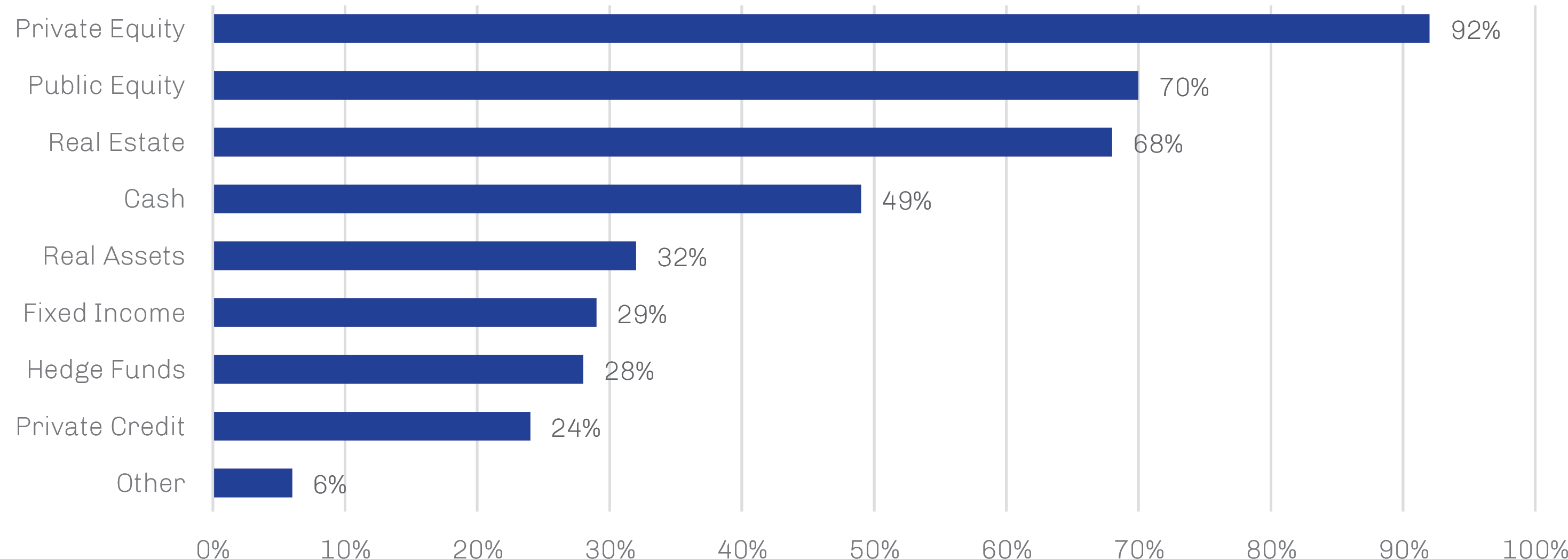
While alternative investments, led by private equity, in aggregate comprise a meaningful portion of a typical family office portfolio—one recent study pegged the share at around 26% globally—allocations to private credit, at 4%, have remained modest.1 As shown in Exhibit 1, 24% of single family offices invest in private credit. The asset class is expected to continue its rapid expansion, with industry forecasts projecting private credit assets under management could reach approximately $4.5 trillion by 2030.2
Exhibit 1. Family Office Exposure to Alternative Credit Is Small but Growing
Percentage of Global Single Family Office Exposure by Asset Class
Source: With Intelligence; data as of May 28, 2025.
While a larger number of family offices appear to be embracing alternative credit exposure, our experience has been that allocations tend to follow a fairly consistent pattern—a core allocation to direct lending complemented by opportunistic or special-situations strategies and often some exposure to real estate credit. While such an allocation may appear diversified on the surface, looking at how these investments behaved over time points to several unfavorable characteristics.
- Negative convexity. These portfolios are often negatively convex, meaning that the relationship between prices and yields is asymmetric in an unfavorable way. In an environment of tight credit spreads, negative convexity implies limited upside potential combined with amplified downside risk, particularly in stress scenarios.
- Overlapping risk exposures. While family office portfolios tend to be well diversified across strategies, the same cannot always be said about underlying risk factors. Many portfolios are underpinned by the same core drivers of performance—such as corporate earnings, leverage and refinancing conditions—and truly differentiated sources of return can be lacking.
- Structural constraints. Alternative credit portfolios are often bulleted to match a known future liability. As a result of this structural constraint, returns are dependent on fixed maturities and repayment events, which ties capital to refinancing cycles and limits flexibility, particularly during periods of market dislocation.
In short, a family office’s alternative credit allocation may be less diversified, less flexible and more directionally exposed than it seems.
Structuring Advantages in Capital-Constrained Markets
The evolution of alternative credit has broadened the investment opportunity set beyond traditional corporate lending and direct lending strategies. As investors seek more diversified sources of income and return in the “Alt Credit 2.0” era, certain segments of public and private credit markets stand out for their ability to provide exposure to distinct risk factors, structural protections and return drivers that are less dependent on economic growth or spread compression.
Many of these opportunities exist in areas where capital remains constrained by regulatory requirements, market complexity, specialized expertise or investor behavior. As a result, investors may be able to access durable sources of risk premia that are supported by collateral, contractual cash flows and structural protections rather than relying solely on corporate credit fundamentals.
Three areas are particularly notable within this opportunity set:
- Real assets. Asset-based financing linked to essential transportation and infrastructure assets, such as railcars, offers exposure to long-lived assets with contractual cash flows. Returns are often driven by utilization rates, lease structures and asset values, creating a different risk-return profile than traditional corporate credit.
- Structured credit. The mezzanine and equity tranches of structured credit can provide access to opportunities created by market dislocations, technical selling pressure and structural complexity. These investments often derive returns from both income generation and the potential for favorable asymmetry when underlying collateral performs better than market expectations.
- Private asset-based lending. Areas such as residential lending, specialty finance and corporate asset-based lending are characterized by financing structures supported by specific collateral pools and cash-flow streams. The combination of asset coverage, contractual protections and bespoke structuring can create differentiated sources of return and downside mitigation relative to unsecured corporate lending.
The potential opportunities available across these segments, several of which are discussed below, illustrate how alternative credit has evolved beyond traditional spread-based investing, offering investors access to a broader set of return drivers, income sources and portfolio diversification benefits across market environments.
Railcar leasing. Through railcars—the only viable method for long-distance transport of heavy commodities through the massive North American heartland—sophisticated investors can tap into an asset that offers an income profile similar to an investment grade fixed income security and the total return potential of a private equity investment.
Railcar owners lease their rolling stock to the producers of raw materials or commodities to facilitate distribution via the North American rail network. Lessors—typically specialty operators or nonbank financial companies—have historically benefitted from contractual cash flows, high residual values and substantial depreciation- based tax benefits. Lessees—oil refineries, food processors, lumber companies and many others—are able to keep off their balance sheets the very large capital outlays associated with buying and maintaining a fleet of railcars.
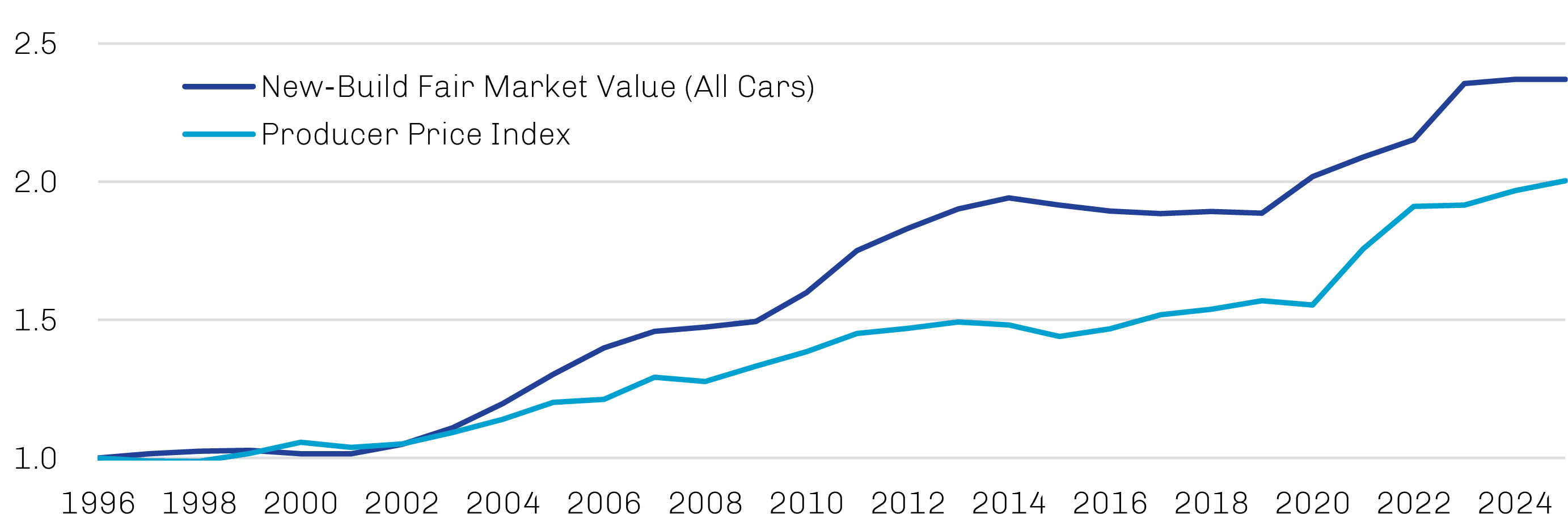
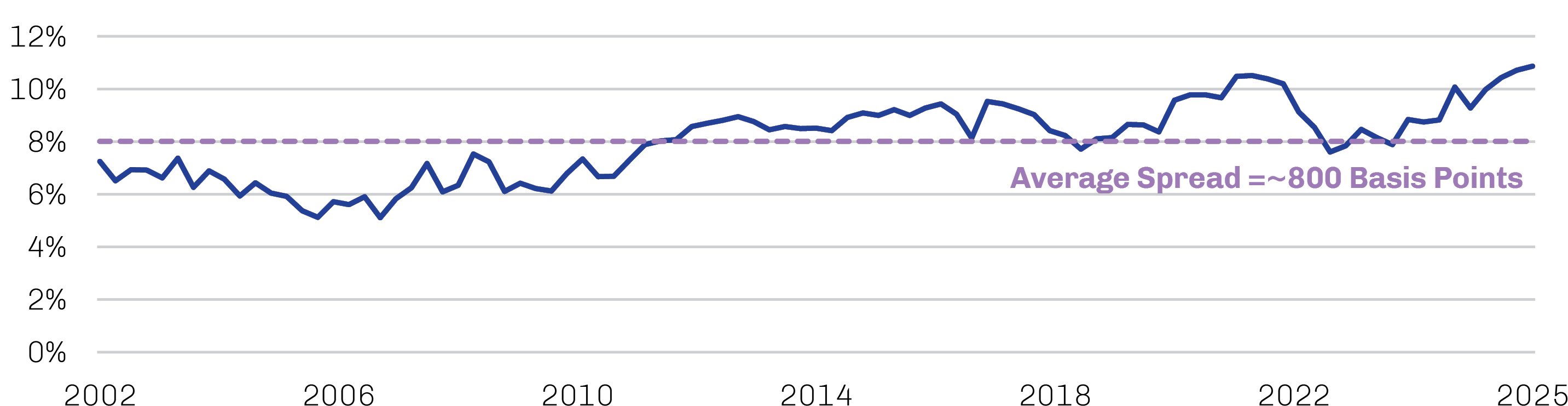
Supply and demand dynamics in the rail transport industry remain biased toward the lessor side of the equation, in our view. The nationwide fleet of railcars has not grown materially in the last 30 years, and the limited supply supports high lease rates and strong residual values for long-lived existing cars.3 At the same time, inflation and the higher cost of capital have increased the cost of railcar ownership, bolstering leasing demand as well as the residual value of cars. Given the low cost of leasing a railcar relative to the value of the goods being transported, lessees tend to be fairly price inelastic, and lessors have little difficulty passing along their rising costs as contracts turn over. These factors historically have resulted in a positive correlation between railcar leasing and both interest rates and inflation, as shown in Exhibits 2 and 3.
Exhibit 2. Market Value of New Railcars Has Outpaced Inflation
Index: January 1996 = 1
Note: Railcar sale price is adjusted using US PPI Final Demand: Finished Goods as of December 31, 2025. Source: RailSolutions, Trinity Industries, Bloomberg, Federal Reserve Bank of St. Louis; data as of December 31, 2025.
Exhibit 3. Railcar Lease-Rates Have Exceeded Treasuries by 800 Basis Points on Average Since 2002
Freight and Tank Car Lease-Rate Spreads to Five-Year Treasuries
Source: RailSolutions, Trinity Industries, Bloomberg, Federal Reserve Bank of St. Louis; data as of December 31, 2025.
The fundamental backdrop also remains supportive of railcar demand, in our view. The US economy has continued to grow, and consumer spending remains strong.4 Buffeted by the impacts of Covid-19 and the Trump administration’s tariffs, manufacturers continue to look for ways to build resilience in their supply chains, including by expanding their US footprints.5 And while growing fears of AI-driven obsolescence plague many investment categories, HALO (heavy asset, low obsolescence) assets like railcars cannot be automated away.
US and European CLOs. CLOs—marketable fixed income securities backed predominantly by broadly diversified pools of first-lien, senior-secured syndicated bank loans—provide institutional investors the potential to generate meaningful incremental yield with manageable incremental risk while also providing potential portfolio diversification features. The relative illiquidity of CLOs, especially lower in the capital stack, often provides potential opportunities for skilled managers to capitalize on mispricings and structural inefficiencies among performing credit assets in an effort to enhance total return through active rotation and generate positive returns over time across different market conditions.
CLOs are divided into multiple tranches that stratify credit risk based on seniority, providing investors an opportunity to target a range of risk/return profiles. Depending on their liquidity needs, we believe many family offices are drawn to CLO mezzanine and equity tranches for the greater spreads on offer, perhaps complemented by senior tranches for their stable floating income and relatively low credit risk.
CLOs offer a number of features potentially beneficial to diversified portfolios, not the least of which is an attractive yield pickup relative to traditional fixed income investments. While there are a number of valid reasons for the structured credit premium—including greater complexity, reduced liquidity and pronounced price volatility— we believe greater credit risk is not one of them. As shown in Exhibit 4, certain ratings of CLOs historically have realized significantly lower defaults than their like-rated traditional counterparts—including, in many cases, none at all. The fact that corporate bonds pay a significantly lower yield despite much higher levels of historical default suggests to us a persistent misrating of CLOs by the ratings agencies—one that has promoted an ongoing yield premium in the markets and a potential corresponding opportunity for investors experienced in the space seeking to generate attractive risk-adjusted returns over the long term.
Exhibit 4. Despite Offering Higher Yields, CLOs Historically Have Had Meaningfully Lower Default Rates
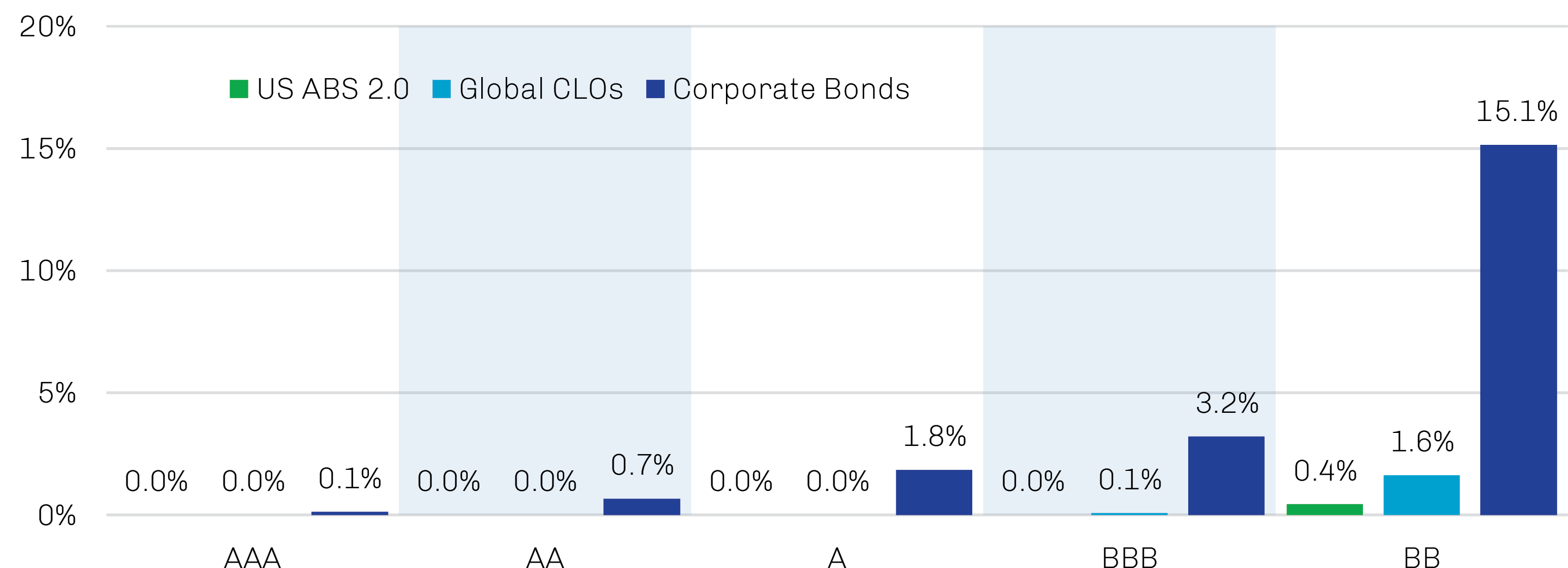
Note: US ABS 2.0 and Global CLOs reflect originations over 2009–24 and are not adjusted for issuers whose ratings were withdrawn. US ABS 2.0 data exclude home equity loans. Corporate bonds data reflect issuer-weighted defaults over 1920–2024.
Source: BofA Global Research, Moody’s Investors Services; data as of July 30, 2025.
Private credit (or middle market) CLOs are a growing subsector of the CLO universe, combining two investment themes: direct lending and structured credit. Unlike a traditional CLO collateralized by broadly syndicated loans, private credit CLOs are backed by a portfolio of direct loans to small and medium sized companies. Given the greater credit and liquidity risk of their underlying collateral, private credit CLOs typically pay a wider spread over Secured Overnight Financing Rate (SOFR) than traditional CLOs. At the same time, the incremental risk in these structures typically is mitigated by a sizable over-collateralization cushion and/or credit enhancements, as well as the covenants in the underlying pool of direct loans (which, as noted above, are more common in the lower middle market space).
At nearly $40 billion, private credit CLOs accounted for almost 20% of total US CLO issuance in 2025. While private credit CLOs had long been limited to the US, the first European one was issued in late 2024 and two more followed in 2025.6 Though private credit CLO issuance in Europe is complicated by disparate tax regimes, currencies and legal and regulatory frameworks, this market is expected to continue growing.7
Residential lending. The US hasn’t built enough homes in recent decades, leading to a significant gap between housing supply and demand.8 We believe the motivation to close this gap represents a strong and durable tailwind for new residential construction and the renovation of existing homes, as well as demand for the capital needed to fund these projects.
At the same time, regulatory changes in the wake of the global financial crisis hampered banks’ ability to finance certain types of real estate activities, including acquisition, development and construction lending. Effectively, the banks have been replaced by a highly fragmented set of lenders across the country that lack institutional capital, which has presented an opening for asset managers to become liquidity providers in the space at attractive terms.
This includes capital to finance residential transitional loans (RTLs)—short-duration, value-add renovation loans—and land-banking transactions—off-balance-sheet financing provided to homebuilders for the acquisition and development of entitled and permitted land. These niche segments of private debt, which are distinct from more widely known corporate direct lending activities, have grown dramatically over the past five years,9 and we believe they continue to offer tremendous opportunity due to high barriers to entry, attractive yields and robust monthly cash flow. A manager able to rotate efficiently between various US markets in both RTLs and land banking may be able to leverage opportunities to invest in markets where the shortfall in supply is even more pronounced.
Asset-based lending (ABL). Asset-based lending (ABL) is a distinct segment of the alternative credit market, characterized by financing secured by specific borrower assets rather than enterprise cash flows. Collateral may include accounts receivable, inventory, real estate, machinery and equipment, or intellectual property, with loan structures typically incorporating covenants and loan-to-value requirements designed to preserve collateral value over time.
These structural features can differentiate ABL from other forms of private credit by providing explicit collateral support alongside contractual protections. Historically, well-structured, conservatively underwritten ABL transactions have experienced relatively low loss-given-default rates, although outcomes remain highly dependent on collateral quality, valuation discipline and workout expertise. Given the diversity and complexity of collateral types, underwriting experience across asset classes and market cycles is often an important determinant of long-term performance.
The ABL market has also tended to exhibit countercyclical characteristics. While these facilities generally carry a higher cost of capital than traditional bank financing or cash flow-based loans, they can become an increasingly important source of financing during periods of economic uncertainty or constrained liquidity. In today’s environment of elevated financing costs and more selective bank lending, asset-based financing continues to serve an important role for many middle market borrowers.
Direct lending. Direct lending has become an increasingly important component of private credit markets, with investor demand driving industry assets and available capital to record levels. As capital has expanded, competitive dynamics have evolved, particularly in the upper end of the market, where larger transactions have in some cases been accompanied by greater leverage, narrower spreads and less restrictive covenant packages than historically characterized the asset class.
By comparison, the lower middle market has generally maintained many of the structural characteristics that have traditionally distinguished private credit. Transactions in this segment have often featured stronger lender protections, wider spreads and more conservative leverage profiles than larger deals. Smaller transaction sizes may also provide greater opportunities for diversification across borrowers and industries while fostering closer engagement among lenders, borrowers and sponsors throughout the life of an investment.
The lower middle market also tends to offer greater access to management teams during the underwriting process, supporting more detailed due diligence and ongoing dialogue after closing. Together, these characteristics have contributed to the segment’s reputation for disciplined underwriting and resilient credit fundamentals across market cycles.
Exhibit 5. Smaller Direct Loans Have Historically Delivered Enhanced Risk-Adjusted Returns
Spread per Unit of Leverage in Basis Points, Three-Month Rolling Average
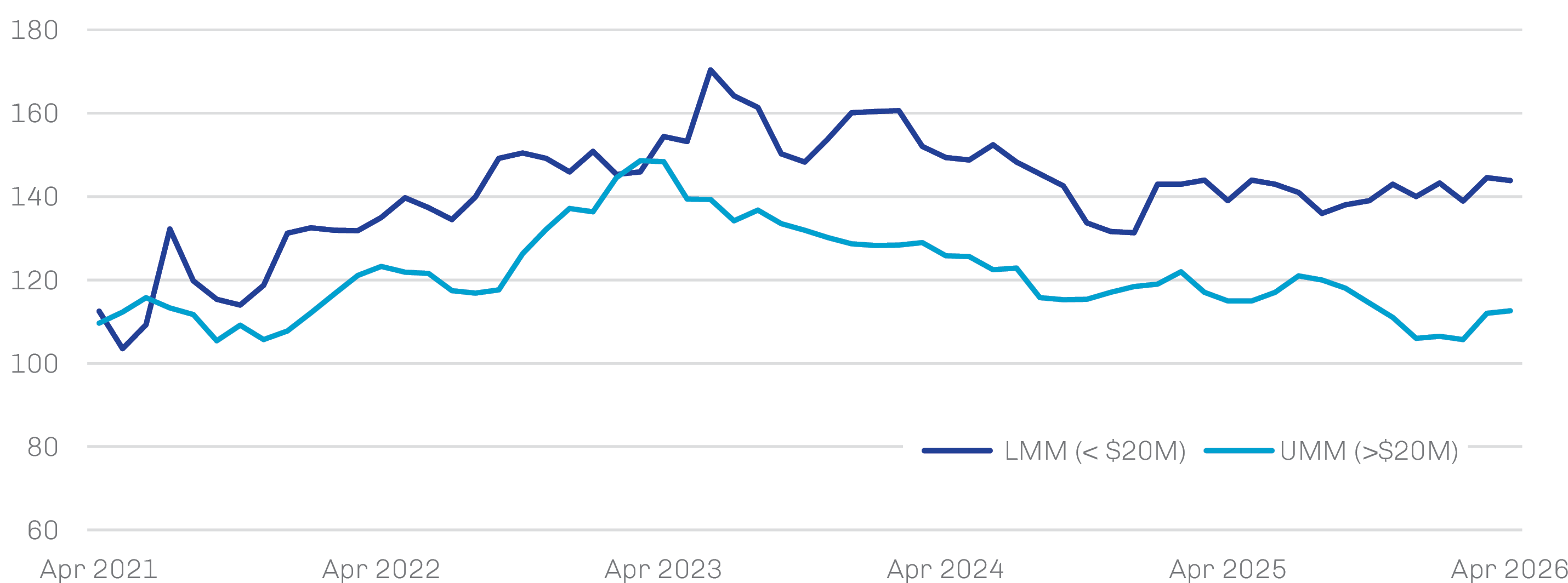
Source: KBRA DLD; data as of February 11, 2026.
An Aligned Mindset
With a modern portfolio lineup built on a family office foundation, First Eagle is an ideal partner to help investors preserve and grow generational assets. Founded in 1864 as a family-owned enterprise, the firm was built to steward capital across generations, first for the founding family and, over time, for a close network of likeminded families. From the outset, the focus was not on transactions, but on preserving wealth, maintaining flexibility and navigating uncertainty with discipline—principals that continue to shape how we invest and how we work with clients.
Though the firm has been managing assets for external investors for nearly 60 years, remnants of our family office roots can be found across our investment platform. Distinguished by disciplined and unconventional thinking, a global perspective and the long-term alignment of interests, our range of actively managed strategies— which feature equities, fixed income and currencies, alternative credit and real assets—offer clients a range of differentiated risk-return profiles with an emphasis on growing and preserving assets over a long time horizons.
For more information, visit firsteagle.com/familyoffice or email familyofficeteam@firsteagle.com.