BLOGThe Bird's Eye View
Timely Perspectives, Unconventional Thinking
We’re excited to share timely market insights, thoughtful perspectives and expert commentary as part of our commitment to providing modern investment solutions to modern challenges.
BLOGThe Bird's Eye View
Timely Perspectives, Unconventional Thinking
We’re excited to share timely market insights, thoughtful perspectives and expert commentary as part of our commitment to providing modern investment solutions to modern challenges.
Can Asset-Based Lending Provide Spreads with Benefits?

Senior Managing Director and Head of Asset-Based Loans

Managing Director
With credit spreads near historical tights, risk appetites have been supported by elevated yields and resilient economic growth.1 Although capital is still available, it has become more conditional as investors are less willing to forgive mistakes. In such an environment, we like the differentiated opportunity set within asset-based lending (ABL).
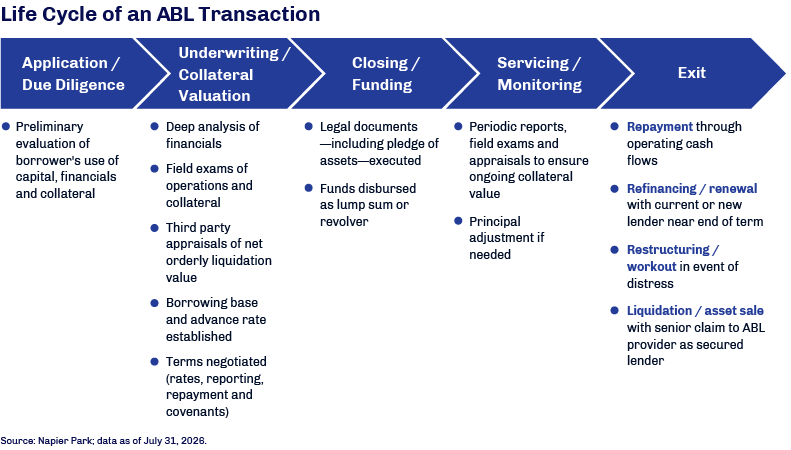
ABL facilities are corporate loans supported by specific assets of the borrower, such as inventory, accounts receivable, real estate, machinery and equipment, and intellectual property. These facilities carry floating rates, typically have tenors of five years or less, and can be structured as term loans or revolving lines of credit. Done right, ABL facilities potentially offer attractive yields and appealing downside mitigation through strong structural provisions and explicit collateral backing.
In our view, the value of an ABL strategy is dependent on how collateral is sourced, underwritten, monitored, and controlled. Relationship-driven sourcing—which is often built on credibility with sponsors, companies, banks and other lenders—can provide established managers with differentiated access to investment opportunities and act as a barrier to entry. Collateral is evaluated as a first line of defense under real downside scenarios. Asset valuations must be dynamically verified and monitored throughout the loan term—not only under base-case assumptions, but also under various liquidation scenarios.
Beyond the evaluation and monitoring of collateral, structuring covenants, reporting practices, cash controls, collateral triggers, remedies and intercreditor arrangements can provide risk mitigation should conditions soften or deteriorate. Lastly, we believe ABL requires sound business judgment—understanding management quality, liquidity, customer concentration, supplier dynamics and the durability of the borrower’s model.
Within an increasingly competitive and commodified credit market, ABL is one of our highest-conviction areas because we believe ABL can offer “spreads with benefits” when the collateral is paired with architecture that provides visibility, verification, priority and enforceability.
Yen Intervention: Watching Our Own Back

Portfolio Manager and Senior Research Analyst
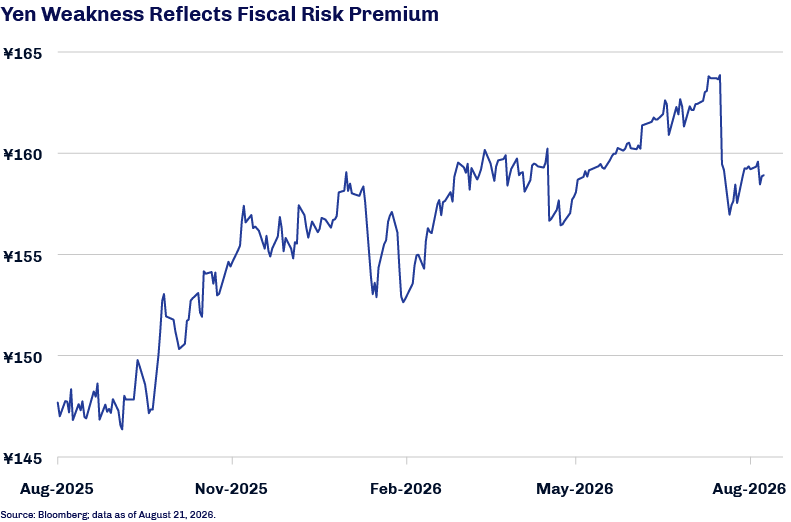
Japan intervened in foreign exchange markets in late July, selling approximately $85 billion of reserves to support the yen, which had fallen to its weakest level against the dollar since the 1985 Plaza Accord. Unusually, the US intervened alongside Japanese authorities.
With its massive store of dollar-denominated reserves in both deposits and securities, Japan’s Ministry of Finance does not need to sell Treasuries to fund yen purchases. Still, the risk of large-scale Treasury sales was one the US likely wanted to avoid. Such sales could push Treasury yields higher—an unwelcome prospect given the volume of US government debt that is continually rolled over at prevailing rates.
Joint intervention should improve the odds of strengthening the yen in the near term by adding buying power and signaling that both governments favor a stronger currency. Indeed, the intervention strengthened the yen from 163.7 to 155.5, though it has subsequently pulled back to around 158.9.1 But intervention is no substitute for addressing the underlying monetary and fiscal policy mix.
The yen is exceptionally weak relative to both history and interest-rate differentials, whether nominal or real. In our view, faster Bank of Japan rate hikes alone are unlikely to solve the problem. Instead, the yen and Japanese government bonds increasingly appear to reflect a fiscal risk premium: the currency has weakened even as Japanese interest rates have risen.
Yet, Japan’s fiscal position may be less precarious than headline debt levels suggest. Japan has a roughly five-year window in which the relationship between growth and interest rates remains favorable, while its primary deficit has improved more since the Covid era than those of many other major economies. Credible fiscal consolidation during this window could reduce the risk premium, support the yen and lessen the burden on monetary policy.