BLOGThe Bird's Eye View
Timely Perspectives, Unconventional Thinking
We’re excited to share timely market insights, thoughtful perspectives and expert commentary as part of our commitment to providing modern investment solutions to modern challenges.
BLOGThe Bird's Eye View
Timely Perspectives, Unconventional Thinking
We’re excited to share timely market insights, thoughtful perspectives and expert commentary as part of our commitment to providing modern investment solutions to modern challenges.
Direct Lending: Where Underwriting and Structure Lead

Senior Managing Director and Chief Investment Officer of Direct Lending, Napier Park Global Capital
While credit markets rebounded in the second quarter as investor appetite for risk returned, direct lending deal volume increased slightly from the first quarter and remained well off the higher pace of second-half 2025. Add-on mergers and acquisitions financings dominated activity in the core middle market and above, while leveraged buyouts were more prevalent in the lower middle market. Lower middle market spreads widened modestly, ending the quarter at their widest level since November 2025, although spread per turn of leverage narrowed.1
Covenant-lite structures accounted for 18% of deals through the first half of 2026, up from 14% in 2025, and were primarily in the upper middle and large cap markets. In contrast, cov-lite structures represented less than 4% of deal flow in core and lower middle market loans. Lower middle market default rates over the past 12 months—2.2% by dollar amount and 2.0% by deal count—remain below 2025, with defaults concentrated in software.2 We believe these dynamics reinforce the continued appeal of the lower middle market segment where market conditions remain differentiated from the upper middle and large cap markets and where typical deal structures are highly covenanted.
We believe these dynamics reinforce the continued appeal of the lower middle market segment.
The default rate in software also highlights the importance of evaluating technology risk—including artificial intelligence (AI)—when underwriting across sectors. The types of technological change may be unique at different points in time, but we think this begins with a simple question, does AI or any other potential change in technology improve a borrower's competitive position or does it threaten it?
Software may be the clearest recent example of shared common risk factors across what on the surface appear as diversified asset classes and why we caution that traditional credit beta increasingly carries vulnerabilities that are not obvious from spread levels alone. In such an environment, we continue to focus on thoughtful processes for originating, underwriting, structuring and managing private credit.

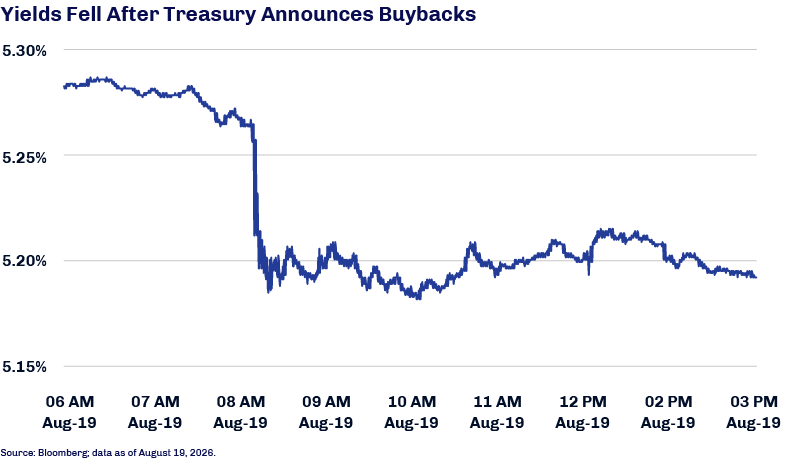
US Treasury Secretary Scott Bessent announced plans to at least double buyback support for longer-dated government bonds with the goal of reducing longer-term yields. This buyback announcement had an immediate and measurable impact on yields—the 30-year Treasury yield fell by as much as 10 basis points after recently reaching its highest level since 2007.1 But we are skeptical of the sustainability of the relief.
We estimate that the implied size of these buybacks would total $28 billion, which is relatively small compared to the $4 trillion balance of outstanding bonds at these tenors.2 Additionally, to the extent that this buyback does ease longer term rates, it does so at a time when financial conditions are already quite easy and inflation pressures persist.
Perhaps more troubling, the Treasury will need to issue more shorter-dated debt to fund these buybacks, implying more interest-rate risk for the Treasury down the road when maturing obligations must be refinanced at higher prevailing rates. This rollover risk is particularly problematic in light of today’s fiscal situation with a large primary deficit and high federal debt.
While government intervention in other sovereign bond markets—typically in emerging economies—have sometimes been effective during periods of stress and dislocation, a small intervention by US Treasury seems inadequate to offset the slow grind-up in Treasury yields due to higher expected short rates and higher term premiums on longer bonds. Moreover, we think efforts to contain the cost of debt through financial repression rather than adopting fiscal discipline to reduce deficits will eventually take its toll and be felt in other markets, as gold strengthened and US dollar weakened in tandem with this announcement.3