


BLOGThe Bird's Eye View
Timely Perspectives, Unconventional Thinking
We’re excited to share timely market insights, thoughtful perspectives and expert commentary as part of our commitment to providing modern investment solutions to modern challenges.
BLOGThe Bird's Eye View
Timely Perspectives, Unconventional Thinking
We’re excited to share timely market insights, thoughtful perspectives and expert commentary as part of our commitment to providing modern investment solutions to modern challenges.
The Structural Case for Residential Real Estate Lending

Senior Managing Director, Head of US Real Estate and Consumer Debt Strategies, Napier Park Global Capital
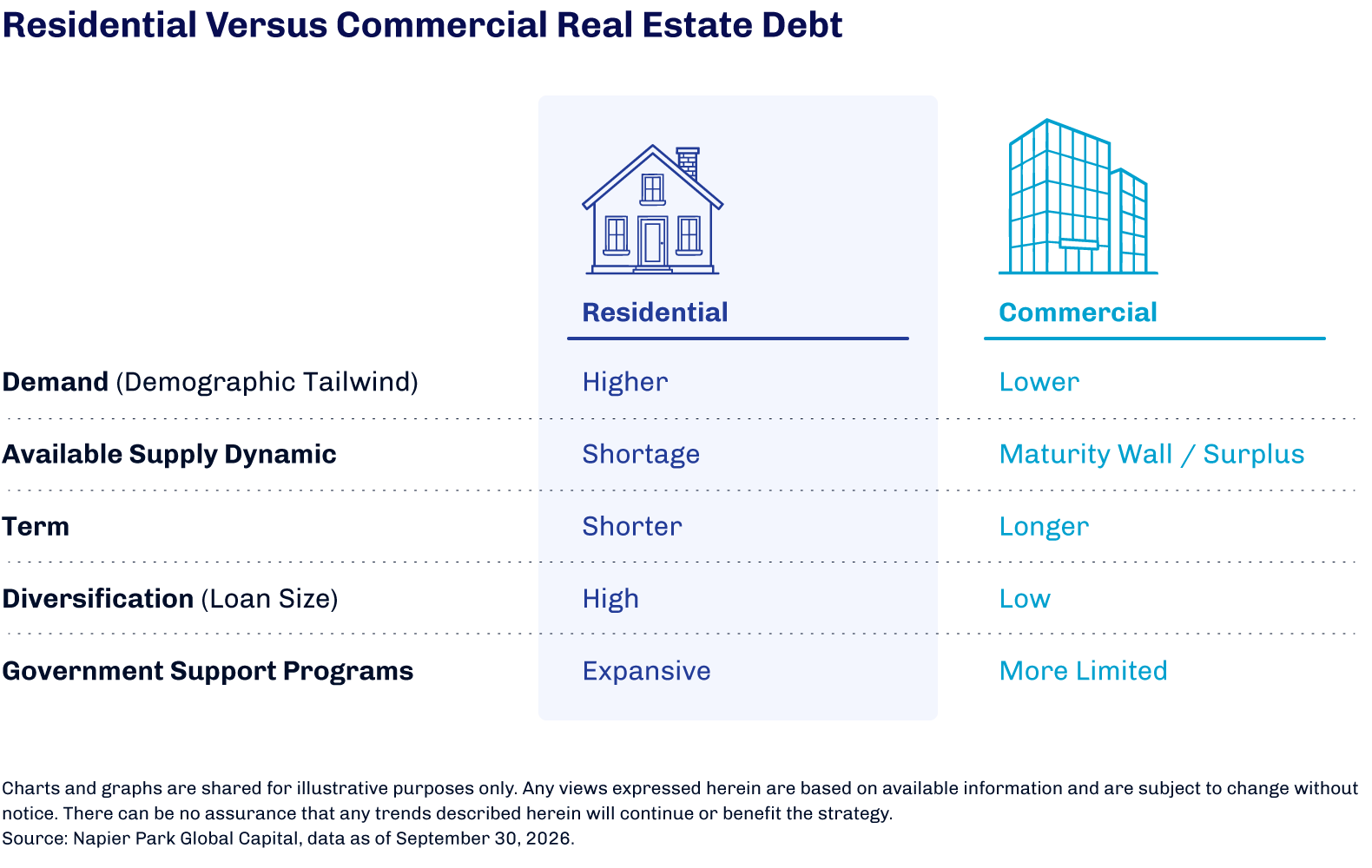
Commercial and residential real estate tell different stories. While commercial property demand varies considerably by sector, residential real estate is shaped by a structural housing shortage and constrained availability of existing homes for sale. We believe the structural case for private specialty lending in residential real estate is supported by the following factors.
A persistent undersupply of housing. Years of underbuilding have left the US with a substantial housing shortage.1 Higher mortgage rates have compounded supply constraints through the “lock-in” effect, as homeowners with low-rate mortgages are less inclined to sell. In contrast, commercial property demand drivers vary considerably by sector and are tied to property-specific factors, like changes in office utilization after the pandemic.
Shorter loan terms. Residential transitional loans and builder finance typically have terms of 12-36 months, and this short maturity allows capital to potentially return relatively quickly and may create opportunities to reassess underwriting and redeploy as conditions evolve. Commercial loans typically involve longer holding periods, making them more sensitive to shifts in property fundamentals, valuations and financing costs.
Granular diversification. Compared with the larger loan sizes often found in commercial real estate, relatively small individual loan balances in the residential segment may allow portfolios to diversify across borrowers, properties and geographies, reducing concentration in any single exposure.
An established housing finance infrastructure. The residential market benefits from support through Fannie Mae, Freddie Mac, the Federal Housing Administration and agency mortgage markets. This infrastructure provides liquidity and financing capacity, while giving policymakers tools to sustain mortgage availability and support the housing market during periods of stress.
Lower refinancing risk. The largest portion of residential mortgages is 30-year fixed rate, which amortize and do not require refinancing.2 In contrast, we estimate that 10–20% of commercial debt requires refinancing annually, potentially at higher rates and lower property valuations.3 During market dislocations, competing financing can compound liquidity pressures and extension risk.
Rising Yields Strengthen Muni Opportunity

Head and Chief Investment Officer of Municipal Credit Team
After a strong first half of 2026, municipal bonds entered the third quarter somewhat richly valued compared to taxable alternatives, which served as an additional headwind to performance as rates sold off sharply.
Treasury yields rose sharply across the curve with the 10-year Treasury yield up 85 basis points and the 30-year Treasury 73 basis points higher at quarter end. The increase in muni bond yields was even more pronounced; based on the BVAL AAA Callable Municipal Curve, the 10-year climbed 124 basis points to 4.1% and the 30-year moved 112 basis points higher to 5.2%.1
Despite rising interest rates, municipal bond issuance is on track to establish a third consecutive annual record in 2026, with year-to-date issuance on pace to exceed $600 billion for the first time.2 However, demand was bifurcated with tax-exempt mutual funds experiencing outflows of $4.3 billion in the third quarter, in contrast to robust exchange-traded fund issuance, where the $55 billion in net issuance year to date has already exceeded 2025’s full-year record of $46 billion.3
Meanwhile, issuer fundamentals continue to be generally supportive with the backdrop of decent economic growth. Fiscal 2026 collections are on track to exceed original estimates, driven by better-than-expected personal income tax receipts and growing sales tax collections. Modest revenue growth and flat spending plans for fiscal 2027 should help states preserve reserves, with many continuing to strengthen rainy-day funds already at nominal highs.4
Muni issuer fundamentals continue to be generally supportive with the backdrop of decent economic growth.
We think the combination of higher yields and supportive credit fundamentals is strengthening the municipal opportunity set, particularly for investors that employ bottom-up, fundamental analysis to identify creditworthiness within sectors and individual names.