


BLOGThe Bird's Eye View
Timely Perspectives, Unconventional Thinking
We’re excited to share timely market insights, thoughtful perspectives and expert commentary as part of our commitment to providing modern investment solutions to modern challenges.
BLOGThe Bird's Eye View
Timely Perspectives, Unconventional Thinking
We’re excited to share timely market insights, thoughtful perspectives and expert commentary as part of our commitment to providing modern investment solutions to modern challenges.
As demands on financial advisors become increasingly more complex, there continues to be rapid growth in financial advisors choosing to work as teams or even in some cases mega teams. In our experience, teaming often allows advisors to bring more expertise to the table for clients, oftentimes creating specialist roles. These specializations may help them be better equipped to offer comprehensive services such as investment management, tax planning, estate planning, insurance, and even concierge-type experiences.
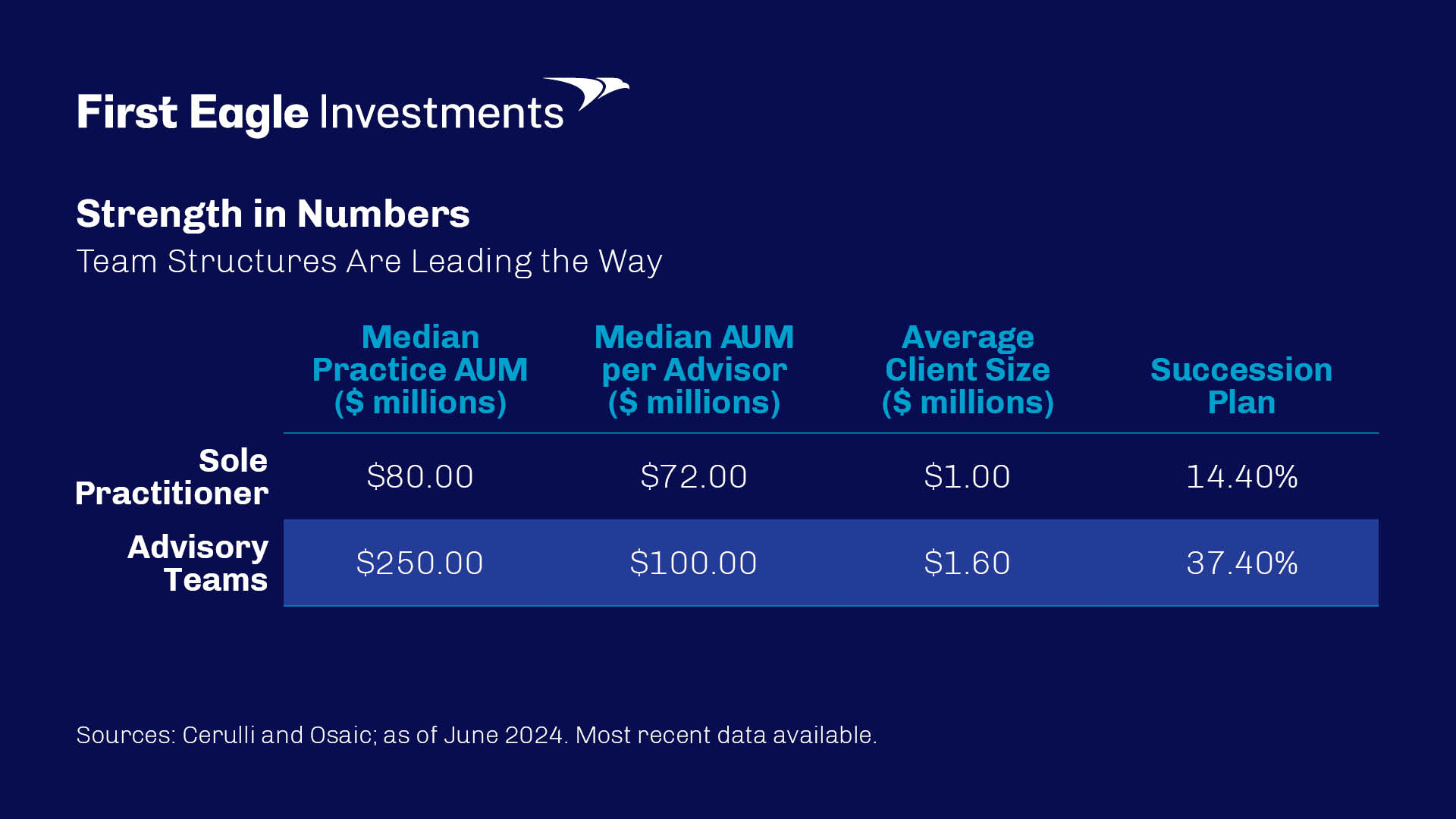
While clients tend to receive a more holistic-based approach working with advisory teams, we also have seen the benefits of teaming when looking at the bottom line for the advisors themselves. According to a recent study, the median AUM for a team-based practice is $250 million versus $80 million for a sole practitioner. It’s not surprising; one would expect a team AUM of multiple individuals to have a higher AUM but looking at the results on a per advisor basis, the median AUM is $72 million per advisor in a sole practitioner practice vs. $100 million per advisor in a team-based practice. If we also review the average client size, solo practitioners average client AUM is 1.0 million vs. $1.6 million for team-based practices.1
First Eagle Academy offers an Elite Teams 2.0 program and consulting services designed to help advisors at each stage of team construction, management, and leadership. Please reach out to your First Eagle representative to learn more about how we can tailor our offerings to meet your needs.

Layering the same macro worries—from tariffs to interest rates to potential recession to freeform uncertainty—on top of one another can only go so far. As we’ve seen since the “Liberation Day” selloff, the bad news loses its sting at some point and investors stop re-discounting the same hypotheticals.
The economy thus far has been more resilient to tariff pressures than was generally anticipated. Decent economic growth and manageable inflation in the US remain well supported, in our view, by low energy prices, strong employment and an undersupply in housing. Smaller companies are broadly expected to benefit from these trends. The consensus estimate Russell 2000 Index earnings growth in 2025, for example, currently stands at 41%, down only slightly from expectations for 50% growth on January 1 despite the many challenges that have emerged throughout the year.1
The economy thus far has been more resilient to tariff pressures than was generally anticipated.
Given this relatively benign backdrop, it’s not hard to imagine the emergence of additional small cap tailwinds. Take, for example, the market for initial public offerings (IPOs). Though volume in April was disrupted by the tariff drama, the 97 initial public offerings (IPOs) launched in the first half puts 2025 on track to easily surpass the 150 offerings in 2024 and the 109 in 20232. While these deals were not in our target capitalization range, momentum can be contagious.
Mergers and acquisitions (M&A) can be similar. Though M&A remains depressed, it’s been our experience that it creates a self-reinforcing dynamic as activity builds, as neither buyers nor sellers want to be left at the table without a partner. All else being equal, a Federal Reserve rate cut would likely bolster both IPO and M&A activity, as well as the small cap market in general.