


BLOGThe Bird's Eye View
Timely Perspectives, Unconventional Thinking
We’re excited to share timely market insights, thoughtful perspectives and expert commentary as part of our commitment to providing modern investment solutions to modern challenges.
BLOGThe Bird's Eye View
Timely Perspectives, Unconventional Thinking
We’re excited to share timely market insights, thoughtful perspectives and expert commentary as part of our commitment to providing modern investment solutions to modern challenges.

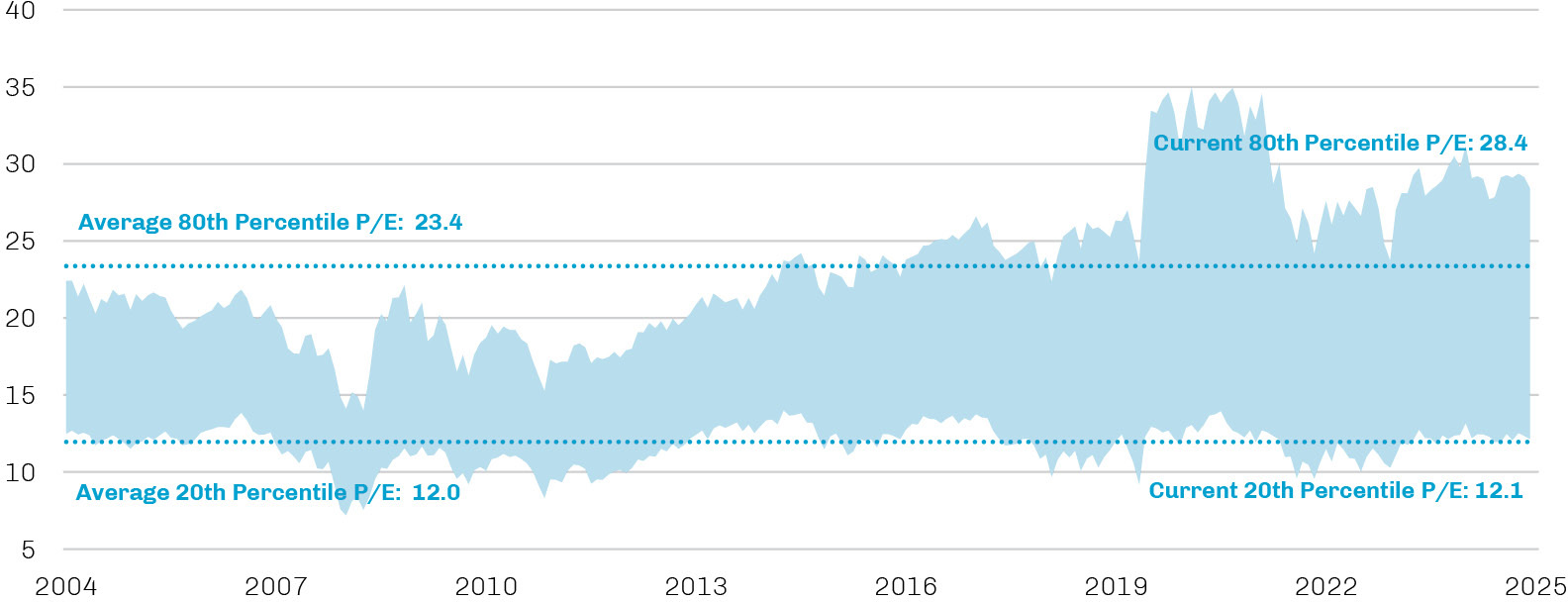
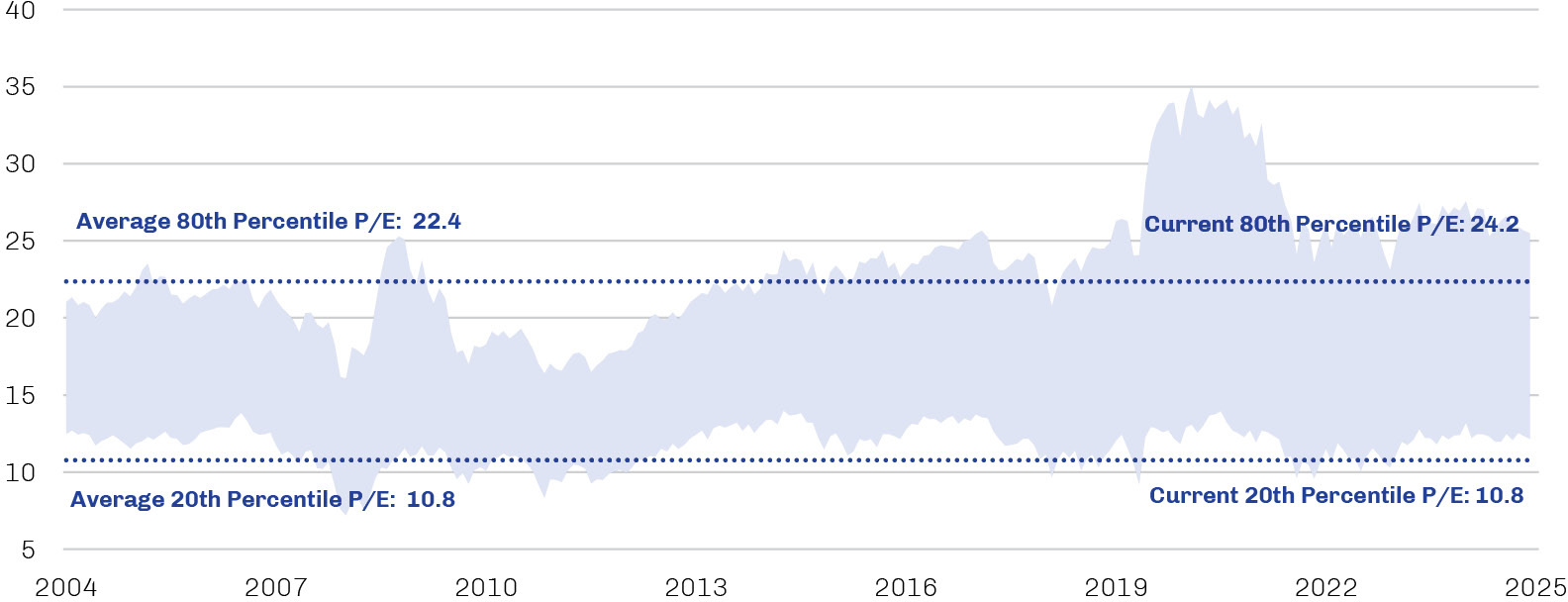
One of the more prominent themes in today’s equity markets is the unusually wide valuation gap. The top 20% most expensive companies in the S&P 500 Index trade at a price-to-earnings ratio (P/E) of just over 28x, while the bottom quintile trades near 12x—marking a wider valuation gap than the historical norm. As for international equities, the pattern is similar, with the highest valued quintile of the MSCI EAFE Index trading just over 24x versus the cheapest trading near 11x.1
The overall valuation backdrop in the US remains stretched relative to its long-term average. As of late October, the S&P 500’s forward P/E stood at 23x, compared to its 20-year average of roughly 16x and 30-year average of 17x.2 While these multiples have eased somewhat earlier in the year, they remain well above their historic norms. This could be a reflection of the heavy influence of mega-cap technology companies, which continue to drive much of the index’s performance and contribute to the perception of US stocks as being overly expensive. That being said, international markets appear much closer to fair value and can benefit from supportive tailwinds, such as moderating inflation trends and a weaker U.S. dollar shown earlier in the year.
For investors seeking diversification, the wide gap between expensive and relatively cheap names supports the case for selectivity—and for global exposure in regions where valuation spreads may offer greater upside potential. Active managers with a focus on quality can be well positioned to navigate this uneven landscape and possibly capitalize on the global market’s persistent inefficiencies.
Valuation Dispersion Remains Wide, Suggesting a Benefit to Selectivity
Comparison of S&P 500 Index (top) and MSCI EAFE Index Valuation Dispersion (bottom) 80th Percentile Versus 20th Percentile P/Es
October 2004 through October 2025
Source: FactSet, as of October 31, 2025.
Bridging the Residential Housing Gap

Senior Managing Director, Head of US Real Estate and Consumer Debt Strategies, Napier Park Global Capital
A variety of indicators have suggested an appreciable uptick in housing market activity of late as mortgage rates eased into the low 6% range.1 In our view, this reaction to a relatively minor rate move—a return to early-2023 levels but still quite elevated compared to most of the post-global financial crisis era—underscores the pent-up demand for housing in the US. Combined with the retreat of traditional banks from construction lending, the result is what we view to be a supportive backdrop for nonbank providers of capital to the real estate industry, particularly in residential transitional loans and land banking.
A variety of indicators have suggested an appreciable uptick in housing market activity of late.
Residential transitional loans. Given that the median age of owner-occupied homes is 41 years, we see significant opportunity to extend short-duration, value-add renovation loans—sometimes called “fix-and-flip” loans—to real estate developers that buy homes with the intent of quickly renovating and reselling them.2 We believe experienced developers with an intimate knowledge of the markets in which they operate have an advantaged position and are likely to quickly turn around their renovated properties, resulting in strong cash flows for lenders and optionality to redeploy capital.
Land banking. The process of preparing raw land for construction can take up to two years, and many large, publicly listed homebuilders have moved toward “land-light” business models in response. Land-banking arrangements facilitate this shift, providing homebuilders with off-balance-sheet financing for the acquisition of entitled and permitted land, which enables them to maintain a robust development pipeline without compromising liquidity or financial flexibility.
With their potentially attractive yields and robust monthly cash flows, residential transitional loans and land banking represent compelling opportunities for capital providers, in our view. High barriers to entry, meanwhile, highlight the importance of sourcing, underwriting and structuring experience.