BLOGThe Bird's Eye View
Timely Perspectives, Unconventional Thinking
We’re excited to share timely market insights, thoughtful perspectives and expert commentary as part of our commitment to providing modern investment solutions to modern challenges.
BLOGThe Bird's Eye View
Timely Perspectives, Unconventional Thinking
We’re excited to share timely market insights, thoughtful perspectives and expert commentary as part of our commitment to providing modern investment solutions to modern challenges.

Artificial intelligence (AI) continues to captivate markets—and for good reason. The next wave of innovation extends beyond today’s generative AI models, with ambitions to develop autonomous systems capable of executing real-world tasks, advanced robotics and increasingly sophisticated multisource models.
Behind the scenes, this transformation demands extraordinary investment. The technology companies driving large-scale AI deployment—often referred to as hyperscalers—are committing unprecedented and increasing amounts of capital toward data centers, computing power and digital infrastructure. Reflecting this broader trend, capital expenditure (capex) among hyperscalers is projected to accumulate to roughly $400 billion by 2025 year-end.1
But the AI expansion extends far beyond headline names. A wide network of suppliers supports this transformation, including semiconductor and chip manufacturers, energy providers, cloud infrastructure operators and data storage firms. Each plays a distinct role in enabling AI at scale, contributing to idiosyncratic performance across AI-related companies.
Some companies already have backbone infrastructure in place. Others are in heavy investment mode, taking on significant costs before profitability becomes clear. Meanwhile, critical upstream providers are benefiting from current demand from today’s rapid adoption of AI. This dispersion highlights the many layers beneath the surface, as companies across the ecosystem face differing opportunities and challenges. At the same time, market enthusiasm may at times be influenced by narrative rather than fundamentals, leading to uneven pricing across companies with varying roles in the AI value chain.
As the AI landscape develops, clear winners and losers are likely to emerge. With AI-related companies representing a meaningful share of major equity indexes, investors must look beyond the hype to understand company-specific drivers. Skilled active managers’ selective approach may help investors assess which companies may be better positioned to navigate the opportunities and risks of a rapidly evolving technological landscape.


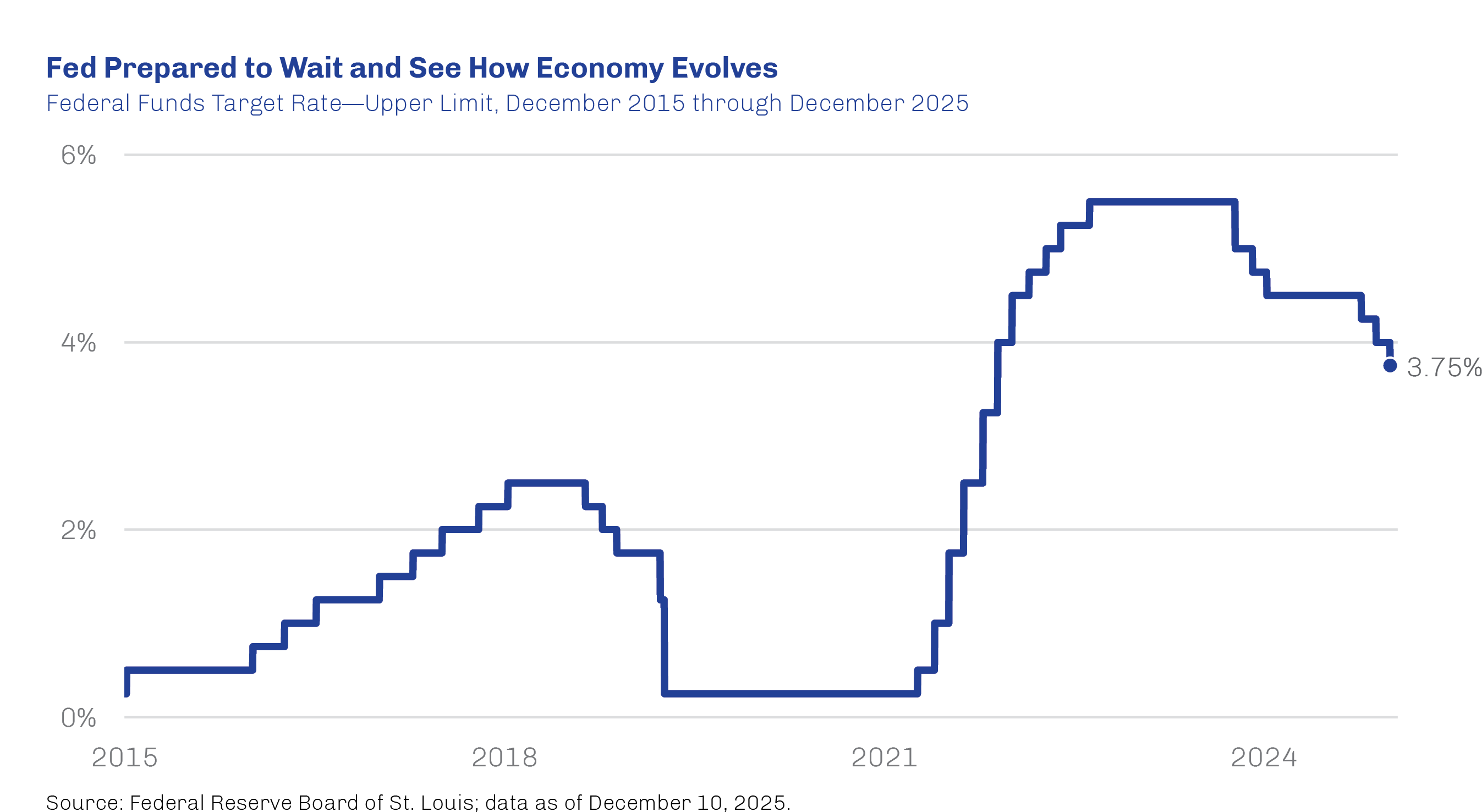
The Federal Open Markets Committee (FOMC) on December 10 cut the federal funds rate 25 basis points to a range of 3.50–3.75%. There were three dissents—the most in six years—as two voters favored no cuts, while one favored a 50 basis point cut, though the dot plot of rate projections indicated broader “soft” dissent among the 19 officials.
While expectations of this meeting had been for a “hawkish cut,” the Fed instead delivered what we view as a balanced, risk-friendly cut that hinted at an extended pause driven by improved growth dynamics. With the rate near neutral, the Fed is “well positioned” to wait and see how the economy evolves as data reporting impacted by the government shutdown catches up and fiscal stimulus kicks in during the first quarter.
The median FOMC participant forecasts one additional cut in both 2026 and 2027, though the distribution of forecasts was extremely wide. Futures markets, in contrast, are pricing a little over two cuts next year, with the first cut fully priced in for June when the next chair takes over from Powell. The market is not pricing any further cuts beyond 2026.
The Fed also announced that it will begin buying Treasury bills to expand its balance sheet at a pace of $40 billion per month starting on December 12 to ensure reserves remain ample. Its quantitative tightening program ended on December 1.