


BLOGThe Bird's Eye View
Timely Perspectives, Unconventional Thinking
We’re excited to share timely market insights, thoughtful perspectives and expert commentary as part of our commitment to providing modern investment solutions to modern challenges.
BLOGThe Bird's Eye View
Timely Perspectives, Unconventional Thinking
We’re excited to share timely market insights, thoughtful perspectives and expert commentary as part of our commitment to providing modern investment solutions to modern challenges.

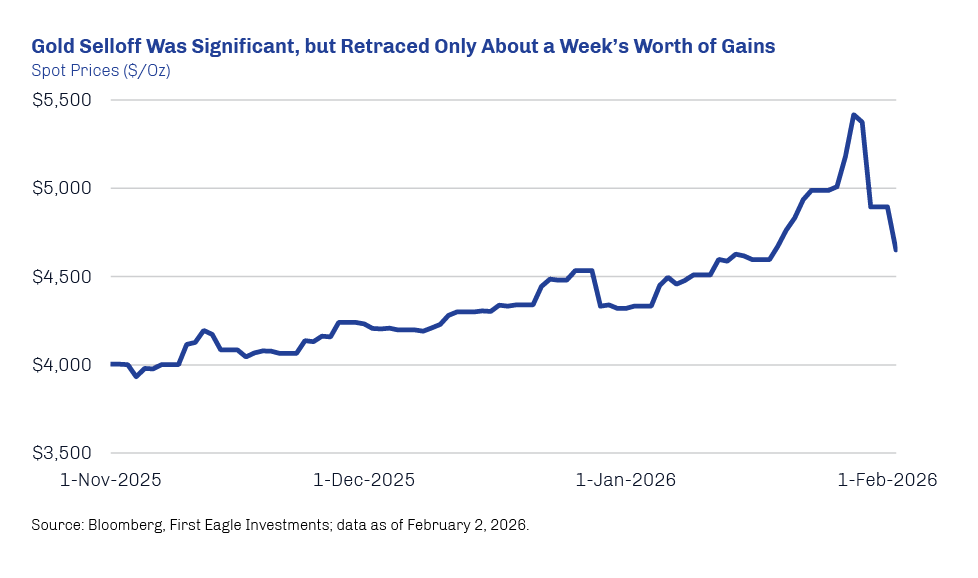
Precious metals experienced a significant correction on Friday, January 30, with gold (-8.95%) and silver (-26.36%) posting their largest single-day percentage declines in history.1
Despite this selloff and subsequent volatility in these markets, we believe the structural role of gold bullion and gold-related securities as a potential hedge remains intact—and perhaps more important than ever—given rising global debt levels, ongoing fiscal pressures, and persistent monetary and geopolitical uncertainties. As illustrated by Friday’s price action, however, disciplined security selection and appropriate position sizing are paramount.
The immediate catalyst for Friday’s selloff was the nomination of Kevin Warsh as the new Federal Reserve chair, set to replace Jerome Powell in May 2026. The choice of Warsh was viewed as less dovish and more supportive of Fed independence than widely anticipated, which weighed on the debasement trade and sparked an extreme reaction in gold and silver markets that appeared short-term overextended following strong rallies.
We believe it is important for investors to keep the decline in perspective. While Friday’s selloff was large, it merely sent the price of gold and silver back to peaks established earlier this year.2 Meanwhile, in our view, gold’s valuation continues to look reasonable on a historical basis relative to the stock of US public debt or equities.
In our view, gold’s valuation continues to look reasonable on a historical basis relative to the stock of US public debt or equities.
Corrections, in our view, are a natural and healthy development following strong upward moves in price, helping flush out excess froth in the market while creating attractive opportunities for disciplined investors. Though painful in the short term, corrections do not necessarily undermine long-term investment theses. The 1987 stock market crash is a classic example; while the S&P 500 sold off 28.5% over the course of several days in October, it did not derail the broader structural bull market in equities that spanned from 1980 to 2000.3
While we won’t hazard a guess at the short-term direction of gold prices, we are confident in the metal’s value as a potential hedge amid an increasingly complicated investment backdrop.

On January 30, President Trump announced he would nominate Kevin Warsh to be the next chair of the Federal Reserve when Jerome Powell’s term ends in mid-May. Warsh’s nomination, in my view, alleviates some degree of concern about the central bank’s independence, especially relative to some of the other candidates that were being considered. On their own, reduced concerns about Fed independence are helpful for the dollar and weigh on the debasement trade; not surprisingly, the dollar rallied on the announcement while gold and silver sold off sharply.1
Warsh has built a reputation as an inflation hawk going back to his days as a Fed governor from 2006 to 2011, but public statements since Trump re-took office last year have been critical of the measured pace of policy easing. He has suggested that the US is amid an artificial intelligence-driven productivity boom that allows for faster economic growth—and lower interest rates—without stoking inflation, but I think it’s way too early to conclude productivity has durably increased. I expect Warsh to push the federal funds rate lower by 50–75 basis points this year, which is what I would have expected even with no change in leadership. Faster rate cuts, on their own, would tend to have a negative impact on the dollar.
Warsh also has been critical of the Fed’s balance sheet expansion, but I don’t expect a near-term restart of quantitative tightening—which ended in December 2025—given the current level of reserves. Broader regulatory reform, a time-consuming exercise, would be necessary to meaningfully reduce reserves. Potentially, a Warsh Fed could accelerate efforts to shift the Fed’s balance sheet back to Treasury securities exclusively, with a bias toward short-term bills, and the steepening in the Treasury yield curve that we are seeing is in line with this view.
A Warsh Fed could potentially accelerate efforts to shift the Fed’s balance sheet back to Treasury securities exclusively.