


BLOGThe Bird's Eye View
Timely Perspectives, Unconventional Thinking
We’re excited to share timely market insights, thoughtful perspectives and expert commentary as part of our commitment to providing modern investment solutions to modern challenges.
BLOGThe Bird's Eye View
Timely Perspectives, Unconventional Thinking
We’re excited to share timely market insights, thoughtful perspectives and expert commentary as part of our commitment to providing modern investment solutions to modern challenges.

Our focus on resilient wealth creation is rooted in the notion that capital can be deployed in such a way that it keeps pace with the nominal drift of the economy over time and thus retains its purchasing power. Perhaps counterintuitively to some, we believe the most effective way to fulfill this purpose—far better than what is considered “safe” short-term government securities—is through thoughtful allocations to risk assets.
Our perspective hinges on differentiating between what we describe as “fixed principal” assets and “fixed positional” assets. Treasury bills, for example, are fixed principal assets; the yield paid to investors is fixed, as is the nominal value of the bill at maturity. Considered risk-free due to its explicit US government backing, every T-bill held to maturity has paid its investors exactly what was promised, no more and no less. While such stability has its merits, it also has its drawbacks; as the supply of these assets varies over time with the funding needs of the government, their real, inflation-adjusted value at maturity is unknowable.
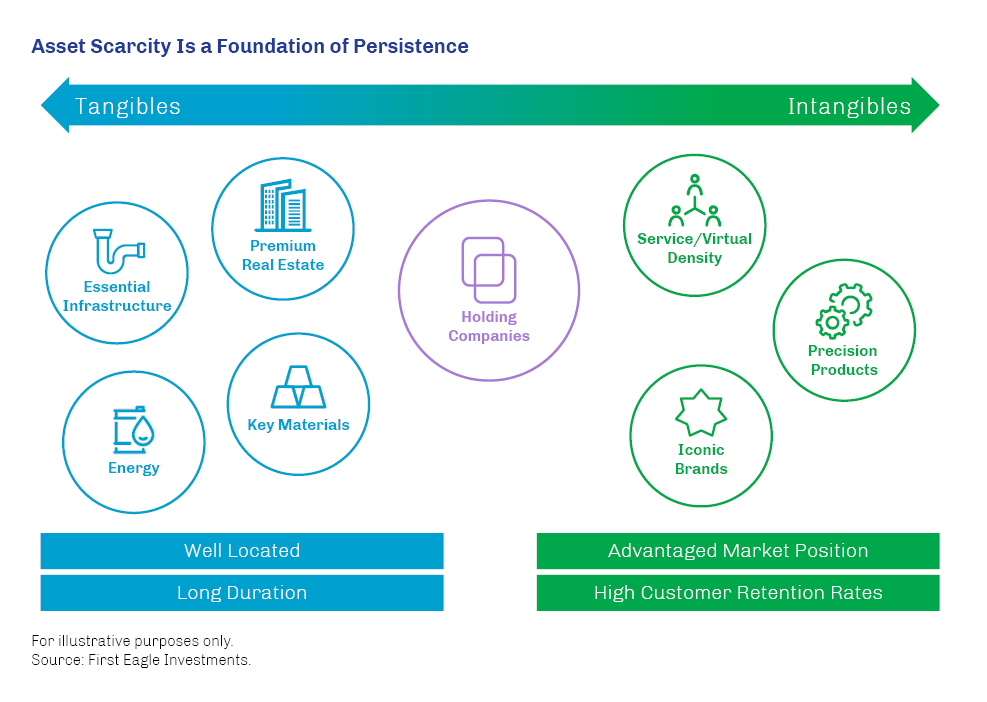
In contrast, equities are examples of fixed positional assets; while their yield is variable or nonexistent and their terminal value is unknown, their relatively fixed supply historically has enabled them to participate in the nominal drift of the economy. As nominal prices have increased alongside the expanding money supply and growing government debt, equity prices have kept pace. We believe this effort hinges on identifying companies that own assets with scarcity value—whether tangible or intangible—that have the potential to provide long-term advantages in profitability and durability.
The relatively fixed supply of equities historically has enabled them to participate in the nominal drift.
The Software Slump

Senior Managing Director and Chief Investment Officer of Direct Lending, Napier Park Global Capital
Next-generation artificial intelligence (AI) tools from the likes of OpenAI and Anthropic have sounded alarms about potential disruption to the tech landscape and weighed heavily on stocks in the enterprise software space. The S&P Software & Services Select Industry Index, for example, is down more than 23% from its September 2025 peak.1
More recently, AI concerns have spread to the credit market. Broadly syndicated loan prices declined $0.90 in January, driven by a $3.60 fall in software, which at 16% is the largest component of the market.2 While private credit lacks a secondary market to capture short-term changes in sentiment, the sharp declines in the share prices of publicly traded private credit vehicles suggest the strain is also being felt in middle market direct lending; a number of high-profile business development companies and listed alternative credit managers are trading 25% or more off recent peaks.3
While the advancement of AI tools is likely to have an impact across software—and many other sectors—we believe there is more nuance to the AI story than the headlines would suggest. The degree of dislocation will likely vary among borrowers. In our view, enterprise software platforms with differentiated offerings, large installed bases and deep integration in customer ecosystems are likely to be most resilient in the face of AI—or potentially even add value to their client relationships by leveraging emerging functionality. In the meantime, credit quality statistics for the industry overall remain strong, and long-term contractual obligations may blunt immediate margin pressure.4
We believe there is more nuance to the AI story than the headlines would suggest.
We’ve written previously about the importance of prudence in today’s market environment of tight spreads, all-in yield compression and heightened idiosyncratic risk, and we believe the swift repricing of software credits year to date underscores our view that caution is the new conviction.