BLOGThe Bird's Eye View
Timely Perspectives, Unconventional Thinking
We’re excited to share timely market insights, thoughtful perspectives and expert commentary as part of our commitment to providing modern investment solutions to modern challenges.
BLOGThe Bird's Eye View
Timely Perspectives, Unconventional Thinking
We’re excited to share timely market insights, thoughtful perspectives and expert commentary as part of our commitment to providing modern investment solutions to modern challenges.

Smaller stocks in general fell out of favor during the third quarter as market leadership narrowed to a small cohort of large artificial intelligence (AI)-related names. Though the economic backdrop remained constructive, inflation pressures and rising bond yields served as a headwind to smaller companies.
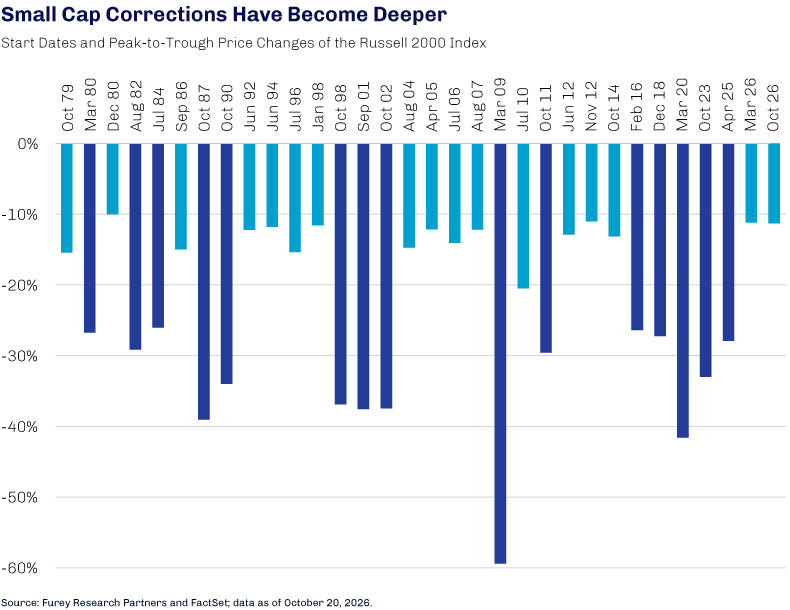
Notably, “normal” bull market corrections for small caps have become deeper and more exaggerated since 2015, as shown in the chart below. Roughly two-thirds of the industries in the Russell 2000 Index have experienced a correction since the August peak, above the historical averages of prior corrections.1 This has enabled us to rotate out of areas like technology and industrials into sectors that we believe are more attractive—including healthcare and energy—as well as more idiosyncratic opportunities.
It also remains to be seen whether the Federal Reserve has begun a prolonged hiking cycle or if September’s hike represented a one-off that will be followed by more “data-dependent” decisions moving forward. Smaller companies tend to be more reliant on short-term, floating-rate debt than large cap names, so the shift toward tighter policy could have a material impact on the companies in this space.
That said, rising rates coincidental with a robust economic backdrop have not historically been an impediment for small company returns; instead, strong economic activity has tended to support corporate fundamentals, to the benefit of these stocks.
With the earnings resurgence continuing—published forecasts reflect 86% earnings growth for the Russell 2000 Index in 2026 and 44% in 2027 compared to 35% and 15%, respectively, for the S&P 500 Index—we would not be surprised to see this dynamic play out once again, especially if there is a successful conclusion to the Iran war in the coming months and energy prices and inflation ease.2

Securitized markets continued to experience robust issuance in September, even as rising interest rates slowed activity and signs of credit deterioration emerged in certain segments. Spreads remained relatively tight across most risk assets, with agency mortgage-backed securities and high-yield corporate debt notable exceptions.
Asset-Backed Securities (ABS)
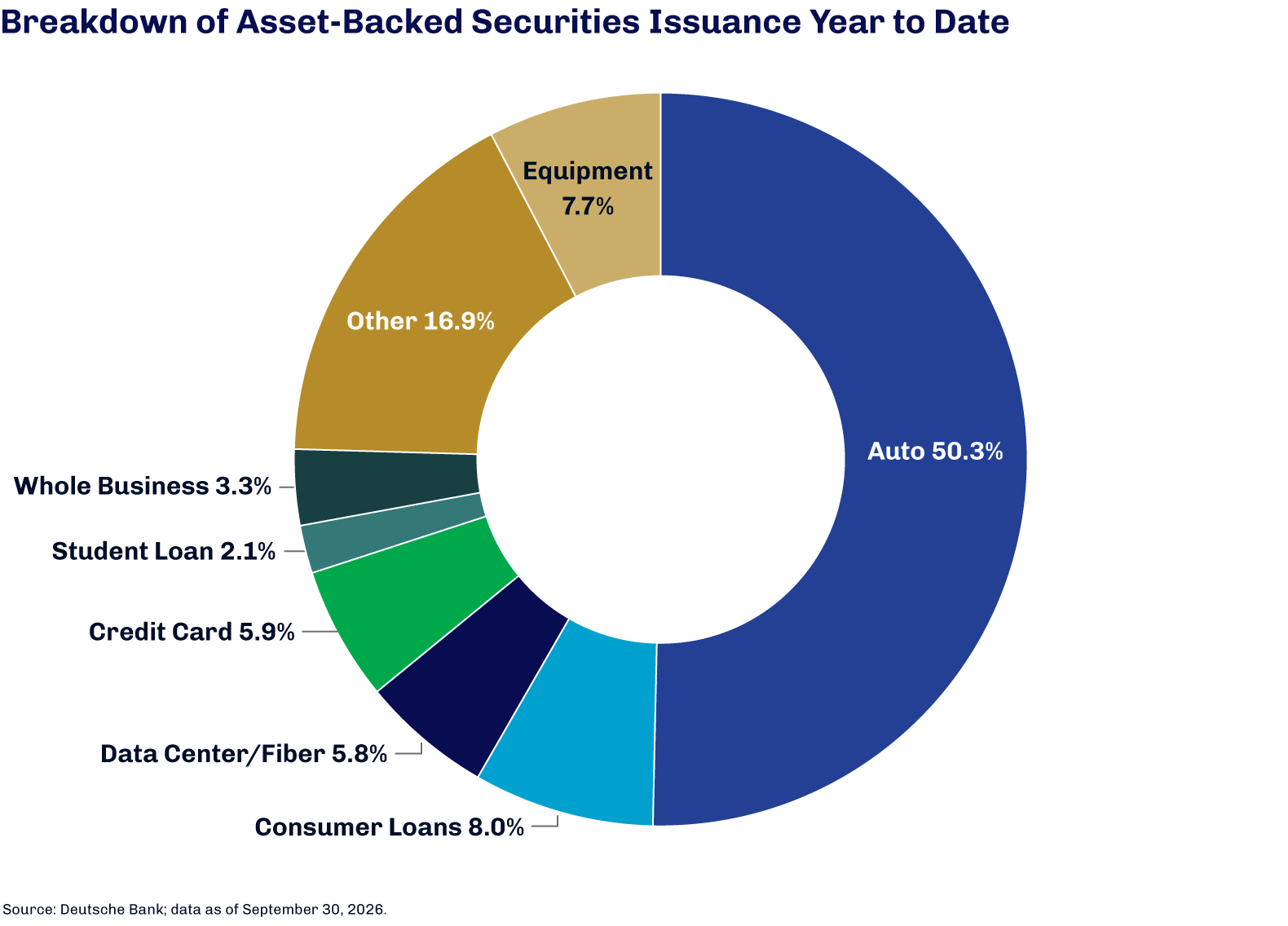
ABS issuance totaled $27.5 billion in September, bringing year-to-date issuance to $284 billion, ahead of comparable 2025 and 2024 levels. Auto ABS accounted for approximately half of monthly issuance, while activity in data center and device payment securitizations increased. Collateral performance remained generally positive, with improving credit trends in prime auto and credit card ABS. Subprime auto delinquencies stabilized, though solar ABS continued to experience deterioration.1
Commercial Mortgage-Backed Securities (CMBS)
CMBS credit pressures persisted, with overall delinquencies rising to 8.02% in September. Office delinquencies reached 12.09%, while multifamily and lodging also experienced increases. Special servicing rates climbed, reflecting continued challenges across commercial real estate. Despite these headwinds, non-agency CMBS issuance reached $133 billion year to date, surpassing full-year 2024 production.2
Residential Mortgage-Backed Securities (RMBS)
Non-agency RMBS issuance slowed to $15.3 billion in September from $19.4 billion in August as higher interest rates weighed on activity. Nevertheless, year-to-date issuance remained on pace to exceed prior-year levels, with non-qualified mortgages continuing to represent a significant share of new supply.1
Consumer Credit Trends
Consumer fundamentals showed signs of weakening as slower employment growth, elevated gasoline prices and rising borrowing costs pressured household finances. However, collateral performance across most ABS sectors remained resilient, highlighting the divergence between broader economic headwinds and underlying securitized credit trends.1