BLOGThe Bird's Eye View
Timely Perspectives, Unconventional Thinking
We’re excited to share timely market insights, thoughtful perspectives and expert commentary as part of our commitment to providing modern investment solutions to modern challenges.
BLOGThe Bird's Eye View
Timely Perspectives, Unconventional Thinking
We’re excited to share timely market insights, thoughtful perspectives and expert commentary as part of our commitment to providing modern investment solutions to modern challenges.

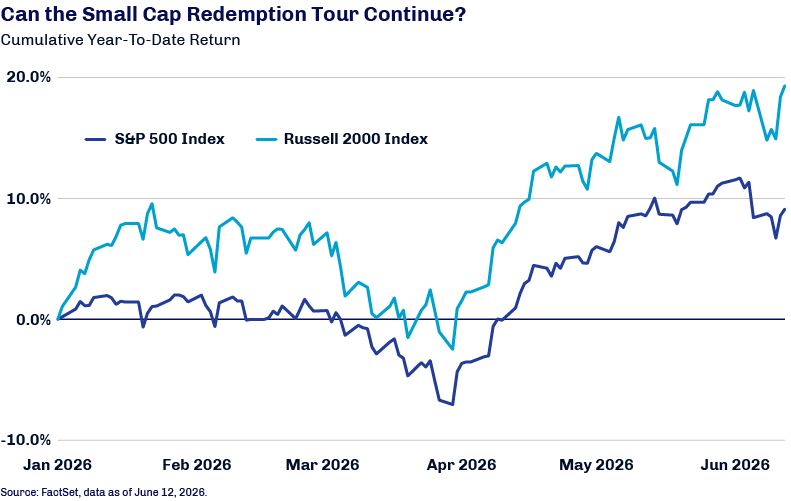
After underperforming for what, to us, seemed like forever, small caps have finally demonstrated what consistently strong earnings can do for equity returns. The Russell 2000 Index has outperformed the S&P 500 Index by approximately 1,000 basis points year to date and is in what we hope is only the early stages of an extended redemption tour.1
While the macroeconomic and geopolitical backdrop remains unsettled, we believe there are a number of bright beacons to help guide small caps to success.
Continued earnings upswing. For the first time in a while, Russell 2000 Index earnings growth is projected to outstrip that of the S&P 500 Index for at least the next two years.2
Software-enabled efficiencies. Outsourced software and servicing solutions may provide resources for small companies to scale their operations, improve efficiency and facilitate the conversion of some costs from fixed to variable, easing the need for working capital.
AI-driven growth. Artificial intelligence (AI) may enable some small cap companies—including suppliers to infrastructure and data-center construction—to expand their customer bases without incremental spending on research and development, underpinning both top-line growth and margin expansion. Healthcare and consumer goods companies could conceivably see even greater benefits from AI through enhanced development of premium products that drive pricing power.
Policy and economic tailwinds. A more benign regulatory environment may spur mergers and acquisitions activity, while reindustrialization and reshoring trends could be of benefit to smaller domestic-focused businesses.
A resurgent IPO market. With free money a thing of the past, private equity sponsors may be incentivized to monetize their investments through initial public offerings (IPOs). Increased liquidity and investor focus on private-to-public marks could more broadly enhance valuations and performance for publicly traded small cap companies overall.

Markets in May remained focused on geopolitical developments, evolving economic conditions and leadership changes at the Federal Reserve. Investors balanced signs of labor market resilience against mixed economic data while closely monitoring central bank independence and governance issues, which continued to influence sentiment and policy expectations.
Corporate credit. Investment grade corporate markets continue to rebound from one of the worst months in recent history—a loss of 1.98% in March—with another solid gain of 0.76% in May. Corporate spreads continued to tighten during May, reversing the widening seen earlier in the year amid geopolitical uncertainty and ending the month at 72 basis points. Despite tighter spreads, the yield-to-worst for the Bloomberg US Corporate Bond Index remained attractive at 5.13%. Investor demand for yield stayed strong, supporting $163 billion of issuance in May and helping year-to-date issuance reach a record $993 billion, up 25% year over year.1
Securitized credit. The spread on the Bloomberg US Securitized Index was essentially flat during May, in contrast with the tightening trend seen across other risk sectors. Even so, spread levels remain near historically tight ranges, reflecting continued investor support for the asset class. The sector returned 0.29% during the month, outperforming Treasuries but trailing investment grade corporates. Securitized assets have generated positive returns during all but one month since August 2025, producing a cumulative return of 5.29%.2
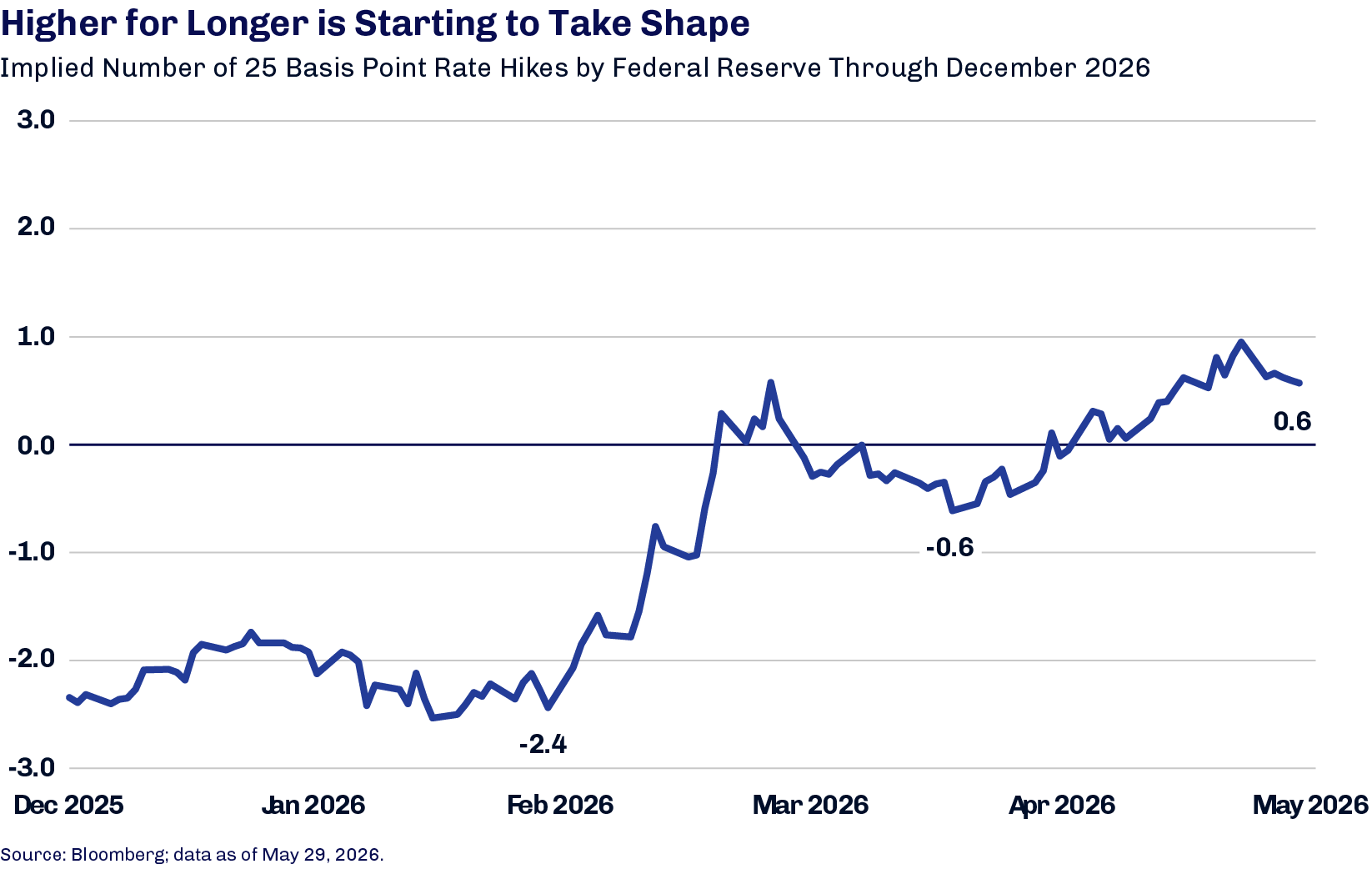
Treasury and rates. Treasury yields were volatile throughout May as markets responded to developments surrounding the Middle East ceasefire and shifting economic data. The labor market showed continued improvement, marking three consecutive months of payroll growth above 100,000 and contributing to higher rates as expectations for a potential year-end rate hike increased.3 Inflation data released on May 12 cast a shadow on interest rate markets, with Treasury yields climbing across the curve on fears that inflation will remain more persistent. After trading between 4.35% and 4.67% during the month, the 10-year Treasury yield declined over the final seven trading days and ended May at 4.45%.4