BLOGThe Bird's Eye View
Timely Perspectives, Unconventional Thinking
We’re excited to share timely market insights, thoughtful perspectives and expert commentary as part of our commitment to providing modern investment solutions to modern challenges.
BLOGThe Bird's Eye View
Timely Perspectives, Unconventional Thinking
We’re excited to share timely market insights, thoughtful perspectives and expert commentary as part of our commitment to providing modern investment solutions to modern challenges.
AI’s Securitized Footprint: The Data Center Boom

Portfolio Manager

Client Portfolio Manager
Outside of the conflict in the Middle East, few topics have dominated recent market conversations more than artificial intelligence (AI), its potential impact on the global economy and the rapid growth of data-center financing.
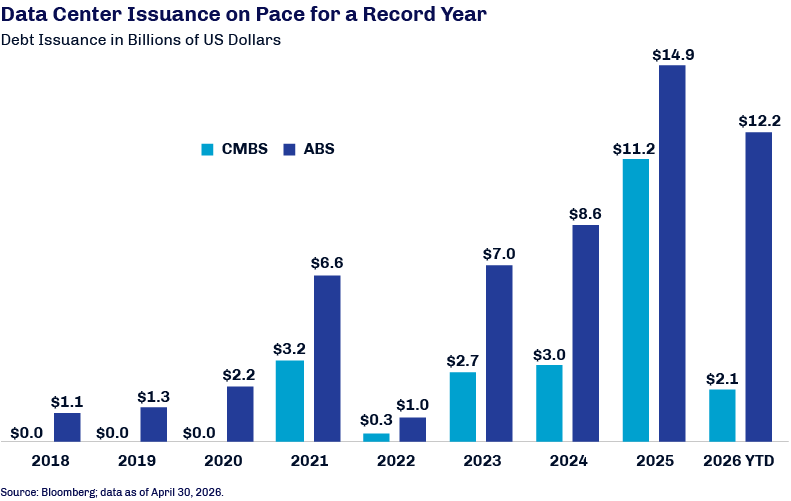
Despite concerns around energy use and their impact on surrounding communities, data centers have rapidly expanded across the US as cloud computing and AI continue to drive demand for computing power. For fixed income investors, this growth has created a new category of securitized collateral with distinct structural features and risk considerations.
Data-center asset-backed securities (ABS) typically utilize master trust structures, allowing issuers to add qualifying collateral and issue new note series over time. Cash flows are tied to underlying tenant leases, making retention a key risk, especially when renewals extend beyond anticipated repayment dates. For investors, these securities can offer exposure to a fast-growing economic segment, backed by standard ABS credit enhancements.
Data-center commercial mortgage-backed securities (CMBS) growth has centered on the single-asset single-borrower market, where credit risk is tied to one borrower and one loan backed by a property or portfolio. Today, hyperscaler facilities dominate issuance given their limited tenant volatility.1 Unlike ABS, which is backed by lease cash flows and can add assets over time, CMBS typically relies on a fixed collateral pool and the underlying real estate. These loans generally have a five-year hard maturity, with refinancing driven largely by property valuation. While borrowers cannot prepay on these loans, they can use a process called defeasance, substituting US Treasuries as collateral to replicate the original loan’s remaining cash flows and thus improve credit quality.
While the segment continues to expand, spreads across both the ABS and CMBS markets have remained exceptionally tight alongside increasing demand for AI-linked investment exposure.2
The New Normal: AI Growth in an Inflationary World

Portfolio Manager and Senior Research Analyst
As the war with Iran enters its fourth month, financial conditions have largely adjusted back to pre-war conditions, but the stagflationary impulse still threatens the global economy. Although Brent crude prices have eased approximately 20% off their peak, the Strait of Hormuz remains closed.1 While most governments have taken measures to mitigate the impact of higher energy prices on households and businesses, we have already begun to see early indicators of demand destruction in emerging economies that are heavily reliant on imported energy from the Middle East.2
Meanwhile, the boon in capital expenditures for artificial intelligence (AI)-related infrastructure has buoyed growth in the US and in select economies in Asia, most notably Korea and Taiwan, where surging technology exports have offset the impacts of energy shocks.3 While the US is not reliant on energy imports, higher energy prices have exacerbated the risk of higher core prices from tariffs and the impact of immigration policy on wage inflation.4
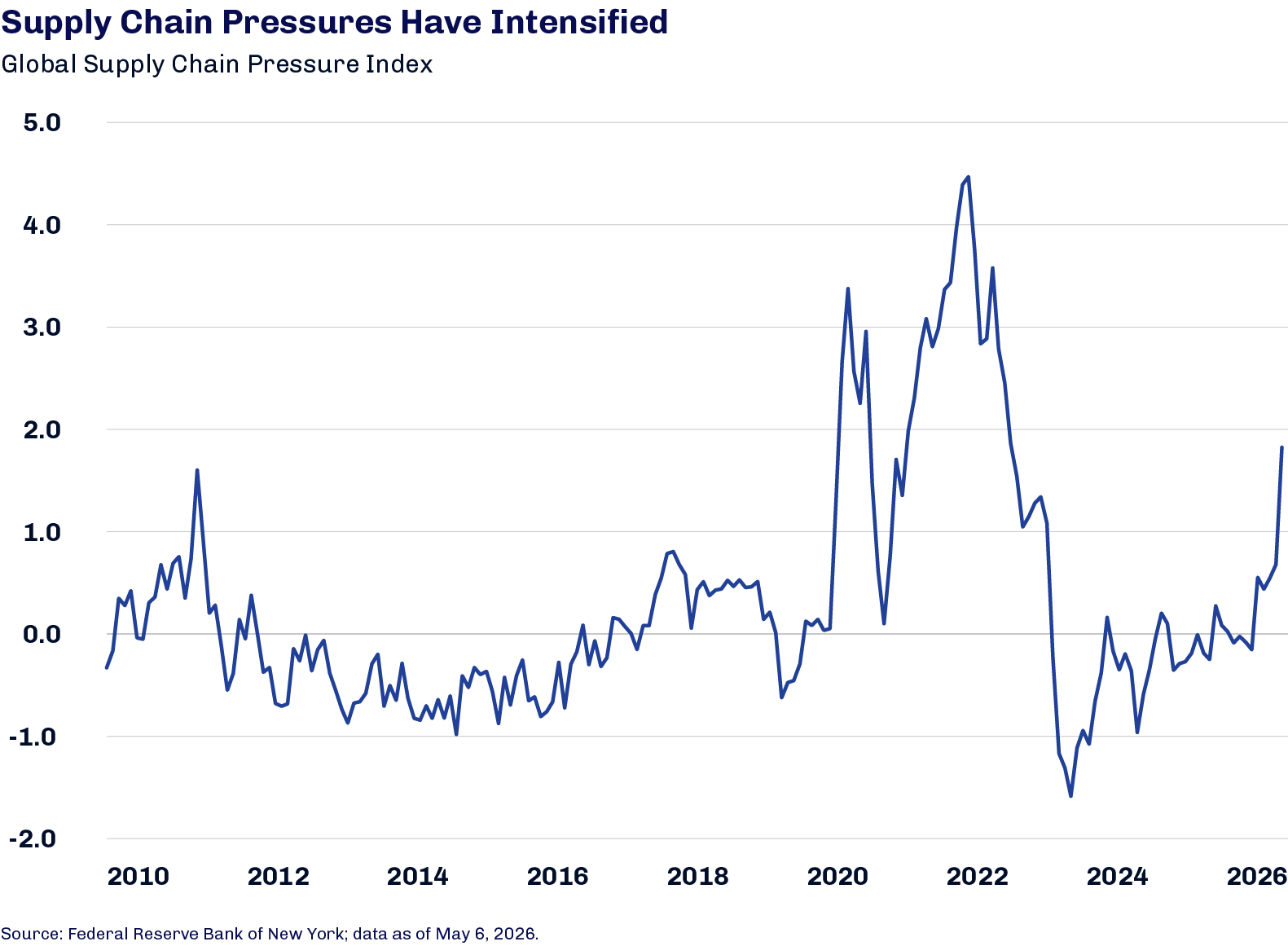
Input and output prices have been increasing as supply chain pressures have intensified worldwide.5 Some economies have begun to tighten monetary policy, and it’s likely more central banks will begin to raise rates in the coming months.
The duration of the current ceasefire remains unclear, as does the question of who will control the flow of traffic through the Strait of Hormuz over the long term. We continue to believe that supply conditions will not immediately return to normal upon the Strait’s eventual reopening, as the need to replenish oil stocks and repair damaged infrastructure will support still-elevated energy prices. In the face of this “new normal,” we believe that assets with the potential to participate in this inflationary dynamic are well positioned to demonstrate resilience across multiple states of the world.