Reflections 2025-2026

Observing the current mania for private assets, Bill Hench, head of the Small Cap team, reflects on why he believes investment fundamentals ultimately trump vehicle structure. While private equity investments benefited from a number of tailwinds coming out of the global financial crisis, Bill thinks the winds may be shifting in favor of quality, publicly listed smaller companies. The potential reversion to the long-term mean could be powerful.

Illiquidity Is the “New New Thing” for Investors…

Oh, for the good old days when fundamentals were king.

Back when I was a lad coming up through the ranks, liquidity—and its corollary, price discovery—were prized investment features. Active trading with real-time marks to market—and the concomitant quick escape hatch, if desired—were generally valued by investors.

Since the global financial crisis, however, heads have been turned by eye-popping returns generated in private equity. Underpinned by belief that the real money is made before a company goes public—and only for those with privileged access, such as institutions and family offices—the proverbial everyman has been clamoring for access to private alternatives. Heeding the cry—and following an executive order issued by President Trump—the US Department of Labor in August paved the way for inclusion of alts in retirement plans by removing 2021 guidelines discouraging private investments, with plan sponsors maintaining their fiduciary responsibility to identify suitable investments.1
 
With pre-public access the current rage, menus of new private alts have proliferated, with themed offerings in artificial intelligence (AI), data centers and infrastructure. Charles Schwab has announced the purchase of Forge Global Holdings to provide its retail clients with access to shares in companies before they go public. Interval funds and business development companies have become popular vehicles through which managers may provide investors liquidity in assets that are inherently illiquid.2


Lucrative returns in some private assets may reflect the zero interest rates that prevailed when these investments were made.

While it’s tempting to attribute lucrative returns to sponsor acumen and/or to the private vehicle structure itself, it seems to us that most of the kudos should go to the zero interest rates that prevailed when these investments were made. The ample capital readily available in the years following the global financial crisis and resulting low hurdle rates enabled private equity sponsors to acquire young and/or broken businesses, nurture them to some semblance of maturity, and then monetize their investments through sale to a strategic or financial buyer or to the public through initial public offerings (IPOs). Since the interest rate environment shifted higher in 2022, the cost of acquiring and building businesses has increased, as have the financing costs and return targets for subsequent buyers.


…but It Comes at a Cost

While a long lockup period—that is, structural illiquidity—has been characteristic of private investment vehicles, it does not in and of itself contribute to investment success. The fundamental qualities of an investment—private or public—ultimately underpin its returns.

Moreover, illiquidity can convey a false sense of security. Scrutiny of an investment may be less stringent without daily marks to market, and the rapid deterioration of a business can take investors unaware. For example, the September 2025 bankruptcies of subprime auto lender Tricolor Holdings and auto parts supplier First Brands Group—alongside allegations of fraud—surprised bankers and syndicated loan investors alike.3 A similar unraveling was seen at home-improvement rollup Renovo Home Partners, whose debt was marked down by its largest lender from par to zero in only a few weeks.4 While these occurrences have been characterized as idiosyncratic, for now, more systemic risk may become apparent over time.

Vintage matters. We would be surprised if the returns realized on private investments entered into today—given a meaningful cost of capital, higher hurdle rates and longer holding periods—kept pace with those made between the global financial crisis and rate tightening in 2022. With exit paths and big gains harder to come by, we expect the lure of privates—and illiquid assets—may ease within the general investing populace.
 
Liquidity may be most important when it’s least accessible. Should private equity sponsors eventually be laden with investments they can’t monetize, redemption gates likely will go down, leaving investors barred from the exits. As the pendulum swings from one extreme to the other, liquidity may reemerge as the old, and more desirable, new thing.


Liquidity may be most important when it's least accessible.


Fundamentals Remain Our Lodestar

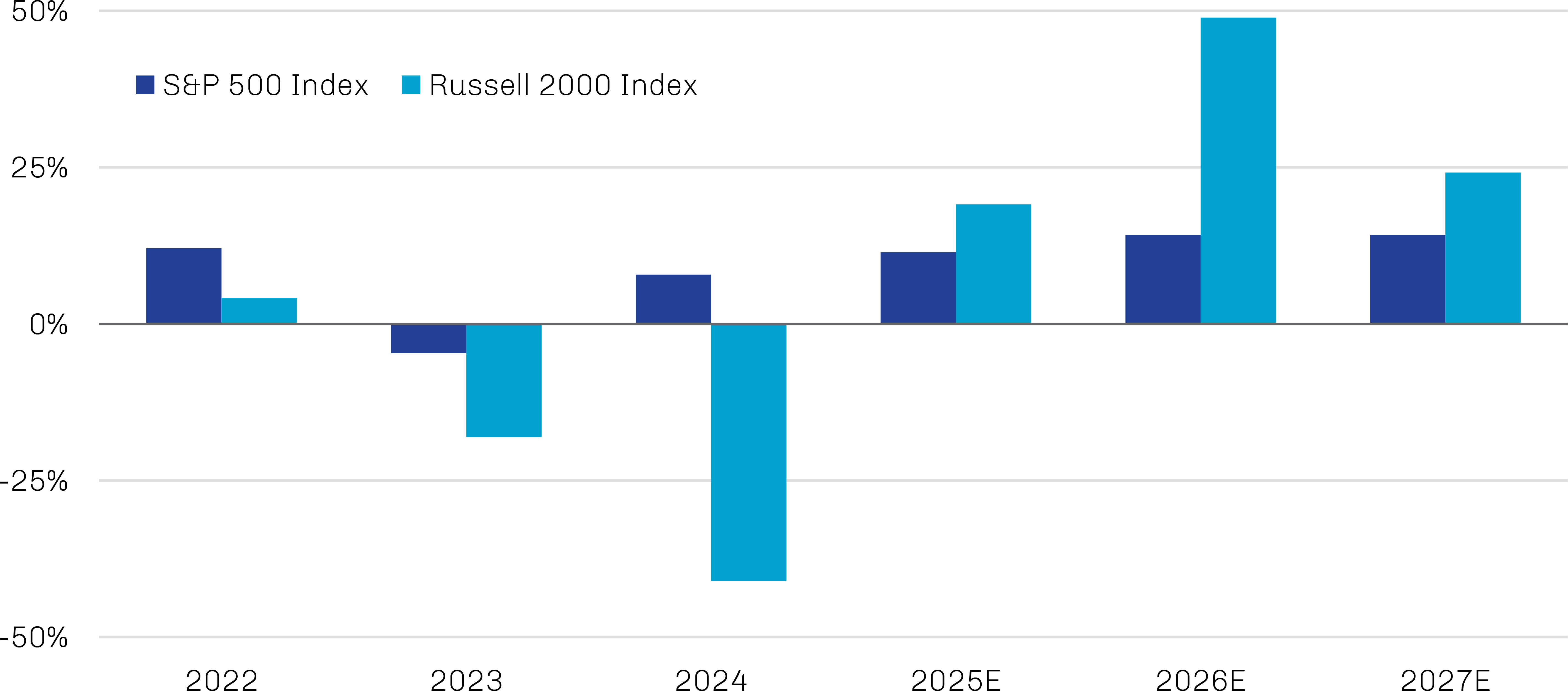
As fundamental investors, we continue to believe that underappreciated earnings potential is the true holy grail and has historically been rewarded in the marketplace. For the past three years, small cap earnings have been overshadowed by those generated by S&P 500 companies—especially the Magnificent Seven—which also were able to sidestep such small cap challenges as access to capital and management depth. But there are signs that a recovery in small cap earnings may at last be underway.

As shown in Exhibit 1, earnings for the Russell 2000 Index are forecast to outpace those of the S&P 500 Index through at least 2027. Even without multiple expansion, earnings growth alone can propel small cap performance.

Exhibit 1. Small Company Earnings May Be on the Upswing

Actual and Estimated Earnings Growth, Year-over-Year Percent Change
 

Source: LSEG I/B/E/S; data as of November 30, 2025.


Further, we see multiple paths to success for small cap businesses. Among the most compelling potential earnings drivers are:

Technology-driven growth. Outsourced software and servicing, broadly, may provide resources that enable small companies to scale their operations, improve efficiency and facilitate the conversion of some costs from fixed to variable, easing the need for working capital.

More specifically, AI may benefit small cap companies over a very long cycle. Pick-and-shovel suppliers to infrastructure and data center construction, for instance, can expand their customer base without triggering incremental spending on research and development (R&D), thus supporting margin expansion. These suppliers may include providers of cable, rebar, HVAC systems and components of energy systems like gas turbines. Healthcare and consumer goods companies could conceivably see even greater benefits from AI. In addition to reduced spending on R&D and selling, general and administrative expenses (SG&A), AI may also enhance development of superior products to drive pricing power.
 
Supportive trade and monetary policy.
Prospective policy developments and lower interest rates could also bolster small cap earnings. Although the domestic orientation of many smaller companies has provided some insulation against tariffs, additional relief on this front may come from the Supreme Court as it considers Trump’s ability to impose tariffs under the International Emergency Economic Powers Act. While it’s possible the administration would seek other legal statutes to reimpose tariffs were they removed, it’s also possible that Trump could point to several trillion dollars of investment promised from abroad and declare victory in the trade war, potentially easing inflation ahead of the November 2026 midterm elections.5 This may also clear the way for additional rate cuts by the Federal Reserve on top of the 75 basis points of cuts since September. Reduced inflation and lower interest rates could further benefit small companies, which still often carry substantial levels of variable-rate debt.


Lower interest rates could benefit small companies, which often carry substantial levels of variable-rate debt.

A resurgent IPO market. We anticipate the IPO market to continue reopening, to the potential benefit of small cap companies. With free money a thing of the past and meaningful hurdle rates, private equity sponsors are incentivized to monetize their investments through the public market, even if they are unable to realize previously hoped-for returns. As discussed earlier, the days of extended holding periods facilitated by zero funding costs appear to be behind us.


The Past Decade Has Generally Favored Larger Stocks

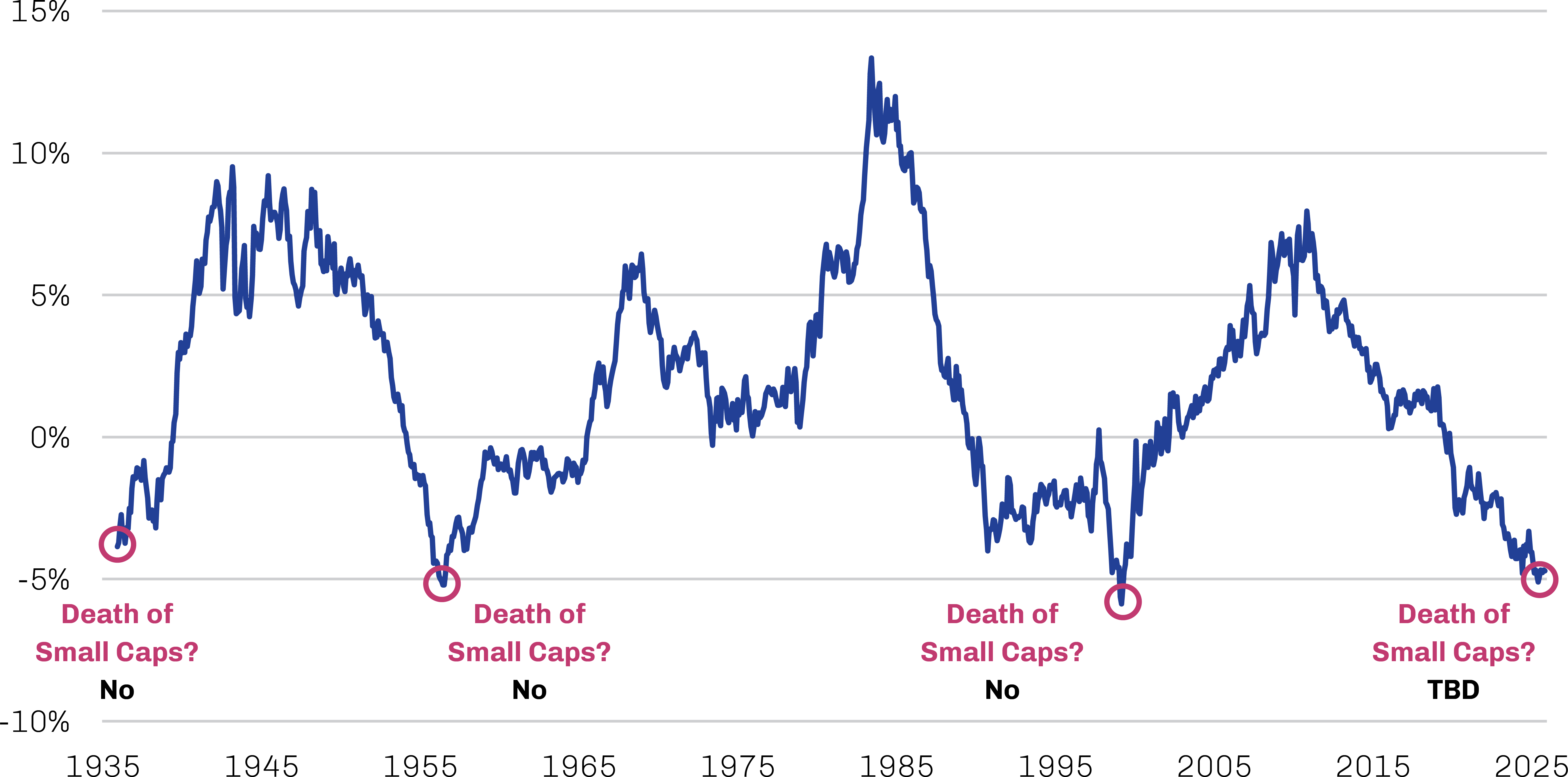
The 39.3% rally in the Russell 2000 Index from its post-Liberation Day swoon through the end of November outpaced the S&P 500 by nearly 300 basis points and reminded us that the small cap beast still has claws.6 Despite this recent show of strength, longer-term performance trends remain skewed toward large names. As shown in Exhibit 2, the relative performance of small caps remains near previous cyclical troughs. Respecting the tendency for reversion to the mean, our confidence in eventual strong sustained returns from small caps—driven by fundamentals— remains firm.


The strong rally following the Liberation Day swoon reminded us that the small cap beast still has claws.

Exhibit 2. Small Cap Returns May Be Near an Inflection Point

Relative Trailing 10 Year Annualized Returns, Russell 2000 Index Less S&P 500 Index
 

Source: Furey Research Partners, FactSet; data as of November 30, 2025.


Recall that small caps historically have been the most rewarding tradable segment of the market over the long term.7 While the volatility inherent to the asset class can sometimes be unnerving in the short term, it often provides opportunity to buy what we perceive as good companies at attractive valuations.


1. Source: US Department of Labor; data as of August 12, 2025.
2. Source: Bloomberg; data as of November 5, 2025.
3. Source: Reuters; data as of October 14, 2025.
4. Source: Bloomberg; data as of November 10, 2025.
5. Source: Politico; data as of October 18, 2025.
6. Source: FactSet; data as of November 30, 2025.
7. Source: Fama and French; data as November 20, 2025.


The opinions expressed are not necessarily those of the firm. These materials are provided for informational purposes only. These opinions are not intended to be a forecast of future events, a guarantee of future results or investment advice. Any statistics contained herein have been obtained from sources believed to be reliable, but the accuracy of this information cannot be guaranteed. The views expressed herein may change at any time subsequent to the date of issue hereof. The information provided is not to be construed as a recommendation or an offer to buy or sell or the solicitation of an offer to buy or sell any fund or security.

 The statements contained herein may include prospects, statements of future expectations and other forward-looking statements that are based on management’s current views and assumptions and involve known and unknown risks and uncertainties. Actual results, performance or events may differ materially from those expressed or implied in such forward-looking statements. Any forward-looking statements herein are made only as of the date of this material, and the company assumes no obligation to update any information or forward-looking statement contained herein, except as required to be disclosed by law.

Past performance is not indicative of future results.

Risk Disclosures 

All investments involve the risk of loss of principal.

A principal risk of investing in value stocks is that the price of the security may not approach its anticipated value or may decline in value. “Value” investments, as a category, or entire industries or sectors associated with such investments, may lose favor with investors as compared to those that are more “growth” oriented.

There are risks associated with investing in securities of foreign countries, such as erratic market conditions, economic and political instability and fluctuations in currency exchange rates.

Investment in gold and gold-related investments present certain risks, including political and economic risks affecting the price of gold and other precious metals like changes in US or foreign tax, currency or mining laws, increased environmental costs, international monetary and political policies, economic conditions within an individual country, trade imbalances and trade or currency restrictions between countries. The price of gold, in turn, is likely to affect the market prices of securities of companies mining or processing gold and, accordingly, the value of investments in such securities may also be affected. Gold-related investments as a group have not performed as well as the stock market in general during periods when the US dollar is strong, inflation is low and general economic conditions are stable. In addition, returns on gold related investments have traditionally been more volatile than investments in broader equity or debt markets. Investment in gold and gold related investments may be speculative and may be subject to greater price volatility than investments in other assets and types of companies.

Municipal bonds are subject to credit risk, interest rate risk, liquidity risk and call risk. However, the obligations of some municipal issuers may not be enforceable through the exercise of traditional creditors’ rights. The reorganization under federal bankruptcy laws of a municipal bond issuer may result in the bonds being cancelled without payment or repaid only in part, or in delays in collecting principal and interest.

The information is not intended to provide and should not be relied on for accounting or tax advice. Any tax information presented is not intended to constitute an analysis of all tax considerations.

The value and liquidity of portfolio holdings may fluctuate in response to events specific to the companies or markets, as well as economic, political or social events in the US or abroad. During periods of market volatility, the value of individual securities and other investments at times may decline significantly and rapidly. The securities of small and micro-size companies can be more volatile in price than those of larger companies and may be more difficult or expensive to trade.

Specific investments described herein do not represent all investment decisions made by First Eagle. The reader should not assume that investment decisions identified and discussed were or will be profitable. Specific investment advice references provided herein are for illustrative purposes only and are not necessarily representative of investments that will be made in the future.

Diversification does not guarantee investment returns and does not eliminate the risk of loss.

Alternative investments can be speculative and are not suitable for all investors. Investing in alternative investments is only intended for experienced and sophisticated investors who are willing and able to bear the high economic risks associated with such an investment. Investors should carefully review and consider potential risks before investing. Certain of these risks include: 

• Loss of all or a substantial portion of the investment; 
• Lack of liquidity in that there may be no secondary market or interest in the strategy and none is expected to develop; 
• Volatility of returns;
• Interest rate risk;
• Restrictions on transferring interests in a private investment strategy; 
• Potential lack of diversification and resulting higher risk due to concentration within one or more sectors, industries, countries or regions; 
• Absence of information regarding valuations and pricing; 
• Complex tax structures and delays in tax reporting; 
• Less regulation and higher fees than mutual funds; 
• Use of leverage, which magnifies the potential for gain or loss on amounts invested and is generally considered a speculative investment technique and increases the risks associated with investing in the strategy; 
• Carried interest, which may cause the strategy to make more speculative, higher risk investments than would be the case in absence of such arrangements; and 
• Below-investment-grade loans, which may default and adversely affect returns. 

10-year Treasury note is a debt obligation of the US government with a maturity of 10 years upon issuance.

AMT bonds are municipal securities whose interest income is subject to federal taxation if the alternative minimum tax applies to the investor.

Asset-backed securities (ABSs) are debt securities whose payments of principal and interest are backed by the cash flow generated by pools of income-producing credit assets.

Asset-based lending (ABL) is corporate borrowing supported by specific assets of the borrower rather than its cash flows.

Beta is a measure of an investment's price volatility relative to that of the overall market.

Business development companies (BDCs) are investment vehicles that provide capital primarily to middle market businesses.

Collateralized loan obligations (CLOs) are financial instruments collateralized by a pool of corporate loans.

Collective investment trusts (CITs) are bank-administered trusts that hold commingled assets.

Convexity measures the sensitivity of a bond’s duration to changes in its yield.

Credit derivatives are financial contracts that transfer credit risk from one party to another in exchange for a fee.

A credit rating is an assessment provided by a nationally recognized statistical rating organization (NRSRO) of credit worthiness of an issuer with respect to debt obligations, including specific securities, money market instruments, or other bonds. Ratings are measured on a scale that generally ranges from AAA (highest) to D (lowest); ratings are subject to change without notice. Not Rated (NR) indicates that the debtor was not rated and should not be interpreted as indicating low quality.

Dry powder refers cash reserves kept on hand by a company or investment fund in anticipation of attractive investment opportunities.

Duration measures the sensitivity of a bond price to changes in its yield.

Exchange-traded funds (ETFs) are listed investment vehicles that seek to provide exposure to a benchmark, index or actively managed strategy.

Federal funds rate is the interest rate at which depository institutions (banks and credit unions) lend reserve balances to other depository institutions overnight on an uncollateralized basis.

General obligation (GO) bonds are municipal securities whose payments are backed by the full faith and credit of the issuer and by extension its ability to tax its residents.

Gross domestic product (GDP) measures the total value of all economic output in goods and services for an economy.

Interval funds are pooled investment vehicle that offer investors periodic liquidity at a designated interval.

Magnificent Seven is widely used in the financial media and elsewhere to refer to seven very large US technology-related stocks—Alphabet, Amazon, Apple, Meta, Microsoft, Nvidia and Tesla.

Moody's Investors Service is a nationally recognized statistical rating organization (NRSRO) that assesses the creditworthiness of an issuer with respect to debt obligations, including specific securities, money market instruments or other bonds. Ratings are measured on a scale that generally ranges from Aaa (highest) to RD (lowest); ratings are subject to change without notice.

Mortgage-backed securities (MBSs) are debt securities whose payments of principal and interest are backed by the cash flow generated by pools of mortgage loans.

Payment-in-kind (PIK) is a financing feature in which the borrower/issuer is allowed to roll accrued interest into the loan/bond principal rather than paying cash.

Private placements are non-public offerings of securities sold directly to investors.

Residential mortgage-backed securities (RMBSs) are debt securities whose payments of principal and interest are backed by the cash flow generated by pools of residential mortgage loans.

Revenue bonds are municipal securities backed by revenues from a specific project or source, such as highway tolls or lease fees.

Separately managed accounts (SMAs) are investment accounts owned by a single investor and managed by a professional investment firm.

Sovereign debt is issued by a country's government as a way to borrow capital.

Structured credit is a financial instrument that pools together groups of similar, income-generating assets.

Tax-exempt bonds are municipal securities whose interest is exempt from federal—and sometime state and local—tax for its investors.

US Treasury securities are debt instruments backed by the full faith and credit of the US government.

A yield curve is a graphical representation of interest rates on debt of equal credit quality across a range of maturities.

Yield to worst is a measure of the lowest possible yield that can be received on a bond that operates within the terms of its contract without defaulting.

Indexes are unmanaged and do not incur management fees or other operating expenses. One cannot invest directly in an index.

Bloomberg US Municipal Bond Index (Gross/Total) measures the performance of the US municipal tax-exempt investment grade bond market. A total-return index tracks price changes and reinvestment of distribution income.

Consumer price index (CPI) (Price) measures inflation as experienced by consumers in their day-to-day living expenses by capturing the average change over time in the prices paid for a representative basket of consumer goods and services. A price-return index only measures price changes.

ICE US Dollar Index is a geometrically averaged calculation of six currencies weighted against the US dollar maintained by ICE Futures US.

iShares 20+ Year Treasury Bond ETF seeks to track the investment results of an index composed of US Treasury bonds with remaining maturities of more than 20 years.

MSCI EAFE Index (Net) measures the performance of large and midcap equities across developed markets countries around the world excluding the US and Canada. A net-return index tracks price changes and reinvestment of distribution income net of withholding taxes.

MSCI World ex USA Index (Net) measures the performance of large and midcap equities across developed markets and emerging markets excluding the US and covers approximately 85% of the free float-adjusted capitalization in each country. A net-return index tracks price changes and reinvestment of distribution income net of withholding taxes.

Russell 2000® Index (Gross/Total) measures the performance of the small cap segment of the US equity universe. It includes approximately 2,000 of the smallest securities based on a combination of their market cap and current index membership. A total-return index tracks price changes and reinvestment of distribution income.

Russell 3000® Index (Gross/Total) measures the performance of the 3000 largest US companies based on market capitalization and is designed to represent approximately 98% of the investable US equity market. A total-return index tracks price changes and reinvestment of distribution income.

S&P 500 Index (Gross/Total) measures the performance of 500 of the top companies in the leading industries of the US economy and is widely recognized as a proxy for the US market as a whole. A total-return index tracks price changes and reinvestment of distribution income.

Non-US Residents: This material and the information contained herein is provided for informational purposes only, do not constitute and is not intended to constitute an offer of securities, and accordingly should not be construed as such. Any funds or other products or services referenced in this material may not be licensed in all jurisdictions and unless otherwise indicated, no regulator or government authority has reviewed this material or the merits of the products and services referenced herein. This material and the information contained herein has been made available in accordance with the restrictions and/or limitations implemented by any applicable laws and regulations. This material is directed at and intended for institutional investors (as such term is defined in any applicable jurisdiction). This material is provided on a confidential basis for informational purposes only and may not be reproduced in any form. This material is for general information only and is not intended as investment advice or any other specific recommendation as to any particular course of action or inaction. The information in this material does not take into account the specific investment objectives, financial situation, tax situation or particular needs of the recipient. Before acting on any information in this material, prospective investors should inform themselves of and observe all applicable laws, rules and regulations of any relevant jurisdictions and obtain independent advice if required. This material is for the use of the named addressee only and should not be given, forwarded or shown to any other person (other than employees, agents or consultants in connection with the addressee’s consideration thereof).

Residents of Australia: This communication is exclusively directed and intended for wholesale clients (as such term is defined in Australian Corporations Act 2001 (Cth) only and, by receiving it, each prospective investor is deemed to represent and warrant that it is a wholesale client. The information contained herein is provided for informational purposes only and should not be considered a solicitation or offering of investment services, nor a solicitation to sell or buy any shares of any securities (nor shall any such securities be offered or sold to any person) in any jurisdiction where such solicitation or offering would be unlawful under the applicable laws of such jurisdiction. Unless otherwise indicated, no regulator or government authority has reviewed this material or the merits of the products and services referenced herein. This material and the information contained herein has been made available in accordance with the restrictions and/ or limitations implemented by any applicable laws and regulations. This material is provided on a confidential basis for informational purposes only and may not be reproduced in any form. Before acting on any information in this material, prospective investors should inform themselves of and observe all applicable laws, rules and regulations of any relevant jurisdictions and obtain independent advice if required. This material should not be relied upon as investment advice and is not a recommendation to adopt any investment strategy. This material is for the use of the named addressee only and should not be given, forwarded or shown to any other person (other than employees, agents or consultants in connection with the addressee’s consideration thereof). First Eagle Investment Management, LLC is exempt from the requirement to hold an Australian financial services licence under the Corporations Act 2001 (Cth) in respect of the financial services it provides to wholesale clients in Australia and is regulated by the US Securities and Exchange Commission under US laws, which differ from Australian laws.

Residents of Brazil: First Eagle Investment Management, LLC is not accredited with the Brazilian Securities Commission - CVM to perform investment management services. The investment management services may not be publicly offered or sold to the public in Brazil. Documents relating to the investment management services as well as the information contained therein may not be supplied to the public in Brazil.

Residents of Canada: This material does not constitute investment advice or an offer or solicitation to sell or a solicitation of an offer to buy any product or service or any securities (nor shall any product or service or any securities be offered or sold to any person until such time as such offer and sale is permitted under applicable securities laws.) Any products or services or any securities referenced in this material may not be licensed in all jurisdictions, and unless otherwise indicated, no securities commission or similar authority in Canada has reviewed this material or the merits of the products and services referenced herein. If you receive a copy of this material, you should note that there may be restrictions or limitations to whom these materials may be made available. This material is private and confidential and is directed at and intended for institutional investors and is only being provided to “permitted clients” as defined under the Canadian Securities Administrators’ National Instrument 31-103 – Registration Requirements, Exemptions and Ongoing Registrant Obligations. This material is for informational purposes only. This material does not constitute investment advice and should not be relied upon as such. Before acting on any information in this material, prospective clients should inform themselves of and observe all applicable laws and regulations of Canada. Prospective clients should inform themselves as to the legal requirements and tax consequences within the countries of their citizenship, residence, domicile and place of business with respect to the acquisition, holding or disposal of shares or the ongoing provision of services, and any foreign exchange restrictions that may be relevant thereto. First Eagle Investment Management, LLC is not authorized to provide investment advice and/or management money in Canada.

Residents of Dubai: This material is intended for distribution only to Professional Clients. It must not be delivered to, or relied on by, any other person. The Dubai Financial Services Authority has no responsibility for reviewing or verifying any documents in connection with any funds, products or services that may be mentioned herein. The Dubai Financial Services Authority has not approved this material nor taken steps to verify the information set out in it and has no responsibility for it. If you do not understand the contents of this material, you should consult an authorized financial adviser.

Residents of the State of Qatar: Any funds, products or services referenced in this material may not be licensed in all jurisdictions, including the State of Qatar (“Qatar”), and unless otherwise indicated, no regulator or government authority, including the Qatar Financial Markets Authority (QFMA), has reviewed this material or the merits of the products and services referenced herein. If you receive a copy of this material, you may not treat this as constituting an offer, and you should note that there may be restrictions or limitations as to whom these materials may be made available. This material is directed at and intended for a limited number of “qualified” investors (as such term is defined under the laws of Qatar). This material is provided on a confidential basis for informational purposes only and may not be reproduced in any form. Before acting on any information in this material, prospective clients should inform themselves of and observe all applicable laws and regulations of any relevant jurisdictions, including any laws of Qatar. This material is for the use of the named addressee only and should not be given, forwarded or shown to any other person (other than employees, agents or consultants in connection with the addressee’s consideration thereof). Any entity responsible for forwarding this material to other parties takes responsibility for ensuring compliance with applicable securities laws.

Residents of Taiwan: First Eagle Investment Management, LLC is not licensed to engage in an investment management or investment advisory business in Taiwan and the services described herein are not permitted to be provided in Taiwan. However, such services may be provided outside Taiwan to Taiwan resident clients.

Residents of United Arab Emirates (Abu Dhabi): The offering of the products and/or services described herein have not been approved or licensed by the UAE Central Bank, the UAE Securities and Commodities Authority (SCA), the Dubai Financial Services Authority (DFSA) or any other relevant licensing authorities in the UAE, and accordingly does not constitute a public offer in the UAE in accordance with the commercial companies law, Federal Law No. 2 of 2015 (as amended), SCA Board of Directors’ Decision No. (13/Chairman) of 2021 on the Regulations Manual of the Financial Activities and Status Regularization Mechanisms or otherwise. Accordingly, this material is not offered to the public in the UAE (including the Dubai International Financial Centre (DIFC)). This material is strictly private and confidential and is being issued to a limited number of institutional and individual clients: a) who meet the criteria of a Professional Investor as defined in SCA Board of Directors’ Decision No. (13/Chairman) of 2021 on the Regulations Manual of the Financial Activities and Status Regularization Mechanisms or who otherwise qualify as sophisticated clients; b) upon their request and confirmation that they understand that the products and/or services described in this material have not been approved or licensed by or registered with the UAE Central Bank, the SCA, DFSA or any other relevant licensing authorities or governmental agencies in the UAE; and c) must not be provided to any person other than the original recipient and may not be reproduced or used for any other purpose.

Residents of United Kingdom: This material is issued by First Eagle Investment Management, LLC and is lawfully distributed in the United Kingdom by First Eagle Investment Management, Ltd. First Eagle Investment Management, Ltd is authorised and regulated by the Financial Conduct Authority (FRN: 798029) in the United Kingdom. This material is directed only at persons in the United Kingdom who qualify as “professional investors.” This material is not directed at any persons in the United Kingdom who would qualify as “retail investors” within the meaning of the UK Alternative Investment Fund Managers Regulations 2013 (S.I. 2013/1773) or the EU Packaged Retail and Insurance-based Investment Products Regulation (No 1286/2014), the UK PRIIPs Regulation, and such persons may not act or rely on the information in this material.

FEF Distributors, LLC (“FEFD”) (SIPC), a limited purpose broker-dealer, distributes certain First Eagle products. FEFD does not provide services to any investor but rather provides services to its First Eagle affiliates. As such, when FEFD presents a fund, strategy or other product to a prospective investor, FEFD and its representatives do not determine whether an investment in the fund, strategy or other product is in the best interests of, or is otherwise beneficial or suitable for, the investor. No statement by FEFD should be construed as a recommendation. Investors should exercise their own judgment and/or consult with a financial professional to determine whether it is advisable for the investor to invest in any First Eagle fund, strategy or product.

First Eagle Investments is the brand name for First Eagle Investment Management, LLC and its subsidiary investment advisers. Napier Park is the brand name of a subsidiary investment adviser engaged in the alternative credit business.

Private equity funds indirectly controlled by Genstar Capital, as well as certain co-investors, indirectly own a majority stake in First Eagle Investment Management, LLC

©2026 First Eagle Investment Management, LLC. All rights reserved.