Macro & Market Views
Global Value Team Annual Letter
As in 2023, diversification failed to matter in 2024.
For two years now, those seeking outsized equity gains likely would have been best served by focusing their investment on the most concentrated, highest-growth segment of the world’s largest stock market; that is, tech-oriented US stocks. As proxied by the “Magnificent Seven,” this cohort advanced 67% in 2024 to help fuel a 25% gain in the S&P 500 Index. The S&P 500’s gain excluding these seven stocks, which accounted for more than one-third of the index’s total market capitalization at year-end, amounted to a far more pedestrian 16%. The MSCI World Index’s 19% return was similarly bolstered by the outperformance of these megacap names.1,2
But when we decompose the factors driving the one-dimensional equity market performance of recent years, it’s not difficult to arrive at a mindset in which diversification regains its reputation as a potential driver of attractive long-term risk-adjusted returns and an essential element of a well-balanced investment portfolio.
Most notable to us has been the pronounced post-pandemic decoupling of the US and China, whose symbiotic relationship represented a primary driver of global macroeconomic activity and financial markets performance for much of the past several decades. In fact, economic historians Niall Ferguson and Moritz Schularick in 2007 coined the term “Chimerica” to describe the interconnectivity of the world’s most rapidly growing emerging market (at the time) and its dominant economic power (still).
The US was happy to buy the competitively priced products mass produced in China, China was happy to lend the resulting trade surplus back to the US through the purchase of Treasuries, and the world’s benchmark interest rate was kept in check.3 But like so many celebrity portmanteaus, Chimerica may not have been built to last.
In contrast, risk perception in China has been high, and for good reason. While China managed to avoid the early-2020s inflation spike that bedeviled the majority of the world, its economy has faced its own set of complications, some self-inflicted. China’s aggressive zero-Covid policy—begun in early 2020 and maintained until the end of 2022, long after most nations had significantly reduced or eliminated pandemic-related restrictions—resulted in an uneven recovery that stymied private investment and household spending. An ideologically driven crackdown on the rapidly expanding domestic tech industry, launched in late 2020, hamstrung what had been among the most dynamic sectors of China’s economy and in the process wiped out trillions of dollars in market capitalization and cost countless jobs.4 The debt-fueled bubble in China’s property market—which once accounted for about 25% of the country’s gross domestic product (GDP)—burst with the default of developer Evergrande in 2021, and it continues its structural and cyclical reset to a lower base.5
As a result of these and other factors, China’s animal spirits have all but been put out to pasture; the MSCI China Index finished 2024 down more than 50% from its early-2021 peak, while yields on 10-year government bonds fell to all-time lows.6 Certain other countries in China’s orbit have been similarly afflicted.
Good News for People Who Love Bad News
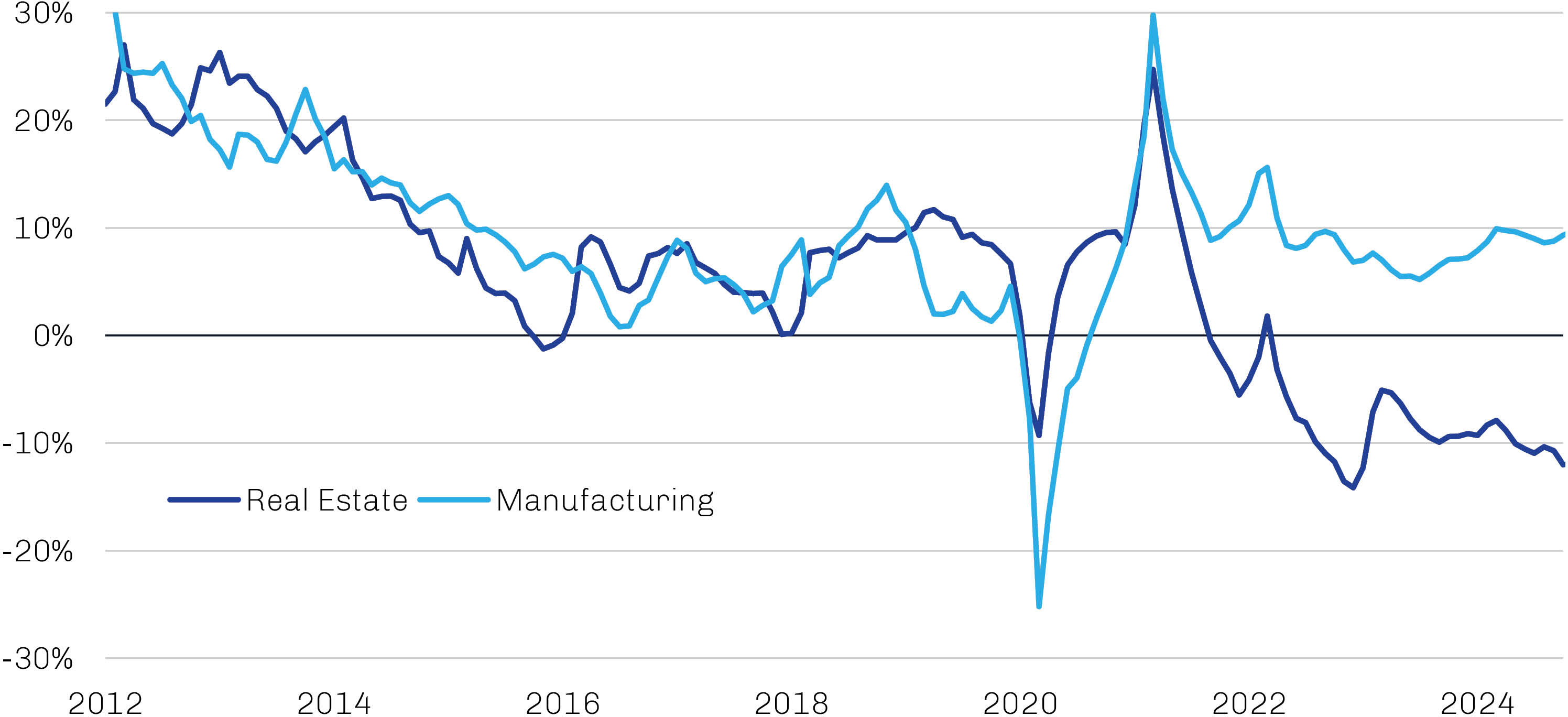
In the past, signs of strain in the Chinese economy were typically viewed as bad news for global activity broadly, and risk assets responded accordingly. This time around, however, the effects of China’s malaise have been more nuanced. China’s property market collapse, for example, is at least partly responsible for the cyclically moderating inflation pressures in the US and many other countries. As shown in Exhibit 1, fixed-asset investment in China has shifted away from real estate and toward manufacturing, and the resulting excess capacity has weighed on export prices and provided China’s trading partners with a strong disinflationary impulse. Meanwhile, waning confidence among Chinese businesses and households has depressed imports and caused a range of economically sensitive commodities—everything from oil to copper to wheat—to derate versus gold, which has been another exogenous source of downward pressure on global inflation.
Exhibit 1. China’s Re-Emphasis on Manufacturing Has Served as a Disinflationary Impulse Globally
Year-over-Year Percent Change in China Fixed-Asset Investment, Three-Month Moving Average; January 2012 through September 2024
Source: UBS, First Eagle Investments; data as of September 30, 2024.
More recently, however, there are signs that the tides may be changing. With unrelentingly downbeat economic data appearing to disabuse them of any notion that their growth targets remained obtainable without intervention, China’s policymakers late in the year announced a series of stimulus measures to combat deflationary pressures, stabilize housing and rebuild market optimism. In September, the People’s Bank of China (PBOC) cut the reserve requirement ratio for banks and its benchmark short-term reverse repo rate, while instructing commercial banks to trim rates on outstanding mortgages and introducing new liquidity mechanisms to support equity markets.7 Though authorities hinted that significant fiscal support was also on tap, the initial package announced soon after the November US elections was underwhelming in size and scope—$1.4 trillion in local government bond issuance to refinance maturing and higher-yielding local government debt rather than injected directly into the economy. However, it stands to reason that Beijing may look to keep some of its powder dry until it has better visibility on potential tariffs from the incoming Trump administration.8
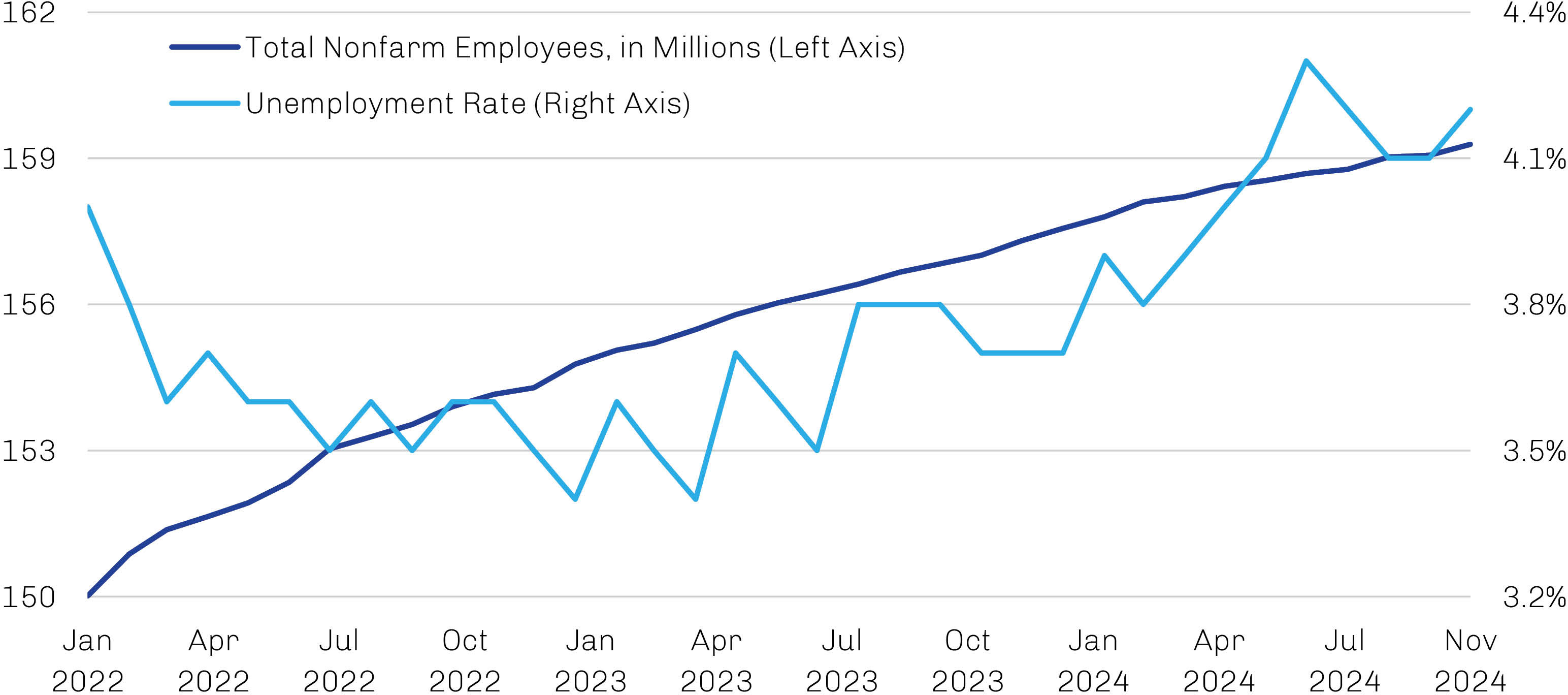
The US may find itself vulnerable to a reversal of China’s fortunes, in our view, as its battle against inflation to date has reached only a fragile peace. Our concerns are underpinned by the behavior of the US labor market throughout the Federal Reserve’s tightening cycle. As shown in Exhibit 2, the labor market—unusually—softened during this period even as payrolls continued to grow, suggesting that the increase in the unemployment rate from its cyclical low of 3.4% to 4.1% by year-end 2024 was driven by increased participation rates. One theory for this phenomenon is that the massive increase in public debt outstanding post-Covid led to a nominal rebasing of the US economy that bolstered corporate profits in the face of contracting margins and supported a moderation in payroll growth rather than an outright decline. With financial conditions having since loosened, both corporate profits and profit margins have inflected higher in nominal terms, and it’s reasonable to think that payrolls and wage growth may follow suit should this trend continue. Though down from its peak of 6.7%, wage inflation of 4.3% remains inconsistent with the Fed’s 2% inflation goal, and this stickiness is likely among the reasons why consumer price index prints have stubbornly persisted above target even as other components have retreated.9
Exhibit 2. US Payrolls Continued to Expand Even as the Unemployment Rate Increased
January 2022 through November 2024
Source: US Bureau of Labor Statistics, Federal Reserve Board of St. Louis; data as of December 9, 2024.
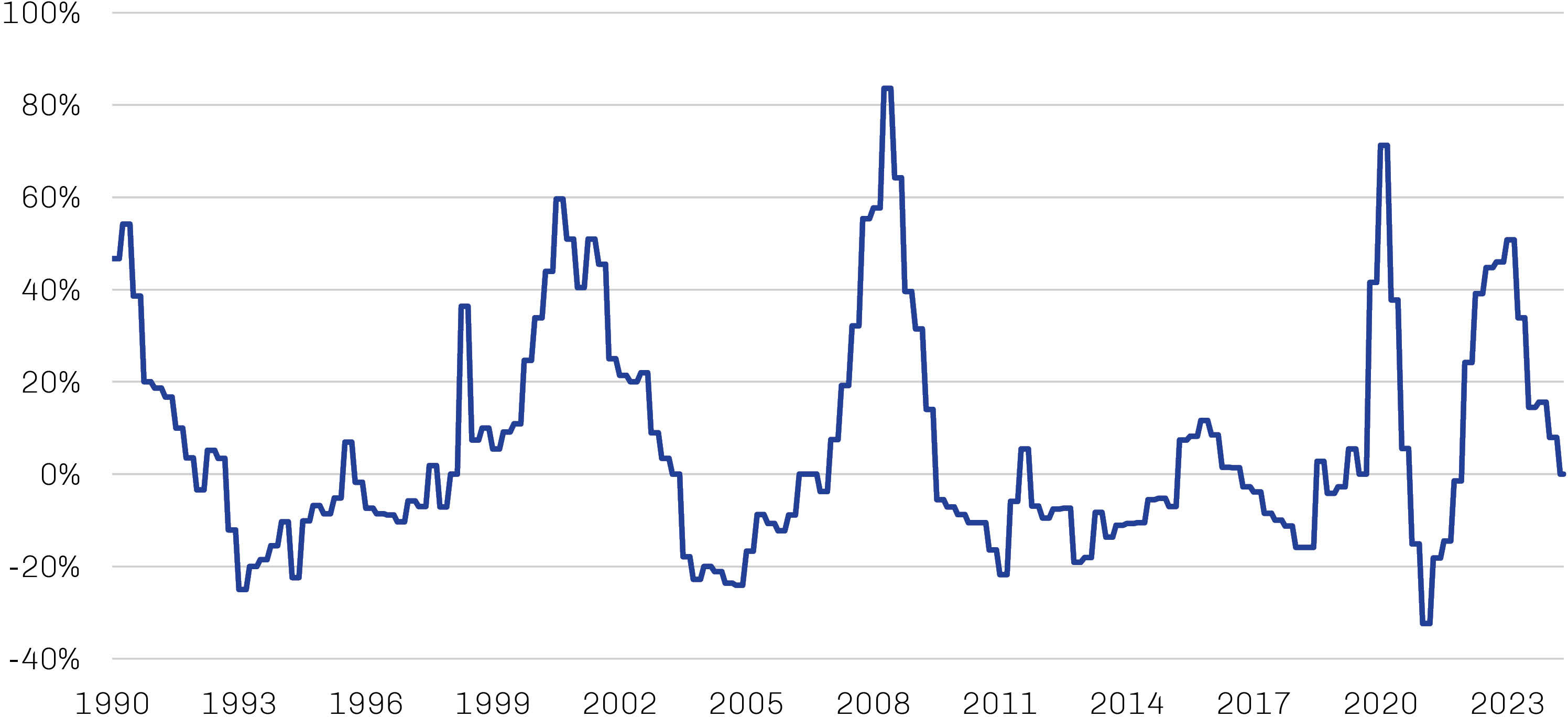
Easing monetary policy presents another potential source of inflationary pressure. With the inflation rate well off its cyclical peak, the Fed in September began to recalibrate its settings, kicking off a much-anticipated rate-cut cycle with a 50 basis point reduction. The Fed followed up that move with two additional 25 basis point cuts in November and December to bring its key policy rate to 4.25–4.50% by year-end, and the latest summary of economic projections suggest an additional 50 basis points of cuts are coming in 2025.10 In response to easier policy, bank lending standards have gone from tight to neutral (as shown in Exhibit 3) and credit spreads have retreated. With market valuations high and earnings expectations buoyant, a Fed shift back to a hawkish policy bias sooner than expected could prompt investors to recalibrate their risk appetites and herald an untimely end to the US Goldilocks tale.
Exhibit 3. More Accommodative US Banks Highlight Easing Financial Conditions
Net Percentage of Domestic Banks Tightening Standards for Commercial and Industrial Loans to Large and Middle Market Firms, January 1990 through November 2024 
Source: Bloomberg; data as of November 30, 2024.
From Politicking to Policymaking
Though the US and China may be decoupling economically, their mutual affection for public debt persists, and their large and growing debt loads—not unique to them by any means—reflect long-term risks to stability even as they support near-term growth. Unrestrained government debt globally has raised the specter of currency debasement and other adverse financial outcomes, and the longer fiscal imbalances go unaddressed, in our view, the more difficult they will be to unwind.
In the US, the federal fiscal deficit expanded again in fiscal 2024 (ended September) to 6.4% of GDP and has only worsened since, coming in at 7.1% for the last 12 months through November; the 50-year average is 3.8%.¹¹ While the policy specifics moving forward are uncertain given January’s leadership changes, higher deficits and debt levels seem likely under the incoming Trump administration (as they would have with a Harris victory).¹²
The Tax Cuts and Jobs Act of 2017, which will see many of its provisions for individual taxpayers expire at year-end 2025 absent Congressional action, is likely to take fiscal center stage next year. A unified Republican government suggests a high possibility that the Trump administration’s key tax priorities will be extended, but the means by which that lost revenue will be offset remain uncertain. A reduction of regulatory hurdles impairing business activity seems likely to promote investment and economic growth. Some in the administration—including Scott Bessent, Trump’s pick to run Treasury—have argued that tariffs “can increase revenue to the Treasury” if used strategically.¹³ But the Congressional Budget Office’s review of tariff increases in 2018–19 found that the initial boost in customs revenues soon declined as imports slowed and were sourced from countries subject to lower duties.14
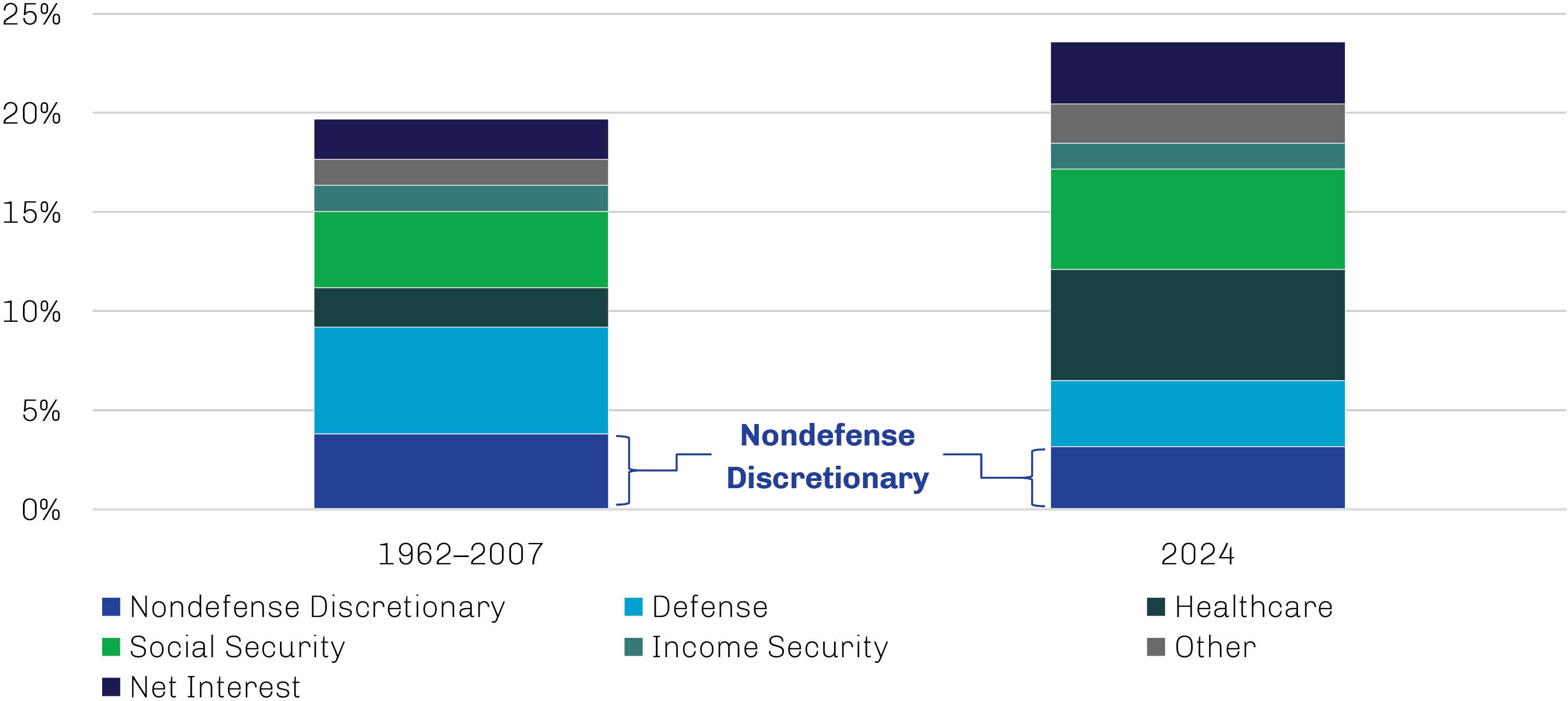
Spending cuts are another avenue to reducing the deficit, and Trump tapped Elon Musk and Vivek Ramaswamy to take on the challenge as co-heads of the Department of Government Efficiency (DOGE). While there is certainly room to cut federal spending and eliminate wastefulness, public discussion has been focused mostly on nondefense discretionary spending, which accounts for only about 15% of total federal outlays and has actually decreased slightly as a percentage of GDP in recent years, as shown in Exhibit 4. Any attempt to meaningfully move the needle on the country’s debt burden likely would require reforms to popular—and seemingly sacrosanct—entitlements like Social Security, Medicare and Medicaid. Mustering the necessary political will for changes to programs so broadly popular with voters seems like an insurmountable challenge. While there is also talk of slashing the government’s workforce of 2.3 million civilians located across all 50 states, their aggregate salary amounts to less than 1.5% of GDP.15
Exhibit 4. Nondefense Discretionary Spending Offers US Legislators Limited Savings Opportunities
Federal Spending by Category as a Percentage of GDP
Source: US Department of the Treasury, US Bureau of Economic Analysis; data as of November 30, 2024.
Gold: All That Glitters
Our belief that the future is inherently uncertain drives our commitment to a strategic exposure to gold as a potential hedge against adverse market outcomes. Such an approach has been particularly beneficial over the past several years, as gold demonstrated remarkable resilience in the face of conditions not typically associated with price appreciation, establishing a series of new nominal highs in the process.
We’ve noted previously that gold’s inverse relationship with real interest rates—i.e., the difference between the nominal interest rate and the expected rate of inflation—historically has been the most important driver of its price movements over time. While we continue to believe this to be true in the long run, the metal’s rally over the past few years is a compelling reminder that numerous factors can affect price movements in shorter time frames.
Gold’s reputation as a perceived “safe haven,” for example, often attracts buyers of all stripes during periods when threat recognition is high, and the past few years have certainly been one of those periods given the deteriorating geopolitical backdrop and large-scale armed conflicts in Russia/Ukraine and the Middle East. Meanwhile, the massive accumulation of debt by governments worldwide has increased concerns about the potential for currency debasement.
Global central banks are among the potential gold buyers sensitive to these issues, and in recent years they have very actively accumulated the metal in an effort to diversify their reserves, providing a key source of support for the metal’s price in the face of traditional headwinds. Net purchases of gold by central banks in 2022 and 2023 were the highest on record by far, and the first three quarters of 2024 were strong, if not quite at the pace of the previous two years. Financial buyers were slower to catch the gold bug, but a midyear 2024 pickup of inflows into phys-ically backed gold ETFs—which capture investment demand from both institutional and individual investors globally—has investor demand on trend for its first positive year since 2020.¹
Notably, gold declined in the initial aftermath of the US presidential election while risk assets rallied sharply. Cryptocurrencies—and bitcoin, in particular—were among the biggest post-election gainers, pulled along by the slipstream of what is understood to be a crypto-friendly Trump administration. While it’s hard to draw conclusions from such a short period of performance, either positive or negative, we continue to view gold as the best potential hedge against the risks facing invest-ment portfolios. Despite the latest round of “risk-on” enthusiasm for crypto and the potential for its regulatory legitimacy, in our view it remains an option on becoming digital gold—and thus an option on becoming a potential hedge asset—rather than a replacement for the time-tested store of value.
Source: World Gold Council; data as of November 12, 2024.
Writing Our Own Narrative
Given equity market performance trends over the past two years, it can be tempting to ride the wave of “narrative economics” that has driven index-level performance. Economist Robert Shiller coined this term to describe the emerging stories that capture public attention and ultimately affect individual and collective behaviors—such as the investor enthusiasm around developments like artificial intelligence and GLP-1 agonists that has fueled a surge in narrow segments of the stock market over the past two years.16 While certain of these narratives are compelling, the valuations of those names overtly benefiting from them are generally less so.
As investors whose definition of risk is centered on avoiding the permanent impairment of capital rather than tracking error against a benchmark, the Global Value team remains focused on building portfolios that offer truly differentiated sources of risk and return and demonstrate perennial relevance. Selectivity is at the heart of our value-oriented investment process, and the flexibility of our mandate allows us to apply this selectivity to the global opportunity set from the bottom up. We look for assets we believe demonstrate scarce quality and value and invest in them only when we can do so at a “margin of safety.”17 Our stock selection often is complemented by a structural allocation to gold—a store of value for millennia—as a potential hedge against extreme market outcomes.
While we remain concerned about the many risks facing investors in the current environment, we also see opportunity. But rather than making concentrated bets on the direction of markets, we have continued to focus on investing in a diversified basket of individual assets we believe have the potential to demonstrate resilience across multiple states of the world.
1. The term “Magnificent Seven” is widely used in the financial media and elsewhere to refer to these seven US technology-related stocks
that drove an outsized share of equity market gains in 2023 and 2024.
2. Source: Bloomberg; data as of December 31, 2024.
3. Niall Ferguson and Moritz Schularick, “’Chimerica’ and the Global Asset Market Boom,” International Finance (10:3, 2007).
4. Source: Bloomberg; data as of September 12, 2024.
5. Source: The Wall Street Journal; data as of October 26, 2023.
6. Source: MSCI, Bloomberg; data as of September 30, 2024.
7. Source: Reuters; data as of September 24, 2024.
8. Source: Reuters; data as of November 8, 2024.
9. Source: Federal Reserve Bank of Atlanta; data as of December 11, 2024.
10. Source: Federal Reserve; data as of September 18, 2024.
11. Source: Congressional Budget Office, Bloomberg ; data as of November 30, 2024.
12. Source: Committee for a Responsible Federal Budget; data as of October 25, 2024.
13. Source: Fox News; data as of November 15, 2024.
14. “How CBO Projects Tariff Revenues,” Congressional Budget Office (October 2024).
15. Source: The Wall Street Journal; data as of November 17, 2024.
The opinions expressed are not necessarily those of the firm. These materials are provided for informational purposes only. These opinions are not intended to be a forecast of future events, a guarantee of future results, or investment advice. Any statistics contained herein have been obtained from sources believed to be reliable, but the accuracy of this information cannot be guaranteed. The views expressed herein may change at any time subsequent to the date of issue hereof. The information provided is not to be construed as a recommendation or an offer to buy or sell or the solicitation of an offer to buy or sell any fund or security.
Past performance is not indicative of future results.
Risk Disclosures
All investments involve the risk of loss of principal.
A principal risk of investing in value stocks is that the price of the security may not approach its anticipated value or may decline in value. “Value” investments, as a category, or entire industries or sectors associated with such investments, may lose favor with investors as compared to those that are more “growth” oriented.
There are risks associated with investing in securities of foreign countries, such as erratic market conditions, economic and political instability and fluctuations in currency exchange rates.
Investment in gold and gold-related investments present certain risks, and returns on gold related investments have traditionally been more volatile than investments in broader equity or debt markets.
Diversification does not guarantee investment returns and does not eliminate the risk of loss.
Currency debasement refers to the reduction of a currency’s purchasing power.
Federal funds rate is the interest rate at which depository institutions (banks and credit unions) lend reserve balances to other depository institutions overnight on an uncollateralized basis.
A Goldilocks economic scenario refers to an economy in which the level of growth is neither strong enough to promote inflation pressures nor weak enough to suggest recession may be near.
A soft landing refers to a gradual economic slowdown that comes to an end without triggering a recession.
Volatility represents the degree to which an investment’s price has deviated from its average over time.
Consumer price index (CPI) (Price) measures inflation as experienced by consumers in their day-to-day living expenses by capturing the average change over time in the prices paid for a representative basket of consumer goods and services. A price-return index only measures price changes.
MSCI China Index (Net) measures the performance of large and midcap representation across China A shares, H shares, B shares, Red chips, P chips and foreign listings. A net-return index tracks price changes and reinvestment of distribution income net of withholding taxes.
MSCI World Index (Net) measures the performance of large and midcap equities across developed markets. A net-return index tracks price changes and reinvestment of distribution income net of withholding taxes.
S&P 500 Index (Gross/Total) measures the performance of 500 of the top companies in leading industries of the US economy and is widely recognized as a proxy for the US market as a whole. A total-return index tracks price changes and reinvestment of distribution income.
Indexes are unmanaged and one cannot invest directly in an index.
FEF Distributors, LLC (“FEFD”) (SIPC), a limited purpose broker-dealer, distributes certain First Eagle products. FEFD does not provide services to any investor but rather provides services to its First Eagle affiliates. As such, when FEFD presents a fund, strategy or other product to a prospective investor, FEFD and its representatives do not determine whether an investment in the fund, strategy or other product is in the best interests of, or is otherwise beneficial or suitable for, the investor. No statement by FEFD should be construed as a recommendation. Investors should exercise their own judgment and/or consult with a financial professional to determine whether it is advisable for the investor to invest in any First Eagle fund, strategy or product.
First Eagle Investments is the brand name for First Eagle Investment Management, LLC and its subsidiary investment advisers.
©2025 First Eagle Investment Management, LLC. All rights reserved.
1. The term “Magnificent Seven” is widely used in the financial media and elsewhere to refer to these seven US technology-related stocks
that drove an outsized share of equity market gains in 2023 and 2024.
2. Source: Bloomberg; data as of December 31, 2024.
3. Niall Ferguson and Moritz Schularick, “’Chimerica’ and the Global Asset Market Boom,” International Finance (10:3, 2007).
4. Source: Bloomberg; data as of September 12, 2024.
5. Source: The Wall Street Journal; data as of October 26, 2023.
6. Source: MSCI, Bloomberg; data as of September 30, 2024.
7. Source: Reuters; data as of September 24, 2024.
8. Source: Reuters; data as of November 8, 2024.
9. Source: Federal Reserve Bank of Atlanta; data as of December 11, 2024.
10. Source: Federal Reserve; data as of September 18, 2024.
11. Source: Congressional Budget Office, Bloomberg ; data as of November 30, 2024.
12. Source: Committee for a Responsible Federal Budget; data as of October 25, 2024.
13. Source: Fox News; data as of November 15, 2024.
14. “How CBO Projects Tariff Revenues,” Congressional Budget Office (October 2024).
15. Source: The Wall Street Journal; data as of November 17, 2024.
The opinions expressed are not necessarily those of the firm. These materials are provided for informational purposes only. These opinions are not intended to be a forecast of future events, a guarantee of future results, or investment advice. Any statistics contained herein have been obtained from sources believed to be reliable, but the accuracy of this information cannot be guaranteed. The views expressed herein may change at any time subsequent to the date of issue hereof. The information provided is not to be construed as a recommendation or an offer to buy or sell or the solicitation of an offer to buy or sell any fund or security.
Past performance is not indicative of future results.
Risk Disclosures
All investments involve the risk of loss of principal.
A principal risk of investing in value stocks is that the price of the security may not approach its anticipated value or may decline in value. “Value” investments, as a category, or entire industries or sectors associated with such investments, may lose favor with investors as compared to those that are more “growth” oriented.
There are risks associated with investing in securities of foreign countries, such as erratic market conditions, economic and political instability and fluctuations in currency exchange rates.
Investment in gold and gold-related investments present certain risks, and returns on gold related investments have traditionally been more volatile than investments in broader equity or debt markets.
Diversification does not guarantee investment returns and does not eliminate the risk of loss.
Currency debasement refers to the reduction of a currency’s purchasing power.
Federal funds rate is the interest rate at which depository institutions (banks and credit unions) lend reserve balances to other depository institutions overnight on an uncollateralized basis.
A Goldilocks economic scenario refers to an economy in which the level of growth is neither strong enough to promote inflation pressures nor weak enough to suggest recession may be near.
A soft landing refers to a gradual economic slowdown that comes to an end without triggering a recession.
Volatility represents the degree to which an investment’s price has deviated from its average over time.
Consumer price index (CPI) (Price) measures inflation as experienced by consumers in their day-to-day living expenses by capturing the average change over time in the prices paid for a representative basket of consumer goods and services. A price-return index only measures price changes.
MSCI China Index (Net) measures the performance of large and midcap representation across China A shares, H shares, B shares, Red chips, P chips and foreign listings. A net-return index tracks price changes and reinvestment of distribution income net of withholding taxes.
MSCI World Index (Net) measures the performance of large and midcap equities across developed markets. A net-return index tracks price changes and reinvestment of distribution income net of withholding taxes.
S&P 500 Index (Gross/Total) measures the performance of 500 of the top companies in leading industries of the US economy and is widely recognized as a proxy for the US market as a whole. A total-return index tracks price changes and reinvestment of distribution income.
Indexes are unmanaged and one cannot invest directly in an index.
Important Information for Non-US Residents
This material and the information contained herein is provided for informational purposes only, does not constitute and is not intended to constitute an offer of securities,
and accordingly should not be construed as such. Any funds or other products or services referenced in this material may not be licensed in all jurisdictions and unless
otherwise indicated, no regulator or government authority has reviewed this document or the merits of the products and services referenced herein. This material and
the information contained herein has been made available in accordance with the restrictions and/or limitations implemented by any applicable laws and regulations. This
material is directed at and intended for institutional investors (as such term is defined in any applicable jurisdiction). This material is provided on a confidential basis for
informational purposes only and may not be reproduced in any form. This material is for general information only and is not intended as investment advice or any other
specific recommendation as to any particular course of action or inaction. The information in this material does not take into account the specific investment objectives,
financial situation, tax situation or particular needs of the recipient. Before acting on any information in this material, prospective investors should inform themselves of
and observe all applicable laws, rules and regulations of any relevant jurisdictions and obtain independent advice if required. This material is for the use of the named
addressee only and should not be given, forwarded or shown to any other person (other than employees, agents or consultants in connection with the addressee’s consideration
thereof).
Notice to Investors in the Abu Dhabi Global Market (ADGM)
This material constitutes an Exempt Communication or is not otherwise subject to the financial promotion restriction in accordance with the Financial Services and
Markets Regulation of the ADGM. It must not be delivered to, or relied on by, any other person. The ADGM does not accept any responsibility for the content of the information
included in this material, including the accuracy or completeness of such information. The ADGM has also not assessed the suitability of the products or services
to which this material relates to any particular investor or type of investor. If you do not understand the contents of this material or are unsure whether the products or
services to which this material relates are suitable for your individual investment objectives and circumstances, you should consult an authorised financial adviser.
Important Information for Residents of Australia
This communication is exclusively directed and intended for wholesale clients only. The information contained herein is provided for informational purposes only and
should not be considered a solicitation or offering of investment services, nor a solicitation to sell or buy any shares of any securities (nor shall any such securities be
offered or sold to any person) in any jurisdiction where such solicitation or offering would be unlawful under the applicable laws of such jurisdiction. Unless otherwise
indicated, no regulator or government authority has reviewed this e-mail or the merits of the products and services referenced herein. This document and the information
contained herein has been made available in accordance with the restrictions and/or limitations implemented by any applicable laws and regulations. This document is
provided on a confidential basis for informational purposes only and may not be reproduced in any form. Before acting on any information in this document, prospective
investors should inform themselves of and observe all applicable laws, rules and regulations of any relevant jurisdictions and obtain independent advice if required.
This document should not be relied upon as investment advice and is not a recommendation to adopt any investment strategy. This document is for the use of the named
addressee only and should not be given, forwarded or shown to any other person (other than employees, agents or consultants in connection with the addressee’s consideration
thereof). First Eagle Investment Management, LLC is exempt from the requirement to hold an Australian financial services licence under the Corporations Act
2001 (Cth) in respect of the financial services it provides to wholesale clients in Australia and is regulated by the US Securities and Exchange Commission under US laws,
which differ from Australian laws.
Important Information for Residents of the Kingdom of Bahrain
This document does not constitute an invitation to the public in the Kingdom of Bahrain to retain First Eagle Investment Management, LLC and its subsidiaries to provide
any products or services and this document will not be and may not be issued, passed to, or made available to the public in the Kingdom of Bahrain. All services described
in this document are to be performed outside of Bahrain. The Central Bank of Bahrain, the Bahrain Bourse and the Ministry of Industry and Commerce of the Kingdom of
Bahrain take no responsibility for the accuracy of the statements and information contained in this document, nor shall they have any liability to any person for any loss or
damage resulting from reliance on any statements or information contained herein.
Notice to Residents of Brazil
First Eagle Investment Management, LLC and its subsidiary investment advisers are not accredited with the Brazilian Securities Commission - CVM to perform investment
management services. The investment management services may not be publicly offered or sold to the public in Brazil. Documents relating to the investment management
services as well as the information contained therein may not be supplied to the public in Brazil.
Notice to Residents of Canada
This document does not constitute investment advice or an offer or solicitation to sell or a solicitation of an offer to buy any product or service or any securities (nor
shall any product or service or any securities be offered or sold to any person until such time as such offer and sale is permitted under applicable securities laws.) Any
products or services or any securities referenced in this document may not be licensed in all jurisdictions, and unless otherwise indicated, no securities commission or
similar authority in Canada has reviewed this document or the merits of the products and services referenced herein. If you receive a copy of this document, you should
note that there may be restrictions or limitations to whom these materials may be made available. This document is directed at and intended for institutional investors
and is only being provided to “permitted clients” as defined under the Canadian Securities Administrators’ National Instrument 31-103 – Registration Requirements,
Exemptions and Ongoing Registrant Obligations. This document is provided on a confidential basis for informational purposes only. Before acting on any information in this
document, prospective clients should inform themselves of and observe all applicable laws and regulations of Canada. Prospective clients should inform themselves as to
the legal requirements and tax consequences within the countries of their citizenship, residence, domicile and place of business with respect to the acquisition, holding or
disposal of shares or the ongoing provision of services, and any foreign exchange restrictions that may be relevant thereto.
Important Information for Residents of Dubai International Financial Centre
This presentation is intended for distribution only to Professional Clients. It must not be delivered to, or relied on by, any other person. The Dubai Financial Services
Authority has no responsibility for reviewing or verifying any documents in connection with the advisory services. The Dubai Financial Services Authority has not
approved this document nor taken steps to verify the information set out in it, and has no responsibility for it. If you do not understand the contents of this document you
should consult an authorized financial adviser.
Important Information for Residents of the Sultanate of Oman
This material and the information contained herein do not constitute and is not intended to constitute an offer to sell or the solicitation of any offer to buy securities and
accordingly should not be construed as such. Any investment vehicles and any other products or services referenced in this material may not be licensed in all jurisdictions,
including the Sultanate of Oman (“Oman”), and unless otherwise indicated, no regulator or government authority has reviewed this material or the merits of the
products and services referenced herein. No regulator or government authority takes any responsibility for the accuracy of the statements and information contained in
this material or have any liability to any person for damage or loss resulting from reliance on any statement or information contained herein. This material and the information
contained herein has been made available in accordance with the restrictions and/or limitations implemented by any applicable laws and regulations, including
in Oman. This material is directed at and intended for institutional investors (as such term is defined under the laws of Oman). This material is provided on a confidential
basis for informational purposes only and may not be reproduced in any form. Before acting on any information in this material, prospective investors should inform
themselves of and observe all applicable laws, rules and regulations of any relevant jurisdictions, including Oman, and obtain independent advice if required. This material
is for the use of the named addressee only and should not be given, forwarded or shown to any other person (other than employees, agents or consultants in connection
with the addressee’s consideration thereof).
Important Information for Residents of the State of Qatar
Any funds, products or services referenced in this document may not be licensed in all jurisdictions, including the State of Qatar (“Qatar”), and unless otherwise indicated,
no regulator or government authority, including the Qatar Financial Markets Authority (QFMA), has reviewed this document or the merits of the products and services
referenced herein. If you receive a copy of this document, you may not treat this as constituting an offer, and you should note that there may be restrictions or limitations
as to whom these materials may be made available. This document is directed at and intended for a limited number of “qualified” investors (as such term is defined
under the laws of Qatar). This document is provided on a confidential basis for informational purposes only and may not be reproduced in any form. Before acting on any
information in this document, prospective clients should inform themselves of and observe all applicable laws and regulations of any relevant jurisdictions, including any
laws of Qatar. This document is for the use of the named addressee only and should not be given, forwarded or shown to any other person (other than employees, agents
or consultants in connection with the addressee’s consideration thereof). Any entity responsible for forwarding this material to other parties takes responsibility for
ensuring compliance with applicable securities laws.
Important Information for Residents of the Kingdom of Saudi Arabia
The information contained herein is provided for informational purposes only and should not be considered a solicitation or offering of investment services, nor a solicitation
to sell or buy any shares of any securities (nor shall any such securities be offered or sold to any person) in any jurisdiction where such solicitation or offering would
be unlawful under the applicable laws of such jurisdiction. Unless otherwise indicated, no regulator or government authority has reviewed this document or the merits of
the products and services referenced herein, including the Saudi Arabian Capital Market Authority. This document and the information contained herein has been made
available in accordance with the restrictions and/or limitations implemented by any applicable laws and regulations. This document is directed at and intended for institutional
investors (as such term is defined under the laws of the Kingdom of Saudi Arabia). This document is provided on a confidential basis for informational purposes only
and may not be reproduced in any form. Before acting on any information in this document, prospective investors should inform themselves of and observe all applicable
laws, rules and regulations of any relevant jurisdictions and obtain independent advice if required. This document should not be relied upon as investment advice and is
not a recommendation to adopt any investment strategy. This document is for the use of the named addressee only and should not be given, forwarded or shown to any
other person (other than employees, agents or consultants in connection with the addressee’s consideration thereof).
Important Information for Residents of Singapore
First Eagle Investment Management, LLC is not registered with or licensed by the Monetary Authority of Singapore (the “MAS”) under the Securities and Futures Act (Cap.
289) (the “SFA”) or the Financial Advisers Act (Cap. 110) (the “FAA”), and accordingly, is not purporting to conduct any business activity for which licensing or registration is
required in Singapore. The information contained herein is provided for informational purposes only and should not be considered a solicitation or offering of investment
services, nor a solicitation to sell or buy any shares of any securities (nor shall any such securities be offered or sold to any person) in any jurisdiction where such solicitation
or offering would be unlawful under the applicable laws of such jurisdiction. Unless otherwise indicated, no regulator or government authority has reviewed this
document or the merits of the products and services referenced herein, including the MAS. This document and the information contained herein has been made available
in accordance with the restrictions and/or limitations implemented by any applicable laws and regulations. This document is directed at and intended for institutional
investors (as such term is defined under the SFA and FAA). This document is provided on a confidential basis for informational purposes only and may not be reproduced
in any form. Before acting on any information in this document, prospective investors should inform themselves of and observe all applicable laws, rules and regulations
of any relevant jurisdictions and obtain independent advice if required. This document should not be relied upon as investment advice and is not a recommendation to
adopt any investment strategy. This document is for the use of the named addressee only and should not be given, forwarded or shown to any other person (other than
employees, agents or consultants in connection with the addressee’s consideration thereof).
Important Information for Residents of the Republic of Korea (“South Korea”)
This document and the information contained herein does not constitute and is not intended to constitute an offer of securities and accordingly should not be construed
as such. Any products or services referenced in this document may not be licensed nor registered in all jurisdictions, including in South Korea, and unless otherwise
indicated, no regulator or government authority, including in South Korea, has reviewed this document or the merits of the products and services referenced herein.
This document and the information contained herein have been made available in accordance with the restrictions and/or limitations implemented by any applicable laws
and regulations. This document is directed at and intended for “Qualified Institutional Investors” (as such term is defined in South Korea). This document is provided on
a confidential basis for informational purposes only and may not be reproduced in any form. Before acting on any information in this document, prospective investors
should inform themselves of and observe all applicable laws, rules and regulations of any relevant jurisdictions and obtain independent advice if required. This document
is for the use of the named addressee only and should not be given, forwarded or shown to any other person (other than employees, agents or consultants in connection
with the addressee’s consideration thereof.
Important Information for Residents of Taiwan
Information displayed on this website is only directed at Taiwanese professional investors (within the meaning of the Taiwanese Securities Investment Trust and
Consulting Law, the Futures Trading Law or the Trust Enterprise Law) and is not suitable for individual investors, as this website contains information on certain advisory
products and services. If you are uncertain about whether you are a professional investor under the laws of Taiwan, then you should consult your legal adviser.
Important Information for Residents of United Arab Emirates
The offering of the products and/or services described herein have not been approved or licensed by the UAE Central Bank, the UAE Securities and Commodities
Authority (SCA), the Dubai Financial Services Authority (DFSA) or any other relevant licensing authorities in the UAE, and accordingly does not constitute a public offer in
the UAE in accordance with the commercial companies law, Federal Law No. 2 of 2015 (as amended), SCA Board of Directors’ Decision No. (13/Chairman) of 2021 on the
Regulations Manual of the Financial Activities and Status Regularization Mechanisms or otherwise. Accordingly, the presentation is not offered to the public in the UAE
(including the Dubai International Financial Centre (DIFC))
This presentation is strictly private and confidential and is being issued to a limited number of institutional and individual clients:
a. who meet the criteria of a Professional Investor as defined in SCA Board of Directors’ Decision No. (13/Chairman) of 2021 on the Regulations Manual of the Financial
Activities and Status Regularization Mechanisms or who otherwise qualify as sophisticated clients;
b. upon their request and confirmation that they understand that the products and/or services described in this presentation have not been approved or licensed by or
registered with the UAE Central Bank, the SCA, DFSA or any other relevant licensing authorities or governmental agencies in the UAE;
c. must not be provided to any person other than the original recipient, and may not be reproduced or used for any other purpose.
Important Information for Residents of United Kingdom
This document is issued by First Eagle Investment Management, LLC and is lawfully distributed in the United Kingdom by First Eagle Investment Management, Ltd. First
Eagle Investment Management, Ltd is authorised and regulated by the Financial Conduct Authority (FRN: 798029) in the United Kingdom. This document is directed only
at persons in the United Kingdom who qualify as “professional investors. This document is not directed at any persons in the United Kingdom who would qualify as “retail
investors” within the meaning of the UK Alternative Investment Fund Managers Regulations 2013 (S.I. 2013/1773) or the EU Packaged Retail and Insurance-based
Investment Products Regulation (No 1286/2014), the UK PRIIPs Regulation, and such persons may not act or rely on the information in this document.
FEF Distributors, LLC (“FEFD”) (SIPC), a limited purpose broker-dealer, distributes certain First Eagle products. FEFD does not provide services to any investor but rather provides services to its First Eagle affiliates. As such, when FEFD presents a fund, strategy or other product to a prospective investor, FEFD and its representatives do not determine whether an investment in the fund, strategy or other product is in the best interests of, or is otherwise beneficial or suitable for, the investor. No statement by FEFD should be construed as a recommendation. Investors should exercise their own judgment and/or consult with a financial professional to determine whether it is advisable for the investor to invest in any First Eagle fund, strategy or product.
First Eagle Investments is the brand name for First Eagle Investment Management, LLC and its subsidiary investment advisers.
©2025 First Eagle Investment Management, LLC. All rights reserved.