


BLOGThe Bird's Eye View
Timely Perspectives, Unconventional Thinking
We’re excited to share timely market insights, thoughtful perspectives and expert commentary as part of our commitment to providing modern investment solutions to modern challenges.
BLOGThe Bird's Eye View
Timely Perspectives, Unconventional Thinking
We’re excited to share timely market insights, thoughtful perspectives and expert commentary as part of our commitment to providing modern investment solutions to modern challenges.

Since bottoming at around $1,630/oz in October 2022, the gold price has rallied more than 120%.1 Perhaps most remarkable about the current rally has been its persistence; the metal’s price plowed unceasingly higher through conditions both hospitable to gold appreciation and otherwise.
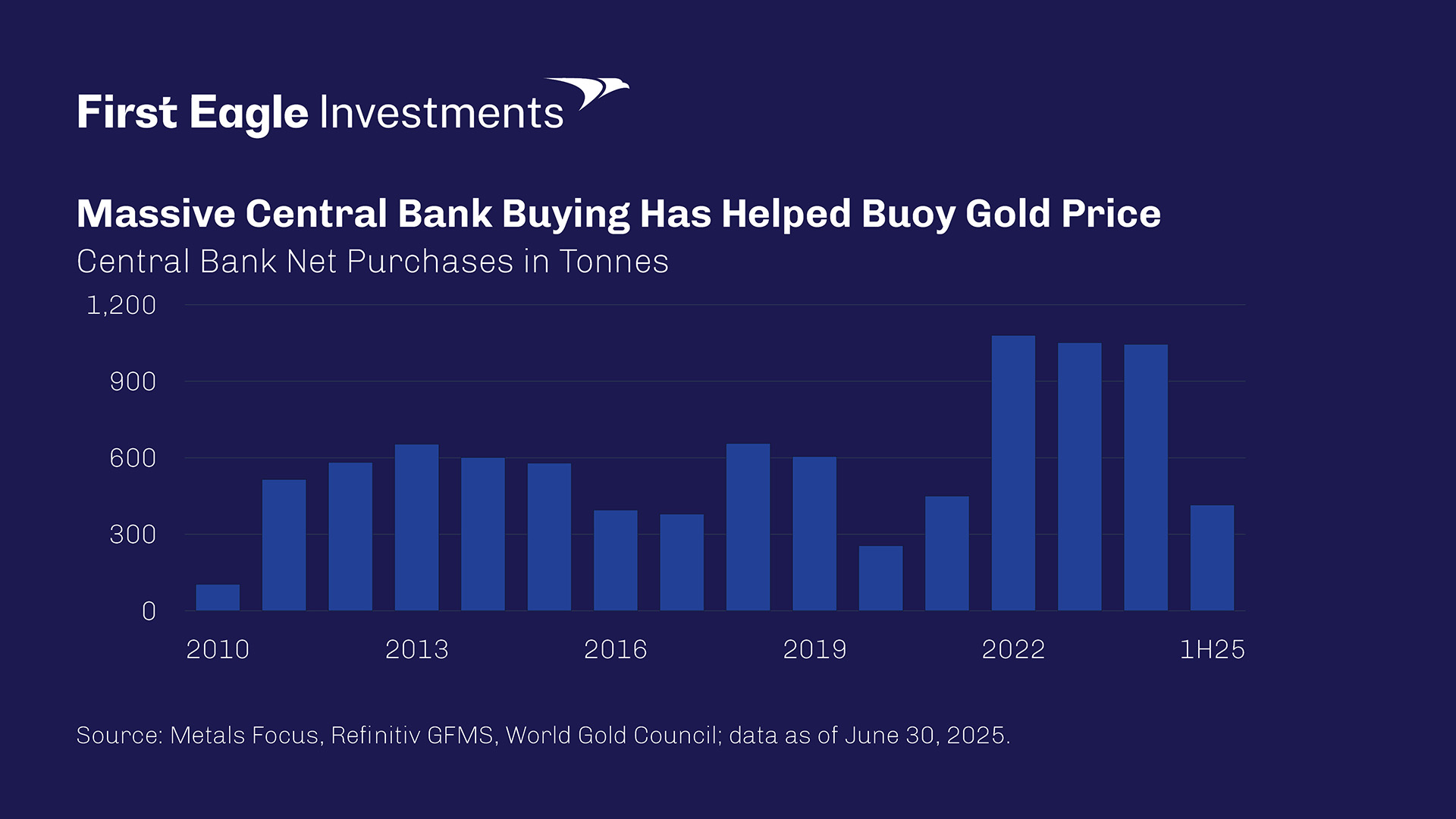
Global central banks, seeking to bolster their strategic gold reserves in response to heightened geopolitical risks and the specter of currency debasement, have been among the key sources of support for gold over the past few years. Annual net purchases of gold by central banks topped 1,000 tonnes in 2022–24 after averaging less than 500 tonnes annually between 2010 and 2021. Demand has remained firm in 2025 despite record prices, with authorities adding another 415 tonnes of gold in the first half of the year.2
A recent survey of central bankers suggested their appreciation of gold is likely to hold up, with 95% saying they expect central bank gold reserves to increase over the next 12 months and 76% believing that gold will represent greater share of total central bank reserves five years from now than it does today.3
More recently, financial buyers have also gotten into the game. Physically backed gold exchange-traded funds ETFs—which capture investment demand from both institutional and individual investors—have seen strong inflows in 2025 after four years of outflows. Year-to-date net demand stood at more than 470 tonnes through early September.4
Valuation Dispersion Favors Selectivity

Deputy Head of Global Value and Portfolio Manager
US equity markets have continued to climb off their April lows in the face of persistent headwinds, seemingly in anticipation of Federal Reserve rate cuts. Indeed, markets cheered the Fed’s 25 basis point reduction in its policy rate last week, and expectations of two additional cuts before year end may continue to provide support. In our view, however, the prospect of easier monetary policy alone isn’t a particularly compelling reason to invest in the continued success of what is a richly valued US stock market.
That said, we believe the current environment does present an interesting dynamic for bottom-up stock pickers. While the US equity market appears quite expensive relative to historical levels by any number of metrics, its extreme concentration—the 10 largest companies in the S&P 500 Index comprise about 40% of its total market cap and trade at price multiples even higher than the index’s median—suggests pockets of opportunity may be found in its less-stretched corners.1 Healthcare comes to mind as a sector in the US where we are seeing what we believe to be attractively valued opportunities.
We believe the current environment does present an interesting dynamic for bottom-up stock pickers.
Dispersion is even more evident on a global basis, as non-US markets generally appear quite a bit cheaper than US markets even after their strong year-to-date outperformance. This is true both on an absolute basis and relative to the long-term trend; international equities currently are trading a lot closer to their historical median than to the 90th percentile-plus levels seen in the US.2 With that backdrop, we are finding interesting bottom-up opportunities across a range of non-US markets and sectors, including certain Latin American and European consumer names, Japanese industrials and Southeast Asian holding companies.