BLOGThe Bird's Eye View
Timely Perspectives, Unconventional Thinking
We’re excited to share timely market insights, thoughtful perspectives and expert commentary as part of our commitment to providing modern investment solutions to modern challenges.
BLOGThe Bird's Eye View
Timely Perspectives, Unconventional Thinking
We’re excited to share timely market insights, thoughtful perspectives and expert commentary as part of our commitment to providing modern investment solutions to modern challenges.

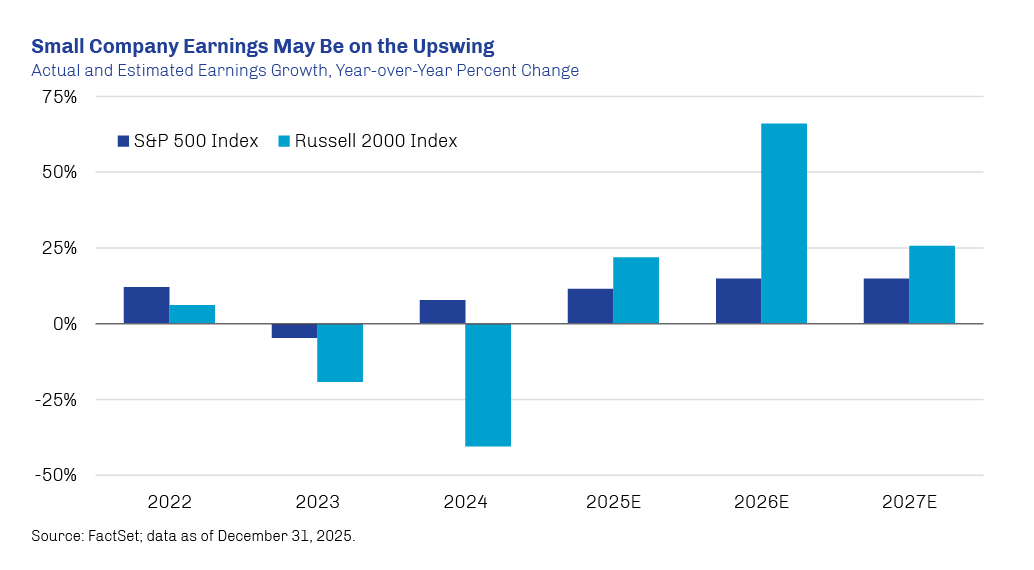
As fundamental investors, we view underappreciated earnings potential as a holy grail that historically has been rewarded in the marketplace. After three years of being overshadowed by companies in the S&P 500 Index, a resurgence in small cap earnings may at last be underway.1 As shown in the chart below, earnings for the Russell 2000 Index are forecast to outpace those of the S&P 500 Index for at least the next two years.
Multiple tailwinds could support this earnings growth for small caps, including:
Outsourced technology may enable small companies to scale their operations, improve efficiency and facilitate the conversion of some costs from fixed to variable, easing the need for working capital.
Artificial intelligence benefits small cap companies over a very long cycle. Suppliers to data center construction can expand their customer base without incremental spending on research and development, thus supporting margin expansion. Healthcare and consumer goods companies could see benefits through reduced spending on expenses and enhanced development of superior products with pricing power.
Prospectively lower interest rates could be especially beneficial to those many smaller companies with substantial levels of variable-rate debt.
A resurgent IPO market could benefit publicly traded small cap companies overall as private equity sponsors acknowledge meaningful hurdle rates in this higher rate environment and monetize their investments through public markets.
With the relative performance of small caps still near previous cyclical troughs—and respecting the tendency for mean reversion—eventual strong sustained earnings growth from small companies could drive meaningful returns going forward.2
Seeking Ballast as the Dark Clouds of Complacency Gather

Deputy Head of Global Value and Portfolio Manager
In an environment of pronounced macro, financial, geopolitical and structural concerns, risk perception in US markets remains low. Equity market valuation multiples are rich, high yield spreads are tight and implied volatility is low.1 We believe the biggest risk today is the lack of “margin of safety”2 as sovereign debt levels increase, geopolitical tensions rise and US economic growth becomes increasingly reliant upon technology capex, namely in artificial intelligence.
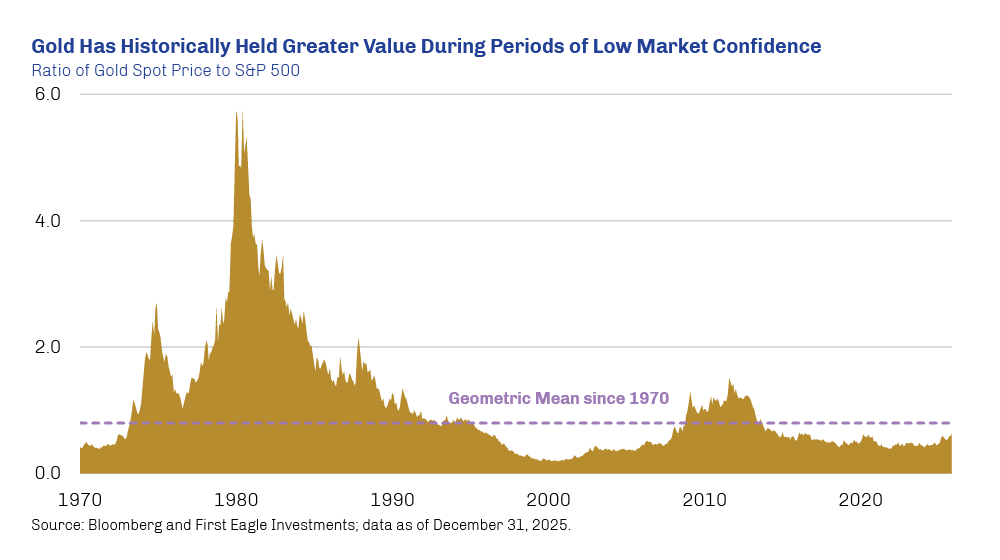
As the dark clouds of complacency accumulate, we seek ballast across assets that provide different layers of resilience. We continue to highly value the strategic hedge potential of gold given the fiscal and geopolitical dynamics currently in place. The monetary value of gold has been reasserting itself as the gold price has increased significantly over the past two years. We note that this rally has merely aligned gold with its 50-year geometric average relative to the stock of US public debt while bringing it closer to its geometric average versus the S&P 500 Index. Gold has historically been worth more than equities during periods of low confidence in markets, and it has been getting closer to its historical average relative to the S&P 500, as seen in the chart below.3
Gold, however, is not the only source of ballast. Nor is cash. In fact, one of our focuses in recent years has been on building resilience through businesses we believe offer ballast through their lower risk character. This is not achieved simply through higher allocations to traditionally defensive segments of the market like health care and consumer staples, though we do have meaningful exposure to these sectors. Rather, we evaluate stocks across industries from the bottom up in search of attributes we believe contribute to low correlations to the broader market, including strong balance sheets, high margins, diverse product lineups, long-lived assets and contractually obligated revenues.