BLOGThe Bird's Eye View
Timely Perspectives, Unconventional Thinking
We’re excited to share timely market insights, thoughtful perspectives and expert commentary as part of our commitment to providing modern investment solutions to modern challenges.
BLOGThe Bird's Eye View
Timely Perspectives, Unconventional Thinking
We’re excited to share timely market insights, thoughtful perspectives and expert commentary as part of our commitment to providing modern investment solutions to modern challenges.

Nonconforming mortgages are those that do not meet the underwriting standards of government-sponsored enterprises (GSEs) like Fannie Mae and Freddie Mac. While the size of the loan is the most common reason, there are a number of borrower-, property- and structure-specific factors that can push a mortgage into this bucket. Nonconforming loans are generally considered riskier for lenders and thus tend to carry higher interest rates than conforming loans.
Nonconforming mortgage originations (excluding jumbo loans) as a share of all mortgages has doubled over the past three years to reach levels not seen since the 2000s housing crash.1 To help deepen the pool of US consumers eligible for more economical conforming mortgages in the face of pent-up housing demand, the Federal Housing Finance Agency in April expanded underwriting standards for the GSEs to include their first new credit score models in decades: VantageScore 4.0 and FICO Score 10T.
Incorporating additional consumer data like rent-payment history, these models are expected to provide a more complete view of a borrower’s creditworthiness. The GSEs began accepting VantageScore 4.0 through a limited rollout to approved lenders in late April, and FICO Score 10T is expected to be implemented in the coming months. Classic Fair Issac Corporation (FICO) scores will continue to be accepted as the GSEs transition.2
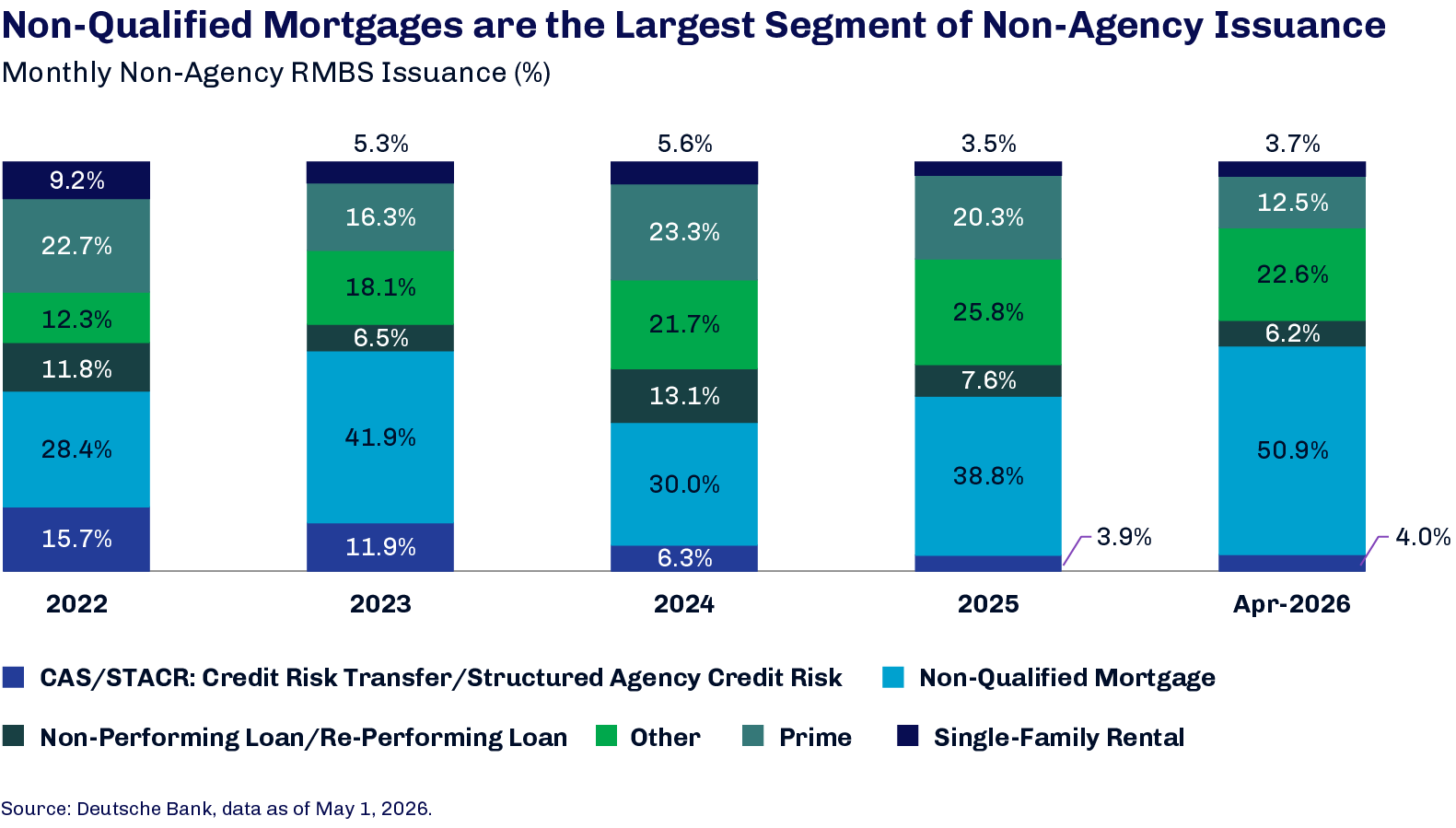
The share of alternative loans is a small portion of the overall market, but non-qualified mortgages—a cohort that includes a large portion of non-jumbo nonconforming mortgages—have historically been the largest segment of issuance within the non-agency residential mortgage-backed security space. Adoption of these new credit score systems appears to be happening faster than expected and may create refinancing incentives for borrowers, which we believe could weigh on conventional low FICO-specified asset pools. That said, the limited scope of the initial rollout may mitigate the near-term impact.3
Harvesting AI Productivity with Smart Farming

Portfolio Manager and Senior Research Analyst
While much of the excitement about artificial intelligence (AI) is focused on the promise of transformational productivity from the massive capital expenditures in data centers and infrastructure, we are already seeing what we believe to be practical and economically meaningful AI applications in sectors that are not traditionally associated with AI. One such example is “smart farming” where farmers use AI to help lower input costs, improve labor efficiency and make better decisions in the field.
In our view, one of the clearest examples is precision application. AI-enabled systems can now identify weeds in real time and apply herbicide only where it is needed, rather than spraying an entire field evenly. That helps reduce chemical use and lowers costs, while also supporting more sustainable farming practices. This can be a real economic benefit for an industry where input costs matter enormously.
Because labor is often difficult to find or expensive to retain, AI is also being used to address labor constraints. Farmers have narrow windows to plant, spray and harvest, and AI-powered equipment have autonomous or semi-autonomous capabilities to help farmers operate more efficiently and with greater consistency, especially during these critical periods. This is another example of AI creating potential value through better execution.
AI is becoming part of how farms are managed through connected platforms that can analyze machine data, field-level information and operating results to help farmers monitor performance and make better decisions across their operations. Over time, that data is also used to improve the tools, creating a feedback loop that makes the technology more useful.
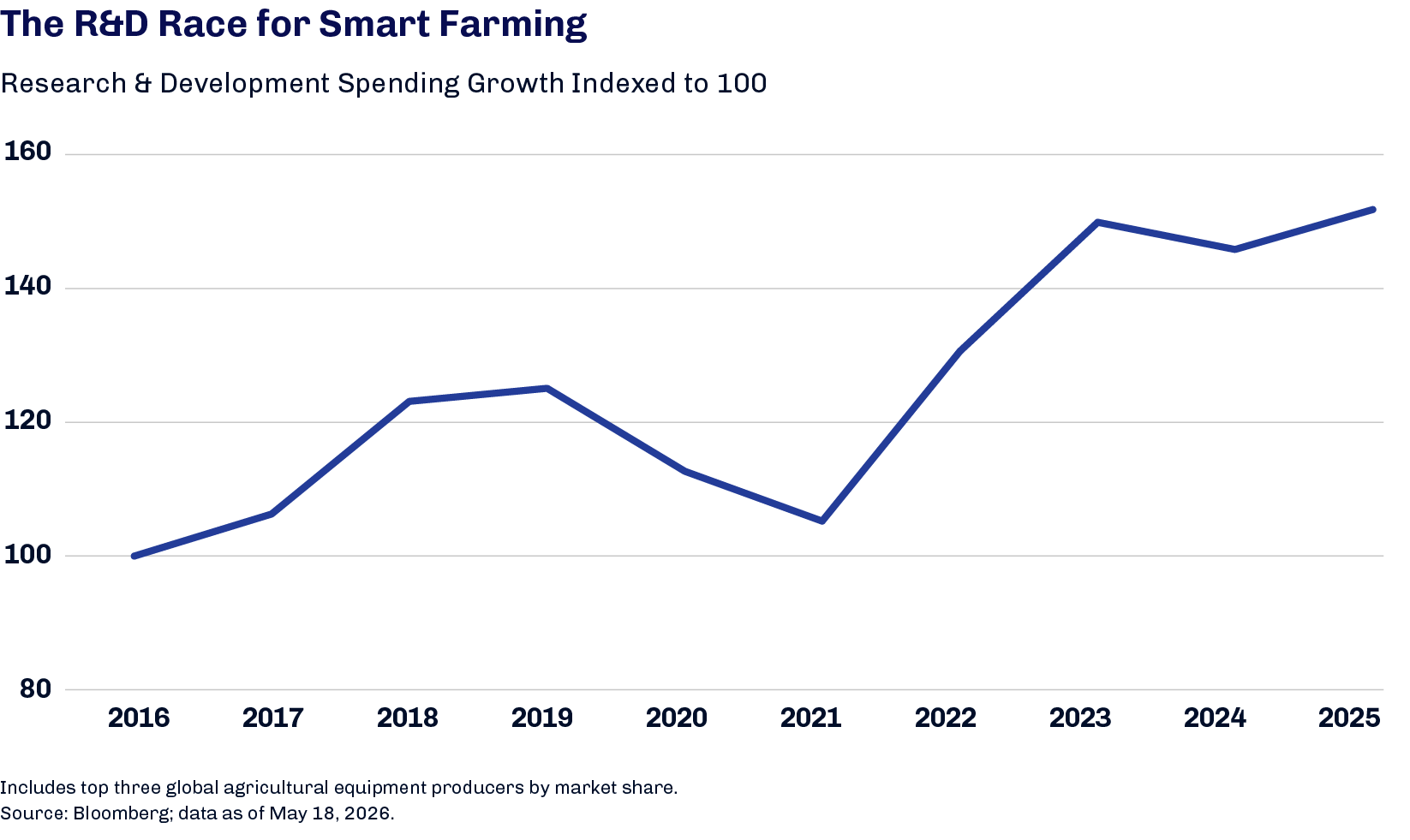
Autonomous equipment and digital farm management tools show how AI is already being embedded into the farm economy in a practical and economically valuable way. In our view, agricultural equipment is an indirect way to invest in real AI-driven productivity gains, while avoiding some of the valuation excesses that have come with more narrative-driven parts of the market in recent years. We are particularly drawn to resilient market leaders that are best positioned to adopt and integrate new technologies because they combine deep research and development (R&D) capabilities, strong customer relationships and a clear understanding of their end markets. As equipment becomes more connected, software-enabled and data-driven, service and maintenance can become more embedded in the customer relationship, potentially increasing switching costs and strengthening the stickiness of the installed base over time.